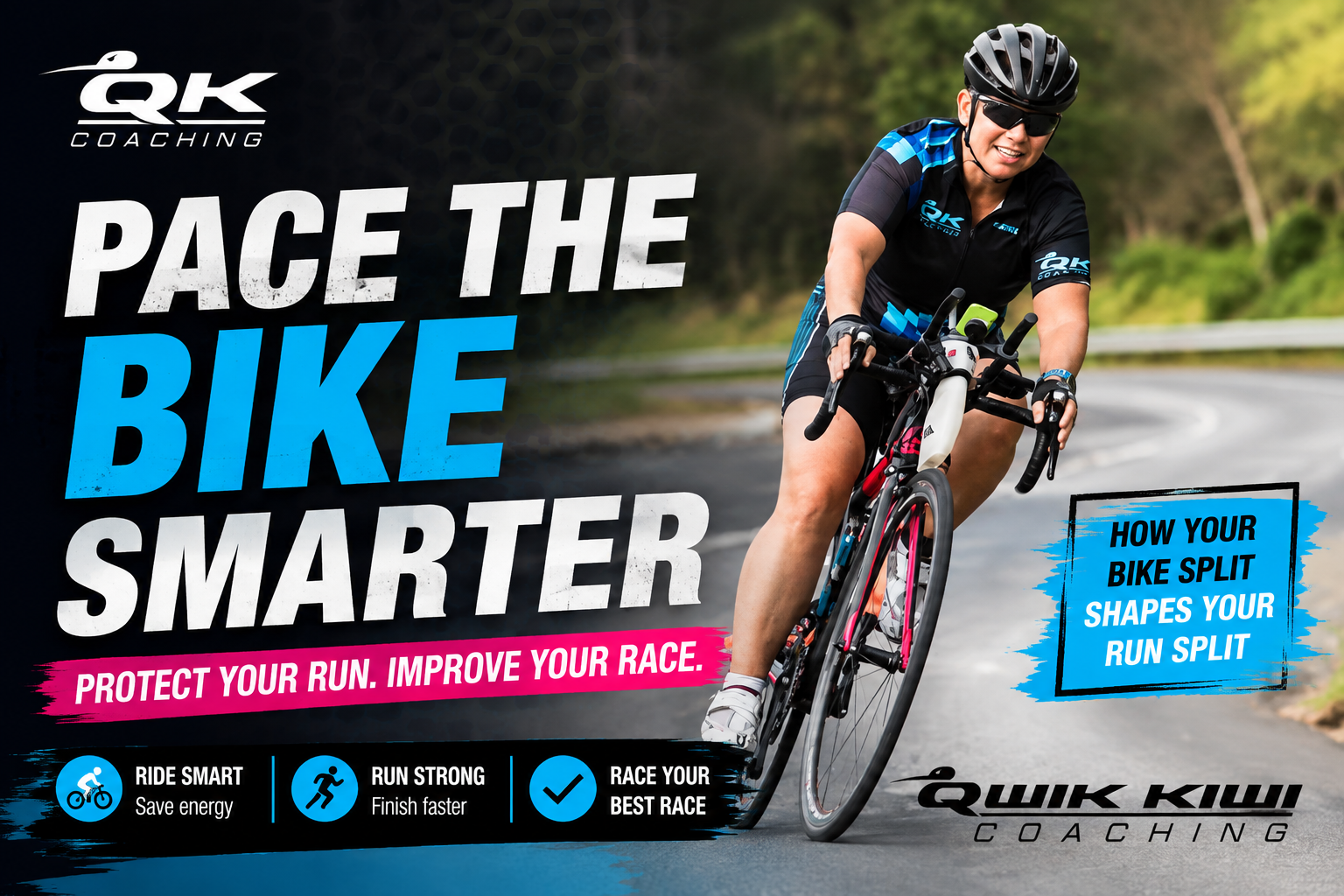
One of the easiest ways to ruin a good triathlon is to have a brilliant bike split.
That might sound strange.
Surely riding faster is a good thing?
Not necessarily.
Triathlon isn’t a cycling time trial followed by a run. The bike leg needs to be paced in a way that allows you to ride strongly and still run well afterwards.
Go too hard on the bike and you might gain a few minutes.
But you could lose far more than that on the run.
Your Triathlon Run Starts on the Bike
When most triathletes think about improving their run split, they immediately think about running training.
More kilometres.
More intervals.
More brick sessions.
All of those can help, but your run performance is also heavily influenced by what happens before you reach T2.
If you ride beyond what your fitness can sustainably support, you begin the run carrying unnecessary fatigue.
Your legs are tired.
Your energy reserves are depleted.
Your fuelling may have suffered.
And instead of settling into your planned running pace, you’re immediately trying to manage the consequences of an overly aggressive bike leg.
That’s why I often remind athletes that their triathlon run starts long before they put their running shoes on.
The Danger of Feeling Good
The early stages of the bike can be deceptive.
You’ve completed the swim, you’re excited to be on the bike, and your legs often feel fantastic.
Other competitors are passing you.
You see someone up the road you’d like to catch.
Your speed looks good.
So you push a little harder.
Then a little harder again.
The problem is that you don’t immediately feel the cost of those decisions.
The bill arrives later.
And usually, it arrives during the run.
Don’t Race Someone Else’s Bike Leg
One of the quickest ways to abandon sensible pacing is to start racing the athletes around you.
Someone passes.
You respond.
Another athlete appears ahead.
You chase them.
A group pulls away.
You increase your effort to stay close.
Before long, your carefully planned bike strategy has disappeared.
Remember that you know almost nothing about the athlete beside you.
They may be a much stronger cyclist.
They may be a poor runner.
They may be making a terrible pacing decision themselves.
Their race has nothing to do with yours.
Ride your own bike leg.
Smooth Power Is Fast Power
Good bike pacing isn’t just about average power, heart rate, or perceived effort.
It’s also about how you produce that effort.
Repeated surges can be costly.
Attacking every hill, accelerating hard out of corners, or constantly changing intensity can create far more fatigue than riding at a controlled and relatively steady effort.
That doesn’t mean maintaining exactly the same power every second.
Terrain, wind, corners, and race conditions naturally change your effort.
But the overall goal should be smooth, controlled riding rather than constantly burning matches.
Save those matches.
You’ll want them later.
Be Especially Careful on the Hills
Hills are one of the easiest places to overdo your bike effort.
Your speed drops and your natural reaction is to push harder.
That’s fine—to a point.
But attacking every climb can quickly turn a well-paced bike leg into a series of hard intervals.
Let the speed fall when necessary.
Use your gears.
Keep your effort under control.
A few extra seconds climbing a hill conservatively can be insignificant compared with the minutes you might lose walking later in the run.
Your Bike Split Doesn’t Exist in Isolation
It’s easy to become obsessed with individual splits.
What was my swim time?
What was my average speed?
What was my bike split?
What was my run pace?
Those numbers are useful, but the only time that ultimately determines your result is the one on the finish-line clock.
Imagine Athlete A rides five minutes faster than Athlete B but then runs 15 minutes slower because they overcooked the bike.
Who had the better bike strategy?
Athlete B.
The goal isn’t to produce your fastest possible bike split.
The goal is to produce the bike split that contributes to your fastest possible triathlon.
Practise Your Bike Pacing in Training
Race day shouldn’t be the first time you discover what sustainable bike intensity feels like.
Use your longer rides and race-specific sessions to practise.
Learn how your target effort feels when you’re fresh.
Learn how it feels after an hour or two.
Then use brick sessions to discover what happens when you run afterwards.
If you consistently finish the bike strongly but can’t settle into your planned run intensity, that’s valuable information.
Your bike pacing may need adjusting.
Training isn’t just about building fitness.
It’s also about learning how to use that fitness.
Fuelling and Pacing Work Together
Bike pacing also affects your ability to fuel.
The harder you ride, the more difficult it can become to comfortably consume and process the nutrition you’ll need later in the race.
That creates a double problem.
You’re using energy faster while potentially making it harder to replace that energy.
A controlled bike leg gives you a much better opportunity to stay on top of your fuelling and hydration strategy.
That becomes increasingly important as race distance increases.
Your bike leg isn’t just about getting from T1 to T2 quickly.
It’s also your biggest opportunity to prepare your body for the run ahead.
How Should the Bike Finish?
Ideally, you should reach the end of the bike feeling like you’ve raced—but not like you’ve emptied the tank.
You shouldn’t be desperate to get off the bike because your legs are destroyed.
You should be thinking:
I’m ready to run.
That doesn’t mean the bike should feel easy.
You’re racing.
But there should be enough control that when you reach T2, you’ve still got another gear available.
That’s the difference between riding a fast bike split and executing a great triathlon.
Final Thoughts
It’s tempting to judge your bike leg by average speed, power, or how many people you passed.
But there’s a much better test.
How well did you run afterwards?
A well-paced bike leg sets up the run.
A poorly paced bike leg sabotages it.
Ride smoothly.
Control the early enthusiasm.
Don’t chase other athletes.
Keep your effort sensible on the climbs.
Stay on top of your fuelling.
And remember that your race doesn’t finish at T2.
Sometimes the smartest way to achieve a faster triathlon isn’t to ride harder.
It’s to ride smarter.
Want to Nail the Pacing for Your Next Triathlon?
If you’re unsure how hard you should be riding, struggling to run well off the bike, or simply want a training programme built around your ability and race goals, let’s have a chat.
Book a free, no-obligation 40-minute coaching call and we can look at your current training, your upcoming event, and where you could make the biggest improvements.
Sometimes a smarter bike leg is all it takes to unlock the run you already have.