Are you putting plenty of effort into your training but not getting the improvements you expect? The missing ingredient might not be another workout. It could be what you’re doing after training.
You don’t actually get fitter while you’re training.
Training gives your body the reason to get fitter, but it’s what happens afterwards that determines how well you adapt.
That means you could be completing every interval session, hitting your target training zones and accumulating plenty of kilometres, yet still be leaving a significant amount of potential improvement on the table if you’re neglecting your recovery.
As endurance athletes, we spend an enormous amount of time thinking about training. We analyse our pace, power, heart rate, duration, intensity and weekly training volume.
But how much attention do we give to what happens when the workout finishes?
That’s why I’ve developed a simple framework I call the ABCDS of Recovery.
It focuses on five fundamental recovery habits that every runner, cyclist, swimmer and triathlete should consider.
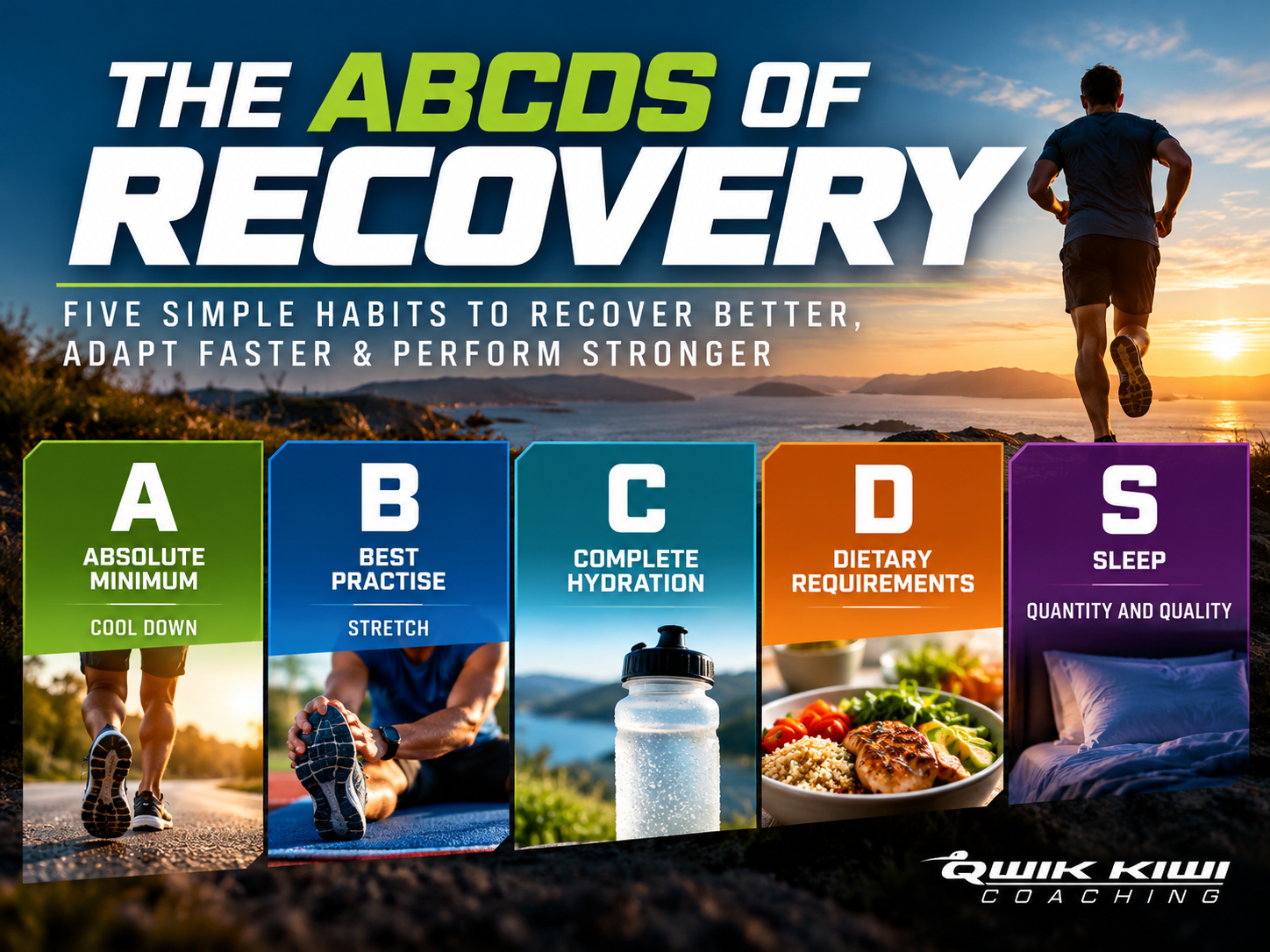
- A – Absolute Minimum: At least 10 minutes cooling down at Level II or below.
- B – Best Practise: Aim for at least 10 minutes of stretching.
- C – Complete Hydration: Replace the fluid you’ve lost during training.
- D – Dietary Requirements: Provide your body with the energy and nutrients needed to replenish, repair and adapt.
- S – Sleep: Prioritise both the quantity and quality of your sleep.
None of these habits is particularly complicated.
That’s exactly the point.
Before spending money on recovery gadgets, compression equipment, supplements or the latest recovery technique, I want athletes to establish the fundamentals.
Because the goal isn’t simply to recover for the sake of recovering.
It’s to recover better, adapt faster and perform stronger.
Why Recovery Is Just as Important as Training
Training is essentially a controlled stress that we apply to the body.
Think about what happens when you complete a demanding interval session.
When you finish, you’re not suddenly fitter than you were when you started.
In the short term, you’re actually more fatigued.
You’ve used energy, placed stress on your muscles and cardiovascular system, potentially depleted a significant amount of your glycogen stores, and lost fluid through sweating.
That isn’t necessarily a bad thing.
It’s exactly what we’re trying to achieve when we train.
We’re providing the body with a stimulus that encourages it to improve.
But the stimulus alone isn’t enough.
We also need to provide the body with the opportunity and resources to recover.
During that recovery process, the body repairs, replenishes and adapts so it’s better prepared to handle similar demands in the future.
The process can be summarised as:
Training Stimulus → Recovery → Adaptation → Improved Performance
When recovery is repeatedly compromised, we risk compromising the adaptations we’re working so hard to achieve.
We may also arrive at our next important training session carrying unnecessary fatigue, making it more difficult to achieve the intended quality.
Recovery doesn’t mean sitting on the couch doing nothing until you feel fantastic again.
It’s about finding the appropriate balance between training stress and the resources needed to respond to that stress.
That’s why I consider recovery part of training rather than something separate from it.
And the first part of my ABCDS framework begins before the workout has even finished.
A – Absolute Minimum: At Least 10 Minutes Cooling Down
My recommendation is to finish every training session with an absolute minimum of 10 minutes cooling down at Level II or below.
The words or below are important.
Your cool-down isn’t another opportunity to squeeze additional intensity into the workout.
We’re trying to bring the body down gradually from whatever we’ve just asked it to do.
After some sessions, Level II may be perfectly appropriate.
After particularly demanding intervals, you might want to drop right down into Level I.
What Does a Cool-Down Look Like?
The activity will depend on your sport.
Running: Finish with at least 10 minutes of very easy jogging.
Cycling: Continue pedalling gently at Level I or Level II, progressively reducing the intensity.
Swimming: Complete at least 10 minutes of relaxed, controlled swimming.
The intention is to transition gradually from training into recovery.
A cool-down also provides additional low-intensity aerobic activity, although its immediate purpose is not to create another significant training stimulus.
Plan Your Cool-Down Into the Session
One mistake I regularly see is athletes completing their final hard interval and stopping immediately because they’ve run out of time.
If you’ve got an hour available to train, the cool-down needs to be included within that hour.
Don’t plan 60 minutes of hard work and then discover there’s no time to cool down.
The cool-down is part of the workout.
It’s also worth remembering that while a gradual cool-down can help you transition out of exercise, the evidence that it directly accelerates long-term recovery or prevents muscle soreness is limited. I recommend it as a consistent part of a well-structured training session, rather than as a guaranteed way to eliminate fatigue.
Coach Ray’s takeaway: Whatever else you do for recovery, start by allowing at least 10 minutes to cool down at Level II or below.
B – Best Practise: At Least 10 Minutes Stretching
Once you’ve completed your cool-down, my next recommendation is to spend at least 10 minutes stretching.
The cool-down and stretching fit together nicely.
You’ve finished the main training session, your muscles are still warm, and it’s a convenient opportunity to work on maintaining or improving your flexibility.
This doesn’t need to become another workout.
We’re not trying to turn ourselves into gymnasts.
And we’re certainly not trying to force ourselves into uncomfortable positions.
Keep the stretching controlled and comfortable, focusing primarily on the muscles you’ve been using.
For runners, that might include the calves, quadriceps, hamstrings and hip flexors.
Cyclists may want to focus on the quadriceps, hip flexors, glutes and calves.
Swimmers may give additional attention to the shoulders, chest and upper back.
The exact routine should reflect your individual mobility needs and the training you’ve completed.
Consistency Matters More Than Occasional Marathon Stretching Sessions
I’d much rather see an athlete complete 10 minutes of stretching consistently than ignore stretching for six days and then attempt an hour-long session because everything feels tight.
There’s also a behavioural component.
If you finish training and tell yourself, “I’ll stretch later,” there’s a good chance later never happens.
You need to shower.
You need to eat.
The kids need something.
The phone rings.
Work gets in the way.
So attach stretching to the end of your workout.
Finish the main session, complete your cool-down, then stretch.
That becomes your normal routine.
Stretching can help improve and maintain range of motion, but it’s important to distinguish that benefit from recovery claims. Post-exercise stretching hasn’t consistently been shown to substantially reduce delayed-onset muscle soreness or speed physiological recovery.
My 10-minute recommendation is therefore a practical flexibility and consistency habit, not a scientifically established minimum for faster recovery.
What If You Can’t Stretch Immediately After Training?
This was an excellent question raised during our group coaching call.
One athlete explained that after our early-morning Velocity indoor cycling sessions, he often needs to get straight into his working day.
Is there still value in stretching later?
Absolutely. The opportunity hasn’t disappeared.
While stretching immediately after training is convenient because your muscles are already warm, stretching later in the day can still be worthwhile.
One practical option I mentioned was using part of your shower time for gentle stretching.
The warm water can make the muscles feel comfortable while you stretch.
However, be particularly careful with balance.
Trying to stand on one leg to stretch your quadriceps on a slippery shower floor is a recipe for disaster!
Use secure support, avoid unstable positions, and don’t attempt movements that increase your risk of slipping.
You can also incorporate brief mobility breaks into your working day.
A short walk away from your desk, a gentle standing stretch or a few controlled mobility exercises are all opportunities to move.
If you’re stretching when your muscles have cooled down, start with some easy movement rather than immediately forcing a deep stretch.
Coach Ray’s takeaway: Aim for 10 minutes of comfortable stretching after training. If your schedule doesn’t allow it immediately, find another opportunity later in the day.
C – Complete Hydration: Replace What You’ve Lost
The most important word here is complete.
There’s a difference between having a drink after training and actually completing your rehydration.
During exercise, we lose fluid, predominantly through sweating.
But how much we lose varies enormously.
Compare an easy 30-minute run on a cold winter morning with a demanding two-hour cycling session in hot, humid conditions.
Your hydration requirements aren’t going to be the same.
Several factors influence fluid losses:
- Session duration and intensity.
- Temperature and humidity.
- Your individual sweat rate.
- Clothing and equipment.
- How much fluid you’ve consumed during exercise.
Some athletes sweat significantly more than others.
Consequently, there isn’t one universal fluid replacement strategy that works equally well for everybody.
Water or Electrolytes: Which Is Better?
This question generated plenty of discussion during our coaching call.
One athlete wanted to know whether electrolyte drinks were better than water for maintaining hydration.
My personal approach is straightforward.
For short, steady-state or technique-focused sessions lasting less than an hour, I generally use water when cycling.
For short runs, I may not carry anything, depending on the conditions.
When sessions become longer or involve demanding intervals, I typically choose an electrolyte-containing drink.
That’s my practical approach, rather than a strict physiological rule that everybody must follow.
Water can be perfectly adequate for many shorter sessions, while drinks containing sodium become more useful when sweat losses are substantial.
The key is to match your hydration strategy to your needs.
What About Electrolytes During Longer Sessions?
Sweat contains water and electrolytes, particularly sodium.
Sodium plays important roles in fluid balance and normal nerve and muscle function.
During prolonged exercise, particularly in hot conditions or for athletes with high sweat losses, replacing some of that sodium can be useful.
I generally use electrolyte drinks during longer rides and higher-intensity training.
If there’s some left in my bottle when I finish, I’ll often finish it afterwards before continuing with water or another beverage.
However, electrolyte needs are individual, and excessive sodium or fluid consumption isn’t beneficial.
It’s also important not to assume that drinking more is always better. Overdrinking can lead to exercise-associated hyponatraemia, a potentially serious reduction in blood sodium concentration.
A sensible approach considers thirst, expected sweat losses, conditions and the duration of exercise.
How Can You Tell Whether You’re Rehydrating?
One simple everyday indicator is urine colour.
Generally, pale yellow urine is reassuring, while persistently dark, concentrated urine may indicate that you need more fluid.
However, urine colour isn’t a perfect measurement. Foods, supplements and medications can influence it.
For athletes wanting a more individualised approach, weighing yourself before and after selected training sessions can help estimate sweat losses, provided you also account for drinks consumed and any urine passed.
You don’t necessarily need to replace every millilitre immediately.
The aim is to restore normal hydration appropriately over the recovery period.
Hydration and Muscle Cramping
Another interesting discussion involved athletes who experience muscle cramps during longer cycling events.
Electrolytes are often the first thing athletes think about when cramping occurs.
But cramping is more complicated than simply losing salt.
Exercise-associated muscle cramps can involve several factors, including neuromuscular fatigue, exercise intensity, conditioning and individual susceptibility.
One athlete explained that he still experiences cramping despite consistently using electrolyte drinks.
That’s an important reminder.
Electrolytes are only one part of the cramping picture, not the whole picture.
If cramping repeatedly affects your performance, look beyond your drinks to factors such as pacing, training preparation and the specific demands of your event.
Athletes who have experienced collapse during or after events should seek individual medical assessment rather than assuming dehydration or sodium loss was necessarily the cause.
Coach Ray’s takeaway: Don’t simply have a drink when you finish. Develop a hydration strategy that reflects your training demands and individual fluid losses.
D – Dietary Requirements: Refuel, Replenish and Repair
D stands for Dietary Requirements.
And I do specifically mean Dietary Requirements, because nutrition doesn’t start with D!
Training creates nutritional demands that we need to meet if we want to support recovery and adaptation.
Two particularly important components are carbohydrate and protein.
Carbohydrate: Replenishing Your Energy Stores
During endurance training, particularly longer or harder sessions, we use carbohydrate stored in our muscles and liver as glycogen.
Part of recovery involves replenishing those stores.
How urgently you need to do that depends on what you’ve just completed and what you’ve got coming up next.
For example, if you finish a demanding session and have another important workout later that day or first thing the following morning, carbohydrate replenishment becomes more time-sensitive.
If tomorrow is a rest day, you may have considerably more flexibility.
This is why recovery fuelling should be considered within the context of your overall training programme.
Protein: Supporting Repair and Adaptation
Protein provides the amino acids required for muscle repair and adaptation.
Including appropriate protein throughout the day helps support the body’s response to training.
But I don’t want athletes reducing recovery nutrition to:
“I need a protein shake after training.”
Protein matters, but it’s only one component of the bigger picture.
We also need sufficient carbohydrate, overall energy and a varied intake of foods providing essential vitamins and minerals.
Your Dietary Requirements Depend on Your Training
A 30-minute recovery ride doesn’t create the same nutritional demands as a three-hour endurance session.
Your requirements will also depend on your body size, overall training volume, goals and the time available before your next session.
The questions I want athletes asking are:
- Am I consuming enough total energy to support my training?
- Am I getting sufficient carbohydrate for the work I’m doing?
- Am I consuming enough protein to support repair and adaptation?
- Am I eating a good variety of foods?
- Have I considered the demands of my next training session?
Should You Train Fasted?
Another question during the coaching call concerned early-morning training.
If you’re starting a session at 5:45 a.m., should you eat beforehand?
My preference is to avoid deliberately starting demanding sessions fasted.
In practice, I don’t always manage that myself.
Sometimes the gap between waking up and needing to be on the indoor trainer is very short.
When I do eat beforehand, it might be something simple such as an apple or a piece of toast with honey.
The important thing is choosing something you tolerate well and that suits the session.
For longer or higher-intensity training, having carbohydrate available before and during exercise can help support training quality.
A short, easy session may require a different approach.
Fasted training isn’t automatically harmful, but neither is it necessary for improving endurance performance. Its usefulness depends on the athlete, the session and the wider training programme.
Coach Ray’s takeaway: Your dietary requirements should reflect the training you’ve completed and the demands of what comes next. Don’t focus on one nutrient while neglecting the bigger picture.
S – Sleep: Quantity AND Quality
If you asked me to rank the ABCDS in order of importance, sleep would be at the top of my list.
That was exactly the question one athlete asked during our coaching call.
My response was that sleep is the most important element of the framework, while the other four habits help support the overall recovery process.
We can buy massage guns, compression equipment and all sorts of technology designed to measure recovery.
But none of those things replaces consistently getting adequate, good-quality sleep.
Sleep provides an extended opportunity for physical and mental recovery.
And there are two important components.
Sleep Quantity: Are You Getting Enough?
Most adults are generally advised to aim for approximately seven to nine hours of sleep per night, although individual requirements vary.
Athletes with substantial training loads may benefit from additional sleep opportunities.
If you’re repeatedly cutting sleep short, you’re reducing the time available for important recovery processes.
However, simply spending eight hours in bed doesn’t automatically mean you’re getting eight hours of good sleep.
That’s where quality comes in.
Sleep Quality: Are You Sleeping Well?
Consider the following questions.
Are you falling asleep relatively easily?
Are you waking repeatedly during the night?
Do you wake feeling reasonably refreshed?
Are you maintaining reasonably consistent sleeping and waking times?
These can help identify whether your sleep habits need attention.
Simple Ways to Improve Your Sleep
You don’t necessarily need an elaborate bedtime routine.
Start by looking at some straightforward habits.
Maintain consistency. Try to keep your sleeping and waking times reasonably regular.
Consider your caffeine intake. Caffeine consumed later in the day may interfere with your ability to fall asleep.
Look at your sleep environment. A quiet, dark and comfortably cool bedroom can help.
Reduce unnecessary stimulation before bed. Consider whether late-night screen use or other activities are making it harder to wind down.
Be mindful of alcohol. Alcohol may make you feel sleepy initially but can interfere with sleep quality.
Make Sleep Improvements Realistic
Most of us aren’t professional athletes whose entire day revolves around training and recovery.
We’ve got jobs, families, children and other commitments.
Life happens.
So telling every athlete to sleep another two hours every night isn’t particularly helpful.
Instead, ask yourself:
What could I realistically improve?
Perhaps you could go to bed 30 minutes earlier.
Maybe you could reduce your caffeine intake later in the day.
Perhaps you could put your phone down earlier in the evening.
Small, consistent improvements can make a meaningful difference.
And remember:
Sleep isn’t time that gets in the way of training. Sleep supports your ability to train.
How Do the ABCDS Work Together?
Although I place sleep at the top of my recovery priorities, I don’t consider the other four habits unimportant.
They all contribute to the broader recovery process.
The cool-down provides a gradual transition out of training.
Stretching provides an opportunity to maintain and develop flexibility.
Hydration restores the fluids and, where necessary, electrolytes lost during exercise.
Dietary requirements ensure your body has the energy and nutrients it needs to replenish and adapt.
And sleep provides an essential opportunity for physical and mental recovery.
These habits don’t all have equally strong evidence for directly accelerating recovery. Sleep, adequate nutrition and hydration are particularly important physiological foundations, while cool-downs and stretching also serve useful practical and mobility-related purposes.
The value of ABCDS is that it gives athletes a simple framework for remembering the things they can control.
Put the ABCDS Into Practice After Your Next Workout
The biggest challenge isn’t necessarily understanding that recovery is important.
It’s consistently doing something about it.
You might already be doing four of the ABCDS particularly well, but there’s one you routinely neglect.
Perhaps you always cool down, stretch, refuel and hydrate, but consistently cut your sleep short.
Or maybe you sleep well and eat appropriately but frequently finish hard sessions without a cool-down.
Whatever your situation, start by identifying the weakest part of your current routine.
You don’t need to completely overhaul everything tomorrow.
Pick one habit. Build consistency. Then work on the next.
Here’s the checklist I want you remembering.
| Letter | Recovery habit | What to do |
|---|---|---|
| A | Absolute Minimum | Cool down for at least 10 minutes at Level II or below |
| B | Best Practise | Aim for at least 10 minutes of comfortable stretching |
| C | Complete Hydration | Replace fluid losses appropriately |
| D | Dietary Requirements | Refuel, replenish and support repair |
| S | Sleep | Prioritise quantity and quality |
The next time you finish a training session, ask yourself one simple question:
Have I done my ABCDS?
Frequently Asked Questions About Recovery
How long should I cool down after exercise?
My recommendation is at least 10 minutes at Level II or below. The appropriate duration and intensity can vary depending on the workout, but I encourage athletes to include a gradual cool-down in their session planning.
Is stretching immediately after training better than stretching later?
Stretching after training is convenient because your muscles are already warm. However, stretching later can still improve or maintain flexibility. If you’re stretching when cold, begin with gentle movement first.
Do I need electrolytes after every workout?
Not necessarily. Water is often sufficient for shorter, lower-intensity sessions. Electrolytes, particularly sodium, may become more useful when exercise is prolonged or sweat losses are substantial.
Does drinking electrolytes prevent muscle cramps?
Not reliably. Muscle cramps have multiple possible contributing factors, including neuromuscular fatigue and exercise demands. Electrolyte replacement can be appropriate for sweat losses but isn’t a guaranteed prevention strategy.
What should I eat after endurance training?
Your needs depend on the session and your next planned workout. Carbohydrate helps replenish glycogen, while protein supports repair and adaptation. Adequate overall energy intake is also essential.
How much sleep should endurance athletes get?
Most adults should aim for approximately seven to nine hours per night, with individual needs varying. Athletes should pay attention to both the amount of sleep they get and how well they’re sleeping.
Which recovery habit is most important?
Of the five habits in my ABCDS framework, I place sleep at the top of the list. However, adequate fuelling and hydration are also fundamental, and the best approach is to develop a consistent overall recovery routine.
Final Thoughts: Recovery Is Part of Training
We don’t train simply to accumulate kilometres, hours, sessions or Training Stress Score.
We train because we want our bodies to adapt.
Training provides the stimulus.
Recovery supports the adaptation.
And that adaptation is what ultimately leads to improved performance.
You don’t necessarily need an expensive recovery device or a complicated protocol to improve your recovery habits.
Start by getting the fundamentals right.
Remember the ABCDS.
A – Absolute Minimum. B – Best Practise. C – Complete Hydration. D – Dietary Requirements. S – Sleep.
And above all, make them part of your normal training routine.
Recover Better. Adapt Faster. Perform Stronger.
Want Help Getting More From Your Training?
Are you consistently putting in the training but unsure whether you’re balancing your workouts, recovery and fuelling effectively?
At Qwik Kiwi Coaching, I help endurance athletes develop structured training programmes that consider not only the work they need to complete, but also how that work fits into their overall preparation, recovery and performance goals.
Whether you’re training for a 5 km, half marathon, marathon, triathlon or cycling event, we can look at how your training and recovery work together.
Book a free 40-minute coaching consultation with Coach Ray and let’s discuss how to make your training more effective.
Coach Ray Boardman
Director & Head Coach – Qwik Kiwi Coaching
www.CoachRay.nz
Train Smarter. Recover Better. Perform Stronger.
WordPress SEO details
These are ready to use with Rank Math and WordPress.
| Field | Recommendation |
|---|---|
| SEO title | The ABCDS of Recovery: 5 Habits for Endurance Athletes |
| URL slug | abcds-of-recovery |
| Focus keyword | endurance training recovery |
| Secondary keywords | recovery after exercise, athlete recovery tips, post-workout recovery, recovery for runners, cycling recovery, sleep and athletic recovery |
| Category | Training Tips / Recovery |
| Suggested excerpt | Discover Coach Ray’s ABCDS of Recovery: five practical habits covering cool-downs, stretching, hydration, dietary requirements and sleep to help endurance athletes recover better, adapt faster and perform stronger. |
Meta description:
Learn the ABCDS of Recovery: five simple habits to improve recovery, support training adaptation and help runners, cyclists and triathletes perform better.
WordPress tags — copy and paste:
endurance recovery, training recovery, post-workout recovery, cool-down, stretching, hydration, electrolytes, recovery nutrition, sleep for athletes, endurance training, cycling recovery, running recovery
Copy tags
Suggested featured image
I’d use the ABCDS graphic from your coaching presentation, adapted to your usual 1200 × 900 px CoachRay.nz featured image format. Retain the five-letter framework and one original Qwik Kiwi Coaching logo, with the title prominently displayed.
Featured image alt text: The ABCDS of Recovery framework by Coach Ray, showing cool-down, stretching, hydration, dietary requirements and sleep for endurance athletes.
Image title: The ABCDS of Recovery – Qwik Kiwi Coaching
Caption: Five simple recovery habits to help endurance athletes recover better, adapt faster and perform stronger.
Image description: Coach Ray’s ABCDS of Recovery framework introduces five important recovery habits for runners, cyclists, swimmers and triathletes: Absolute Minimum cool-down, Best Practise stretching, Complete Hydration, Dietary Requirements and Sleep.
One editorial point: I’ve preserved your recommendations for 10-minute cool-downs and stretching while distinguishing your coaching philosophy from claims that these specific durations are scientifically proven to accelerate recovery. I’ve also treated the athletes’ questions about electrolytes, collapse and cramping carefully, because those situations can have several underlying causes.
The article is based on your full coaching call, including the athlete Q&A, rather than only the original presentation script.