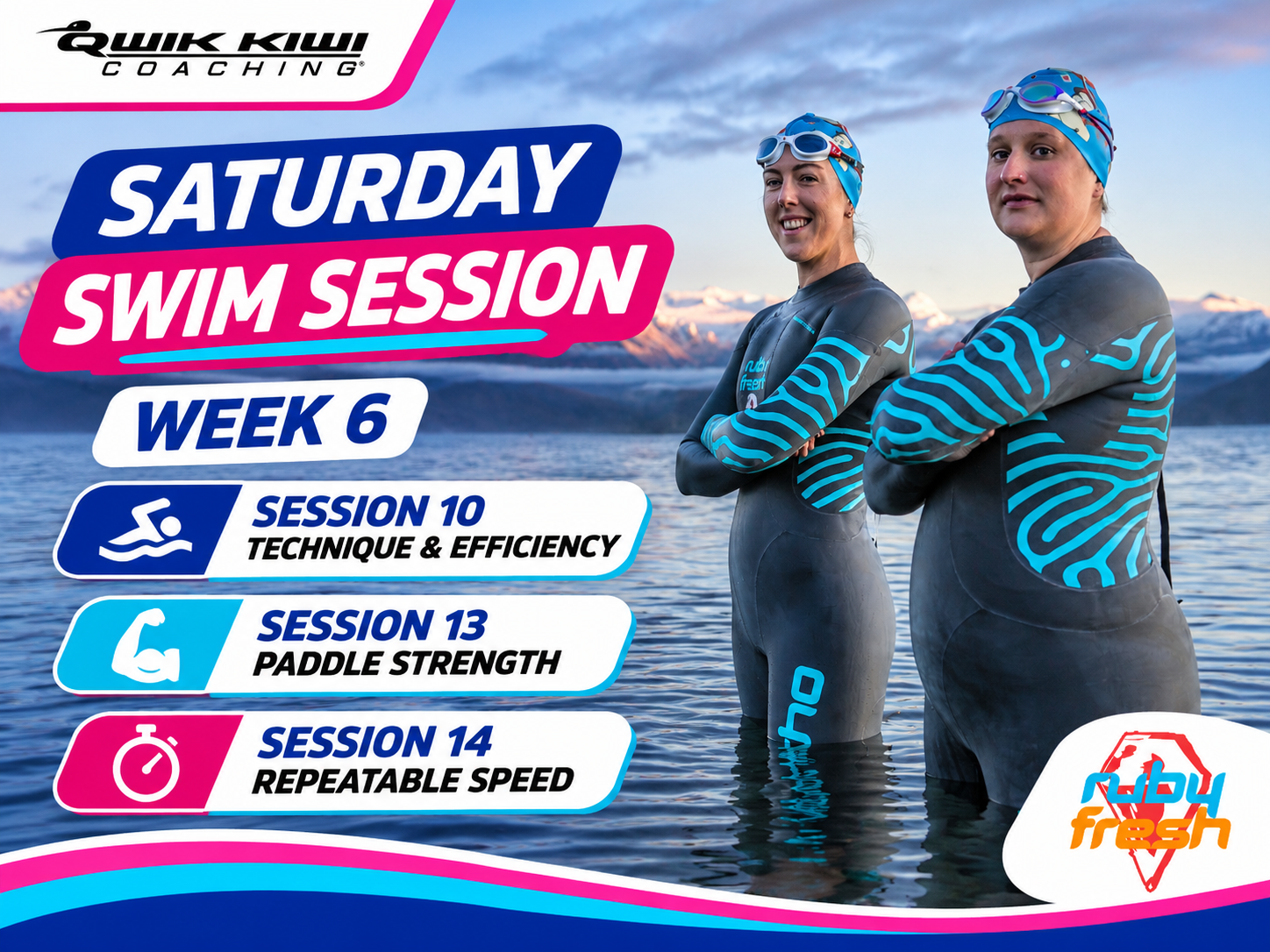
Week 6 | Qwik Kiwi Performance Swim Sessions 10, 13 & 14 | 8,000m Total
Swimming faster isn’t simply about working harder. It’s about improving how efficiently you move through the water, developing the strength to maintain an effective stroke, and learning to hold your pace as fatigue builds.
This week’s Saturday Swim Session brings together three complementary workouts that develop those skills.
We revisit Session 10, a technique-focused workout previously featured in Week 4. This is an opportunity to reinforce your swimming mechanics and see whether you’re becoming more comfortable and efficient in the water.
Next is Session 13, a paddle-based strength session built around ten 150m repetitions.
Finally, Session 14 combines 100m and 50m intervals to develop consistent pacing and the ability to maintain good technique while swimming at higher intensities.
Across the week, you’ll complete 8,000m of purposeful swimming.
This Week’s Goals
By the end of these three sessions, you should have worked on:
- Technique: Developing better body position, rotation, balance and stroke coordination.
- Strength: Improving your ability to apply effective force through the water without compromising your technique.
- Pacing: Learning to sustain repeatable efforts and maintain swimming efficiency as fatigue accumulates.
Each session has a different purpose, so resist the temptation to turn every workout into a race.
Swim 1 — Session 10: Technique Development and Stroke Efficiency
Today’s Goal
Improve your freestyle technique through repeated drills and short periods of normal swimming, concentrating on transferring the movements practised during the drills into your everyday freestyle stroke.
Why You’re Doing This Session
Swimming drills are most useful when they help you improve your normal swimming.
It’s relatively easy to concentrate on body position, rotation or arm movements while completing a drill. The real challenge is maintaining those improvements when you return to full freestyle.
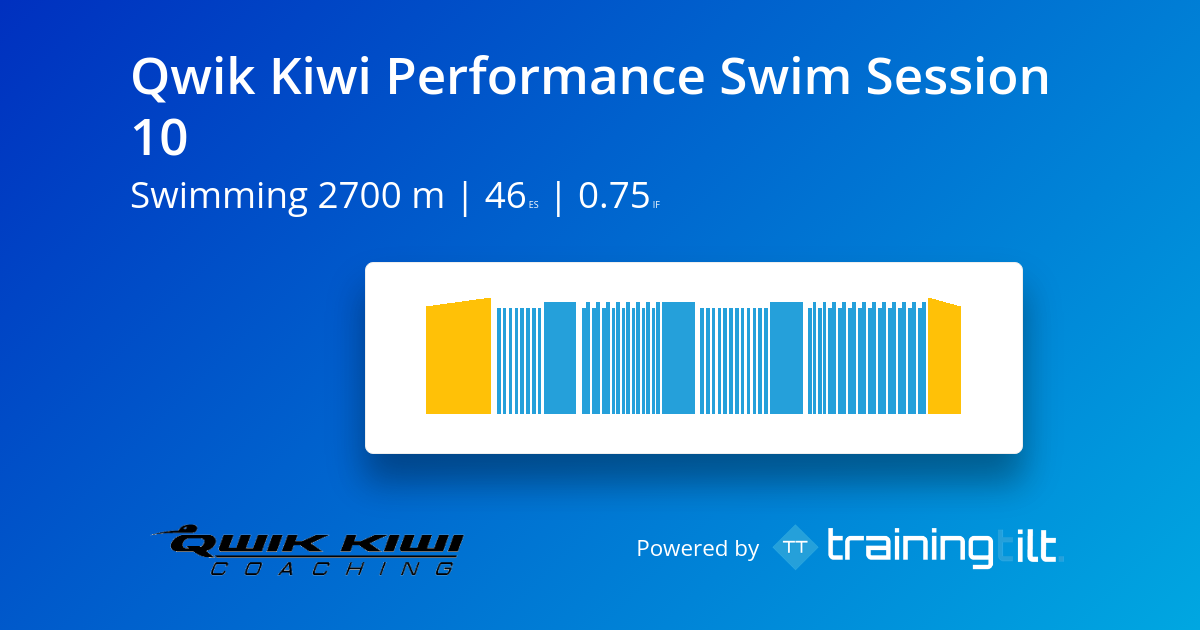
Session 10 alternates dedicated drill work, drill/swim combinations and easy swimming.
The structure gives you multiple opportunities to practise a movement, apply it to freestyle, and then reinforce it later in the session.
This workout appeared in Week 4, and revisiting it provides a useful opportunity to consolidate the skills you’ve already been practising.
Today’s Workout
| Set | Distance |
|---|---|
| Warm-up | 400m |
| 8 × 25m Drill | 200m |
| Easy swim | 200m |
| 8 × 50m Drill/Swim | 400m |
| Easy swim | 200m |
| 12 × 25m Drill | 300m |
| Easy swim | 200m |
| 12 × 50m Drill/Swim | 600m |
| Cool-down | 200m |
| Total | 2,700m |
How to Complete This Workout
400m Warm-Up
Begin with 400m of comfortable swimming.
Gradually settle into a relaxed freestyle rhythm. You can incorporate other strokes, pause between lengths and stretch your shoulders if needed.
Don’t rush. This is a technique session, so start thinking about how you’re moving through the water rather than how quickly you’re covering the distance.
8 × 25m Drill
Complete eight 25m repetitions, concentrating on one technical skill at a time.
A suggested sequence is:
- 25m Kick on Side — Left
- 25m Kick on Side — Right
- 25m 6/1/6 Drill
- 25m 6/3/6 Drill
- 25m Kick on Side — Left
- 25m Kick on Side — Right
- 25m 6/1/6 Drill
- 25m 6/3/6 Drill
Kick on Side: Extend the lower arm in front of you, keep the opposite arm alongside your body and use a relaxed flutter kick. Focus on maintaining a balanced, streamlined position. Complete the drill on both sides.
6/1/6 Drill: Complete six kicks on one side, take one freestyle arm stroke to rotate onto the opposite side, then complete another six kicks. Continue alternating.
6/3/6 Drill: Complete six kicks on one side, take three freestyle strokes to rotate through to the other side, then complete another six kicks.
The objective is precision rather than speed.
You can use fins if they help you maintain your body position and concentrate on the movement.
Take enough rest between repetitions to ensure you’re performing each drill correctly.
200m Easy Swim
Swim 200m at a comfortable pace.
Concentrate on maintaining the body position and rotation practised during the drills.
This isn’t a recovery race. Keep the swimming relaxed.
8 × 50m Drill/Swim
Each 50m repetition consists of:
- 25m of a swimming drill.
- 25m normal freestyle, applying the movement practised during the drill.
Use the same four drills as the previous set, completing each twice.
For example, after 25m of Kick on Side — Left, swim 25m normal freestyle while concentrating on maintaining a balanced body position.
After 25m of 6/3/6, swim 25m freestyle with an emphasis on smooth body rotation and coordinated arm movements.
The transition from drill to normal swimming is the most important part of this set.
200m Easy Swim
Swim another relaxed 200m.
Try to maintain the same technical focus without needing to think about every individual movement.
12 × 25m Drill
Return to dedicated drill work.
Complete twelve 25m repetitions, using three rounds of the following sequence:
- Kick on Side — Left
- Kick on Side — Right
- 6/1/6
- 6/3/6
Alternatively, if one particular drill is exposing a weakness, spend more repetitions working on that movement.
The aim is to improve the quality of your swimming, not simply complete twelve lengths.
200m Easy Swim
Swim 200m at a comfortable pace.
Concentrate on applying the technical improvements developed during the preceding drill set.
12 × 50m Drill/Swim
Complete twelve repetitions of 50m.
Each repetition is again divided into 25m drill followed by 25m normal freestyle.
Use three rounds of the four-drill sequence.
By this stage, you’ve completed a substantial amount of technical work. The challenge is to maintain concentration and avoid becoming sloppy simply because you’re approaching the end of the session.
200m Cool-Down
Finish with 200m of relaxed swimming.
Use any comfortable stroke and allow your breathing and heart rate to settle.
Common Mistakes
- Rushing through drills without understanding their purpose.
- Using an excessively strong kick to compensate for poor balance.
- Completing the freestyle portion without applying the drill focus.
- Allowing fatigue to reduce the quality of the final drill set.
Tips for Success
Choose one or two technical cues to concentrate on throughout the session.
For example, you might focus on maintaining a long body position and rotating smoothly from side to side.
Avoid trying to correct every aspect of your freestyle technique at once.
Coach Ray’s Tip: The 25m freestyle immediately after each drill is where the learning becomes useful. Concentrate on making your normal swimming feel like a natural continuation of the drill.
Swim 2 — Session 13: 10 × 150m Paddle Strength Intervals
Today’s Goal
Develop swimming-specific strength and improve the effectiveness of your freestyle catch and pull while maintaining good technique.
Why You’re Doing This Session
Hand paddles increase the surface area of your hands, changing how you interact with the water and increasing the load through your pulling muscles.
Used appropriately, they can help develop swimming-specific strength and improve awareness of your catch and pull.
However, paddles are not an invitation to force your way through the water.
This workout is about producing a strong, controlled stroke repeatedly while maintaining good body position and avoiding unnecessary strain on your shoulders.
Today’s Workout
| Set | Distance |
|---|---|
| Warm-up | 600m |
| 8 × 50m Drill/Swim | 400m |
| 10 × 150m Paddles, 30sec RI | 1,500m |
| Cool-down | 200m |
| Total | 2,700m |
How to Complete This Workout
600m Warm-Up
Begin with 600m of easy swimming.
Start gently and gradually build towards a comfortable training rhythm.
You can mix strokes, pause between lengths and incorporate gentle stretching as required.
Towards the end of the warm-up, concentrate on maintaining a relaxed recovery over the water and a controlled catch beneath the surface.
8 × 50m Drill/Swim
Complete eight repetitions of 50m.
Each repetition consists of 25m drill followed by 25m normal freestyle.
Use the following sequence twice:
- Kick on Side — Left
- Kick on Side — Right
- 6/1/6
- 6/3/6
These drills prepare you for the main set by reinforcing balance, body rotation and coordination.
During the freestyle portion of each repetition, concentrate on transferring those movements into your normal stroke.
You can use fins during the drill section if required.
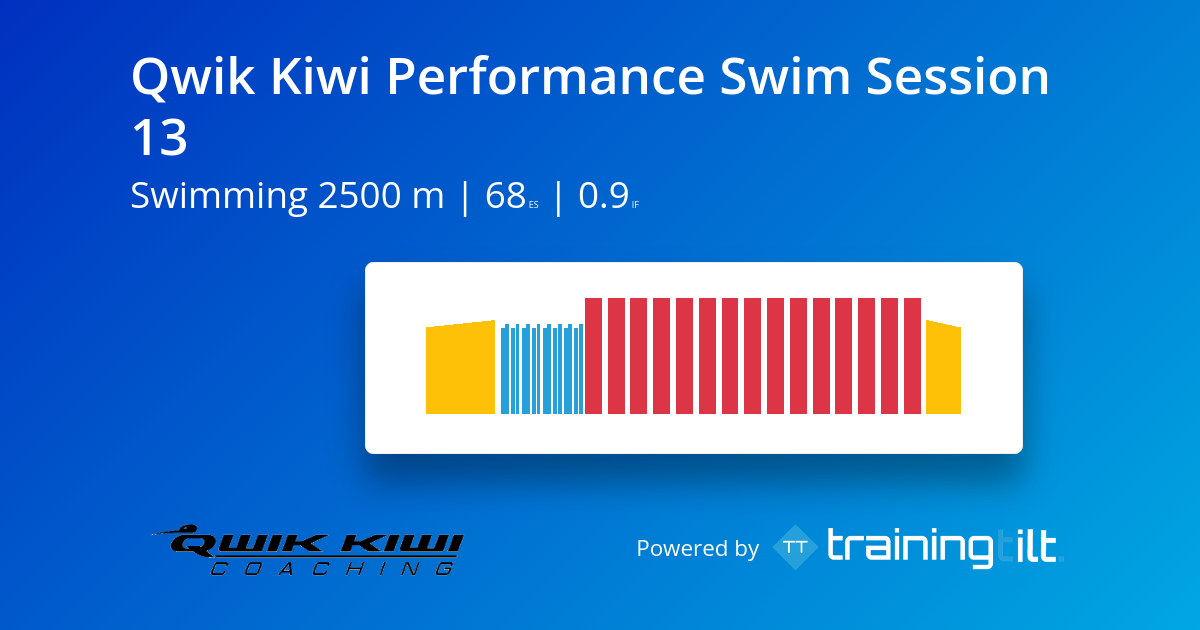
10 × 150m Paddles — 30sec RI
Put on your hand paddles for the main set.
Complete ten repetitions of 150m freestyle, taking 30 seconds of rest between repetitions.
The objective is to swim at a strong but controlled pace while maintaining effective technique.
Don’t treat the first few repetitions as a sprint.
Instead, choose an effort you can repeat consistently across all ten intervals.
Repetitions 1–3: Establish Your Technique
Use the opening three repetitions to settle into your swimming rhythm.
Concentrate on:
- Entering your hand smoothly into the water.
- Establishing an effective catch.
- Applying pressure through the water in a controlled manner.
- Maintaining a balanced body position.
The paddles should help you feel the water, not encourage you to force your stroke.
Repetitions 4–7: Maintain Strength and Efficiency
As fatigue begins to accumulate, concentrate on maintaining the quality of your pull.
Avoid shortening your stroke or increasing your stroke rate unnecessarily.
Continue swimming at a controlled, sustainable effort.
If you notice your technique deteriorating, reduce your pace slightly rather than trying to overpower the water.
Repetitions 8–10: Finish with Good Technique
The final three repetitions challenge your ability to maintain effective swimming mechanics when your arms and shoulders are becoming tired.
Aim to keep your times reasonably consistent.
If you’re feeling strong, you can gradually increase your effort, provided your technique remains controlled.
The final repetition should be as technically sound as the first.
Choosing Your Paddles
Use paddles that are appropriate for your swimming ability and shoulder strength.
Larger paddles create greater resistance, but that doesn’t necessarily make them better.
If you’re relatively new to paddle swimming, start with smaller paddles.
If you experience shoulder pain or discomfort, remove the paddles and complete the remaining distance using normal freestyle.
What About a Pull Buoy?
The prescribed main set is a paddle session, so a pull buoy isn’t required.
Swimming with paddles alone encourages you to maintain your normal body position and kick while working against the additional resistance.
200m Cool-Down
Remove your paddles and complete 200m of easy swimming.
Concentrate on a relaxed, smooth freestyle stroke.
Notice how your hands feel in the water after removing the paddles.
Common Mistakes
- Using paddles that are too large.
- Pulling excessively hard rather than maintaining an effective catch.
- Starting the intervals too quickly.
- Allowing shoulder fatigue to compromise technique.
- Ignoring discomfort while swimming with paddles.
Tips for Success
Record your 150m times if possible.
Look for consistency across the set, but don’t sacrifice stroke quality simply to maintain a particular time.
Coach Ray’s Tip: The purpose of paddles is to help you become a stronger, more effective swimmer. Focus on how well you apply force through the water rather than how much resistance you can create.
Swim 3 — Session 14: 100m and 50m Intervals for Repeatable Speed
Today’s Goal
Develop the ability to maintain a consistent swimming pace over repeated 100m efforts, then sustain faster, controlled swimming over shorter 50m repetitions.
Why You’re Doing This Session
Swimming speed is useful only when you can reproduce it.
Many swimmers can complete one fast repetition, but struggle to maintain their pace as the number of intervals increases.
This session combines two different repetition distances.
The 100m intervals challenge your ability to maintain a strong, repeatable pace.
The shorter 50m intervals then allow you to swim at a higher intensity while concentrating on preserving good technique.
Together, they help develop pacing discipline, speed endurance and confidence swimming at different intensities.
Today’s Workout
| Set | Distance |
|---|---|
| Warm-up | 400m |
| 12 × 100m, 20sec RI | 1,200m |
| 16 × 50m, 15sec RI | 800m |
| Cool-down | 200m |
| Total | 2,600m |
How to Complete This Workout
400m Warm-Up
Begin with 400m of comfortable swimming.
Gradually increase your effort as you warm up.
Concentrate on establishing a smooth freestyle rhythm, maintaining good body position and preparing your breathing for the harder swimming ahead.
You can pause between lengths and incorporate other strokes if required.
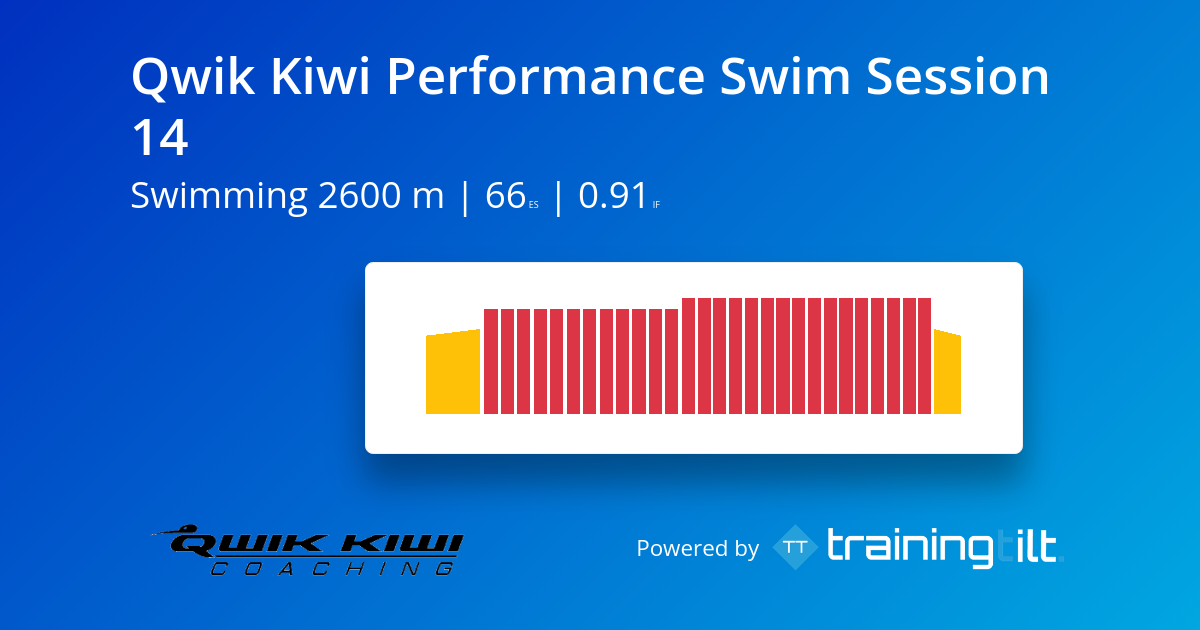
Main Set Part One: 12 × 100m — 20sec RI
Complete twelve repetitions of 100m freestyle.
Take 20 seconds of rest between repetitions.
Your objective is to establish a challenging but sustainable pace and maintain it throughout the set.
Repetitions 1–4: Establish Your Pace
Start at a controlled effort.
Avoid sprinting the first repetition.
Choose a pace that you believe you can maintain across all twelve 100m efforts.
Concentrate on relaxed breathing, a smooth stroke and good body position.
Repetitions 5–8: Maintain Your Rhythm
The middle repetitions are about consistency.
Try to keep your times similar to those recorded during the opening four repetitions.
As fatigue develops, avoid allowing your stroke to become rushed or inefficient.
Maintain your technique and focus on swimming smoothly.
Repetitions 9–12: Finish Strong
The final four repetitions challenge your ability to maintain the same swimming speed as fatigue accumulates.
If you’ve paced the set correctly, you should still be swimming strongly.
Aim to keep the final repetition at least as fast as the first, without sacrificing technique.
Pacing Example
If you begin with a 100m time of 1min 50sec, aim to keep your remaining repetitions close to that pace.
You don’t need every repetition to be identical, but large variations suggest that your pacing may need attention.
Main Set Part Two: 16 × 50m — 15sec RI
After completing the 100m intervals, move into sixteen repetitions of 50m freestyle.
Take 15 seconds of rest between repetitions.
The shorter distance allows you to increase your swimming speed compared with the 100m efforts.
However, the objective remains controlled, repeatable swimming.
Repetitions 1–4: Find Your Faster Rhythm
Increase your swimming speed compared with the 100m set.
Concentrate on maintaining an effective catch and controlled body rotation as your stroke rate increases.
Avoid sprinting flat out.
Repetitions 5–8: Maintain Your Speed
Continue swimming at a strong, repeatable pace.
Try to keep your 50m times consistent.
Pay attention to your breathing and avoid becoming tense through your shoulders.
Repetitions 9–12: Hold Your Technique
By this stage, you’ll have completed a substantial amount of interval swimming.
Focus on maintaining a strong body position, effective catch and consistent rhythm.
Don’t allow your technique to deteriorate simply because you’re trying to swim faster.
Repetitions 13–16: Finish Strong
Aim to complete the final four repetitions at least as consistently as the opening four.
If you’re still feeling strong, gradually increase your effort.
Your final repetition can be your fastest, provided you’re maintaining good swimming technique.
The Difference Between the Two Sets
The 100m repetitions are about holding a sustainable pace over a longer distance.
The 50m repetitions are about swimming faster while maintaining the same technical discipline.
The aim isn’t to sprint every repetition. It’s to develop the ability to reproduce a strong swimming performance again and again.
200m Cool-Down
Finish with 200m of very easy swimming.
Allow your breathing and heart rate to return towards normal.
Use whichever strokes feel comfortable and pause between lengths if required.
Common Mistakes
- Starting the 100m intervals too quickly.
- Treating the 50m repetitions as sixteen all-out sprints.
- Ignoring the prescribed rest intervals.
- Allowing technique to deteriorate as fatigue accumulates.
- Focusing on one exceptionally fast repetition rather than consistency across the set.
Tips for Success
Record your times for both the 100m and 50m intervals.
Compare your opening repetitions with your closing repetitions.
If your times remain consistent, you’ve probably selected an appropriate pace.
If your times deteriorate significantly, consider starting slightly more conservatively next time.
Coach Ray’s Tip: Don’t judge this workout by your fastest 50m. Judge it by how well you maintain your swimming speed and technique across all twenty-eight repetitions.
How the Three Sessions Work Together
| Session | Distance | Primary Focus |
|---|---|---|
| Session 10 | 2,700m | Technique and stroke efficiency |
| Session 13 | 2,700m | Paddle-assisted swimming strength |
| Session 14 | 2,600m | Consistent pacing and repeatable speed |
| Week 6 Total | 8,000m |
These sessions complement one another.
Session 10 develops the technical foundations of efficient freestyle swimming.
Session 13 challenges you to apply effective force through the water while maintaining those foundations.
Session 14 then tests your ability to sustain good swimming mechanics while completing repeated efforts at progressively higher speeds.
The result is a balanced week that develops technique, strength and swimming performance.
What Should You Record?
If you use a swimming watch or TrainingPeaks, consider recording a few simple observations after each workout.
For Session 10, note which drills felt easiest, which were most challenging and whether you noticed improvements in your normal freestyle.
For Session 13, record your 150m repetition times and how your shoulders, catch and body position felt throughout the paddle set.
For Session 14, record your 100m and 50m repetition times. Look for consistency rather than simply identifying your fastest repetition.
These observations can help you understand your progress and identify which aspects of your swimming need further attention.
Who Are These Workouts Suitable For?
These sessions are particularly useful for recreational and developing triathletes who want to improve their freestyle swimming.
Session 10 can be adapted to suit a wide range of abilities because the focus is on technique rather than speed.
Session 13 is best suited to swimmers who already have a reasonable freestyle foundation and can use paddles comfortably without shoulder discomfort.
Session 14 is suitable for swimmers who can complete repeated 100m and 50m efforts while maintaining their technique and managing short rest intervals.
If you’re newer to swimming, reduce the number of repetitions where necessary while maintaining the purpose of the workout.
Structured Training Plans
Want more structure and progression in your triathlon swimming?
My 16-Week Triathlon Swim Performance Plan provides three purposeful swim sessions each week, helping you progressively develop your technique, strength, endurance and confidence in the water.
The plan is designed for triathletes preparing for events such as Olympic-distance triathlons, Ironman 70.3 and T100 races.
Find out more about the 16-Week Triathlon Swim Performance Plan:
🏊 16 Weeks | 3 Swim Sessions Per Week | Just NZ$59
Final Thoughts
Week 6 is a reminder that becoming a better swimmer requires more than simply accumulating distance.
Technique helps you move through the water efficiently.
Strength helps you maintain an effective stroke.
Consistent pacing helps you use that technique and strength when fatigue begins to build.
Approach each session with its intended purpose in mind, and concentrate on the quality of your swimming rather than simply completing the distance.
Train smarter, swim stronger!
Coach Ray
Qwik Kiwi Coaching
www.CoachRay.nz