This week’s Saturday Swim Session progresses from longer, controlled aerobic swimming into increasingly shorter and faster repetitions. Instead of asking you to hold one pace throughout the session, the workout gradually increases the intensity as the distances decrease. It’s a great way to develop endurance first, then challenge your ability to maintain good technique as you begin swimming faster later in the workout.
As usual, there are three options to choose from. Option A is for swimmers looking for a workout between 1,000 and 2,000 metres, Option B is for swimmers wanting between 2,000 and 3,000m, and Option C provides a workout of more than 3,000m.
Read my article on Swim Intensity for an explanation of the terminology and intensities used throughout the workout.
Today’s Goal
The goal of today’s session is to increase your speed as the repetition distance decreases.
Your longer repetitions should feel controlled and sustainable. As you progress from the 300s into the 200s—and, for Options B and C, the 100s—you’ll gradually increase your effort.
The challenge is to swim faster without allowing your technique to deteriorate.
Why You’re Doing This Session
Being able to swim faster isn’t simply about sprinting. An important part of developing swim fitness is learning to produce different speeds while maintaining an efficient stroke.
Today’s workout starts by developing your aerobic endurance through longer repetitions at steady and moderate intensities. As the repetitions become shorter, the intensity increases and you’ll be able to swim faster while still maintaining control.
This progression challenges you to produce your fastest swimming when some fatigue has already accumulated. That’s particularly useful for triathletes and open-water swimmers, where being able to increase your effort late in a swim—or respond to a change in pace around you—can be valuable.
Session Inspiration
The inspiration for this week’s session came from an Instagram reel by triathlon coach Natasha Van Der Merwe. I’ve used the ideas from that session as the basis for today’s workout and adapted the distances and structure to provide three options suitable for recreational swimmers, masters swimmers and age-group triathletes.
Today’s Workout
Option A – 1,850m
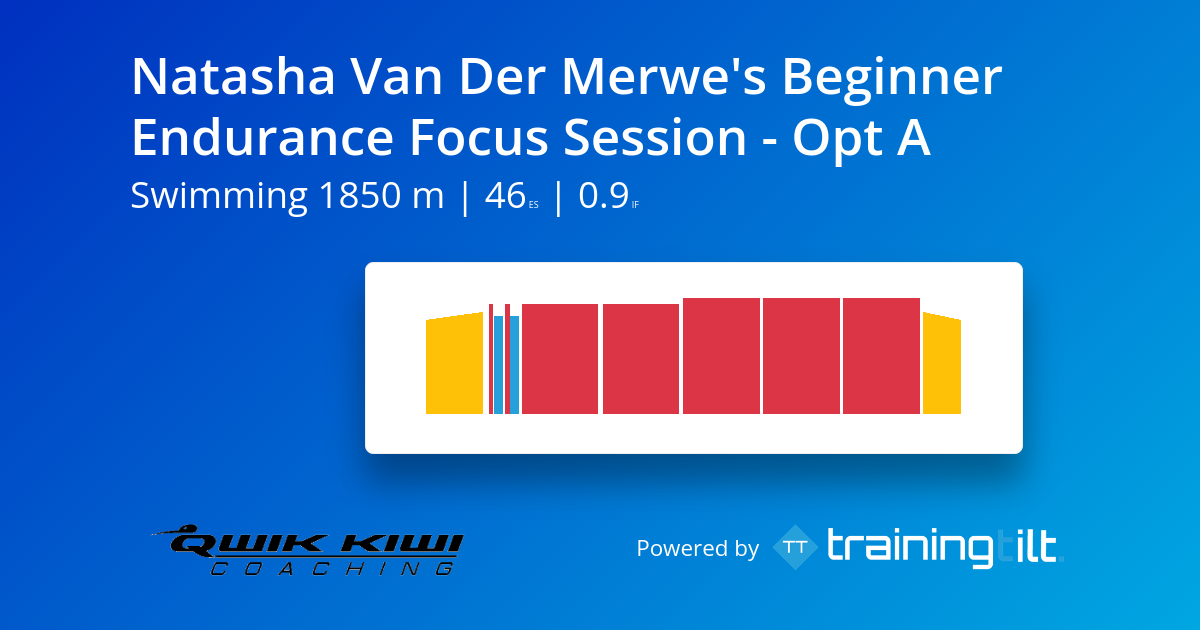
- 300m Warm Up (WU)
- 2 × 75m (25m Kick / 50m Swim)
- 2 × 300m Moderate – 20 sec RI
- 3 × 200m Moderate-Fast – 15 sec RI
- 200m Cool Down (CD) with Pull Buoy & Paddles
Option B – 2,600m
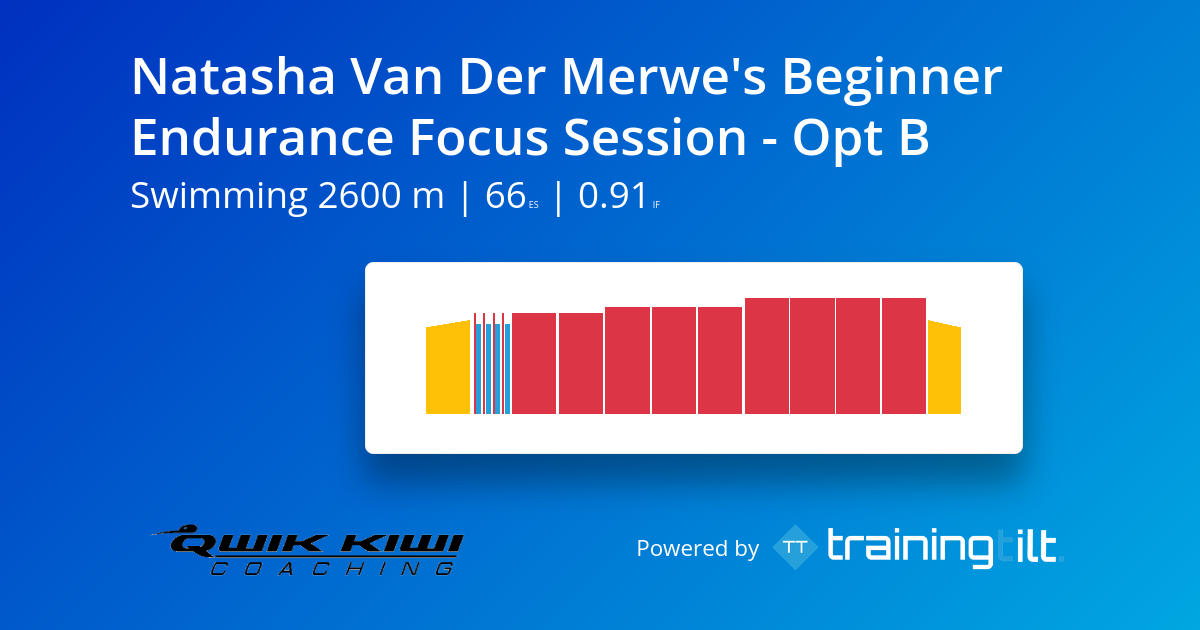
- 400m Warm Up (WU)
- 4 × 75m (25m Kick / 50m Swim)
- 2 × 300m Moderate – 20 sec RI
- 3 × 200m Moderate-Fast – 15 sec RI
- 4 × 100m Fast – 10 sec RI
- 300m Cool Down (CD) with Pull Buoy & Paddles
Option C – 3,100m
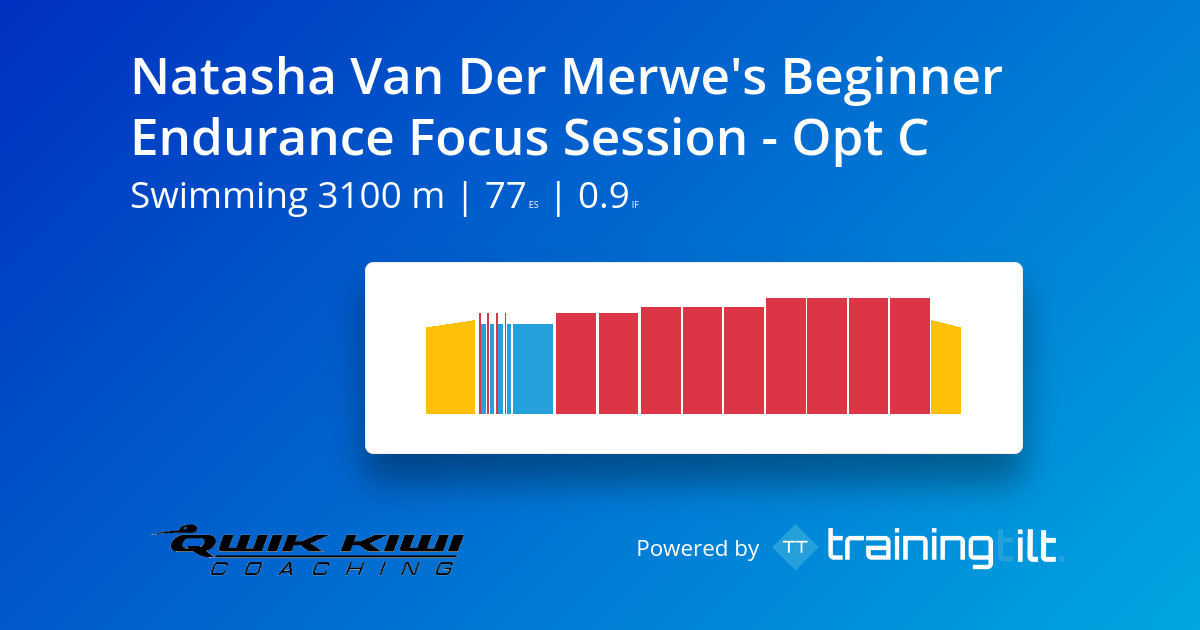
- 500m Warm Up (WU)
- 4 × 75m (25m Kick / 50m Swim)
- 400m Steady – 30 sec RI
- 2 × 300m Moderate – 20 sec RI
- 3 × 200m Moderate-Fast – 15 sec RI
- 4 × 100m Fast – 10 sec RI
- 300m Cool Down (CD) with Pull Buoy & Paddles
What You Should Focus On
- Let the pace build naturally. Don’t turn the early moderate swimming into fast swimming.
- Maintain a long, efficient stroke as your speed increases.
- Use the decreasing distances as an opportunity to gradually increase your effort.
- Keep the prescribed Rest Intervals (RI) short and consistent.
- During the fast 100s, concentrate on swimming fast with good technique, rather than simply increasing your stroke rate.
- Aim for consistency between repetitions within each set.
Common Mistakes To Avoid
Starting Too Fast
The steady 400 and/or moderate 300s shouldn’t feel like a race. If you swim them too aggressively, you’ll compromise the quality of the faster work later in the session.
Confusing Faster With Frantic
Increasing your pace doesn’t mean simply spinning your arms faster. Maintain your catch, body position and stroke length as your intensity increases.
Extending The Rest Intervals
The relatively short recoveries are part of the workout. Turning 10 or 15 seconds into 30 or 40 seconds changes the nature of the session.
Allowing Technique To Disappear Late In The Workout
The 100m repetitions should be your fastest swimming, but they shouldn’t be your messiest. If your technique is falling apart, slightly reduce your pace and regain control.
Tips For Completing The Workout Successfully
Think of this workout as a progression rather than a collection of separate sets.
The early swimming establishes your rhythm. The moderate 300s begin adding intensity. The moderate-fast 200s take another step upwards, and Options B and C finish the main work with fast 100s.
If you pace the session correctly, you should feel as though you’re gradually working your way through the gears.
During the kick/swim repetitions, complete the first 25m as kick before transitioning directly into 50m of regular swimming. I recommend kicking without a kickboard where possible, as this encourages a more natural body position in the water.
You can see how I recommend completing kick without a kickboard in the video below.
Workout Breakdown
Start with 300m (Option A), 400m (Option B) or 500m (Option C) of mixed swimming. Include a variety of strokes and use this time to gradually prepare your body for the work ahead. Feel free to stop and stretch during the Warm Up—it doesn’t need to be one continuous swim.
Next, complete two (Option A) or four (Options B and C) 75m repetations, swimming the first 25m as kick before transitioning into 50m of regular swimming.
Option C then completes an additional 400m at a steady intensity followed by a 30-second Rest Interval.
All three options then move into 2 × 300m at a moderate intensity, with 20 seconds recovery after each repetition. Settle into a controlled rhythm here rather than chasing speed.
The next progression is 3 × 200m at a moderate-fast intensity, with a 15-second Rest Interval. Your pace should now be noticeably quicker than during the 300m repetitions, but you should still feel in control.
For Options B and C, the main set concludes with 4 × 100m fast, taking just 10 seconds recovery between repetitions. These should be the fastest sustained swimming of the workout. Aim to make all four repetitions strong rather than producing one very fast 100m followed by three progressively slower ones.
Finish with 200m (Option A) or 300m (Options B and C) using a Pull Buoy and Paddles. Ease the intensity back, concentrate on a long controlled stroke and use the set to finish the session with good technique.
After Your Swim
Before leaving the pool, think about how successfully you progressed your effort throughout today’s session.
Ask yourself:
- Were my 200m repetitions clearly faster than my 300s?
- If I completed Option B or C, could I increase my pace again for the 100s?
- Did I maintain good technique as my speed increased?
- Were my repetitions within each set reasonably consistent?
- Did I finish feeling that I’d paced the entire workout well?
If you started conservatively, increased your pace as the distances shortened and still had enough control to swim well during your fastest repetitions, you’ve achieved the main goal of today’s session.
Want 8 Weeks of Swim Sessions Like This?
If you enjoyed today’s workout, why stop at just one?
Download my FREE Swim Engine Builder Workout Pack and receive 24 structured swim sessions spread across three training options:
🏊 Foundation – Under 2,000m per session
🏊 Performance – 2,000–3,000m per session
🏊 Endurance – 3,000m+ per session
Whether you’re swimming for fitness, preparing for your next triathlon or simply looking for more variety in the pool, you’ll have eight weeks of purposeful workouts ready to go.
👉 Download your FREE Swim Engine Builder Workout Pack today and start building a stronger swim engine!
