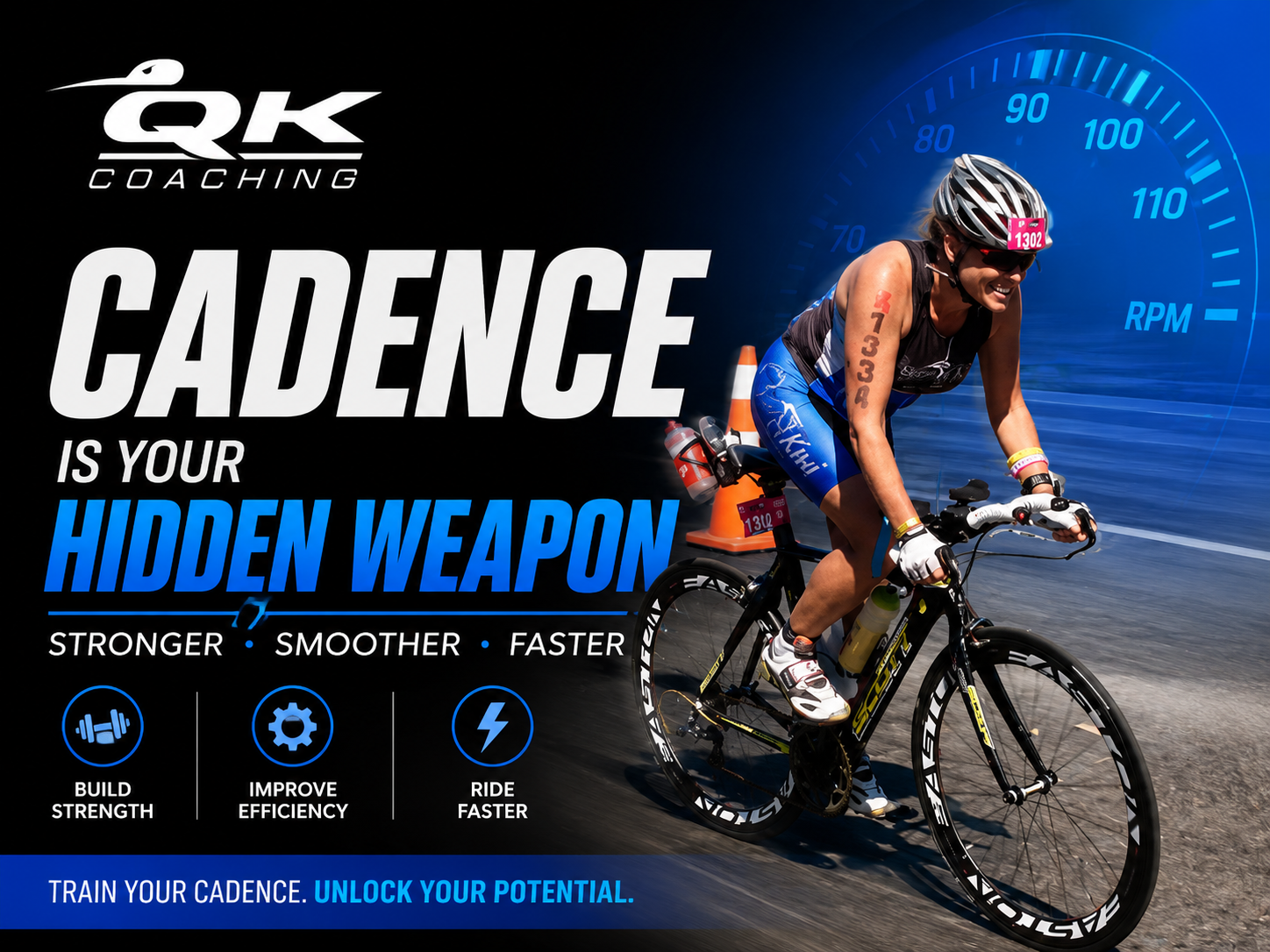
Most cyclists have a cadence they naturally settle into.
Jump on the indoor trainer, start riding, and before long you’re probably turning the pedals at roughly the same cadence you use during almost every other session.
There’s nothing inherently wrong with that.
In fact, for most cycling situations, a cadence somewhere around 90–100rpm provides a very useful target range.
But if you always ride at exactly the same cadence, you’re missing an opportunity to develop another important part of your cycling.
Cadence is a trainable skill.
And one of the great advantages of indoor cycling is that you can deliberately practise riding smoothly and effectively across a much wider range of pedalling speeds.
What Is Cycling Cadence?
Cadence is simply how quickly you’re turning the pedals, measured in revolutions per minute—or rpm.
If you’re riding at 90rpm, each crank completes 90 revolutions every minute.
What’s important to understand is that power and cadence aren’t the same thing.
You can produce the same power at different cadences.
At a lower cadence, each pedal stroke requires more torque.
At a higher cadence, you’re completing more pedal strokes each minute, with less torque required per revolution.
That creates different demands on your body.
Why 90–100rpm Is Such a Useful Range
For most normal cycling situations, developing the ability to ride comfortably at approximately 90–100rpm is worthwhile.
This range provides a useful balance between the muscular demands of pushing a larger gear and the cardiovascular demands associated with spinning increasingly quickly.
It also means you’re not relying excessively on muscular force with every pedal stroke.
For cyclists who naturally grind away at 60–70rpm, gradually developing the ability to ride smoothly around 90rpm can therefore be particularly valuable.
But being comfortable at 90–100rpm doesn’t mean that’s the only cadence you should train.
That’s where cadence-specific workouts become useful.
Don’t Become a One-Cadence Cyclist
Cycling isn’t performed under perfectly controlled conditions.
Outside, you’ll encounter:
- Climbs.
- Descents.
- Headwinds.
- Tailwinds.
- Accelerations.
- Changes in terrain.
- Different gearing requirements.
Sometimes you’ll need to turn a bigger gear more slowly.
At other times you’ll need to spin quickly.
Being comfortable across a range of cadences gives you more options and makes you a more adaptable cyclist.
Use Low Cadence Purposefully
Lower-cadence riding increases the force required with each pedal stroke when power is maintained.
That’s why I use controlled low-cadence work to develop cycling-specific strength.
You might include periods around 60–70rpm during an appropriately prescribed session, concentrating on maintaining good technique and smooth pressure throughout the pedal stroke.
The aim isn’t simply to select the biggest gear you can turn.
The resistance needs to be appropriate, your position should remain stable, and your pedalling should remain controlled.
Low-cadence work is a training tool.
Use it deliberately.
High Cadence Is a Skill Too
At the other end of the spectrum is high-cadence riding.
Once you move beyond your comfortable cadence, maintaining control becomes increasingly difficult.
Your hips may begin bouncing.
Your upper body starts moving.
Your pedal stroke becomes less coordinated.
That’s exactly why practising higher cadences can be useful.
Try gradually progressing through ranges such as:
- 90–95rpm.
- 95–100rpm.
- 100–105rpm.
- And, when appropriate, 105–110rpm or higher.
The goal isn’t simply to make your legs move as quickly as possible.
The goal is to maintain control while they do.
Smoothness Comes First
Cadence training isn’t about chasing the biggest number you can see on the screen.
If you’re bouncing around on the saddle at 120rpm, you’re probably not achieving what the drill is designed to develop.
Instead, gradually increase your cadence until you reach the point where your technique starts deteriorating.
Then concentrate on becoming smoother at that speed.
Relax your shoulders.
Keep your upper body quiet.
Maintain a stable position on the saddle.
Focus on smooth, controlled pedalling.
Over time, cadences that once felt frantic can begin to feel natural.
Indoor Cycling Is Perfect for Cadence Training
This is where the indoor trainer really shines.
There are no traffic lights.
No corners.
No descents.
No changing road surfaces.
You can control your resistance, power, and cadence precisely while concentrating completely on technique.
That makes indoor cycling an ideal environment for dedicated cadence sessions.
You can progressively move through different cadence ranges while keeping the overall intensity relatively controlled.
Instead of simply chasing fitness, you’re developing a cycling skill.
Try Cadence Changes Without Changing the Workout
Cadence training doesn’t always need to be a dedicated session.
You can introduce cadence variation into other workouts too.
During an endurance ride, for example, you might complete several short blocks at a higher cadence while keeping your power within the prescribed intensity.
Alternatively, you could include controlled lower-cadence periods during suitable workouts.
The important point is that cadence becomes an intentional training variable rather than something you completely ignore.
Build Your Cadence Toolbox
Think of 90–100rpm as an important part of your normal cycling toolbox.
Then deliberately expand that toolbox in training.
Develop the strength and control to ride effectively at lower cadences.
Develop the coordination and neuromuscular control to ride smoothly at higher cadences.
And become increasingly comfortable around that 90–100rpm range that will serve you well in many cycling situations.
Fitness matters.
Power matters.
But cycling performance isn’t only about producing watts.
It’s also about how effectively you produce them.
Don’t just train harder. Train your cadence.
Take Your Indoor Cycling to the Next Level
If you’re looking for structured indoor cycling workouts that build fitness, improve performance, and take the guesswork out of your training, check out Qwik Kiwi’s Velocity platform.
Velocity gives you access to hundreds of cycling workouts including VO₂ Max, Threshold, Tempo, Endurance, Technique, and Recovery sessions suitable for cyclists, triathletes, and endurance athletes of all abilities.
You can try Velocity completely FREE for 14 days with no long-term commitment.
Start your free trial today:
http://app.vqvelocity.com/join?a=rhs956
Train smarter. Ride stronger. Stay consistent.
Develop Your Cadence with Coach Ray’s Cadence Sessions
A great way to put these skills into practice is with the Coach Ray’s Cadence Session series in Qwik Kiwi’s Velocity. These structured workouts progressively take you through different cadence ranges, typically working from 90–95rpm through 95–100rpm, 100–105rpm and 105–110rpm, while keeping the intensity controlled. The focus isn’t simply on spinning your legs faster; it’s on developing the coordination, smoothness, efficiency, and control to remain comfortable across a wider cadence range. Combined with the lower-cadence and Big Gear workouts available in Velocity, the series helps you develop both ends of your cadence toolbox so you’re better prepared for the changing demands of real-world cycling. All available within Velocity.