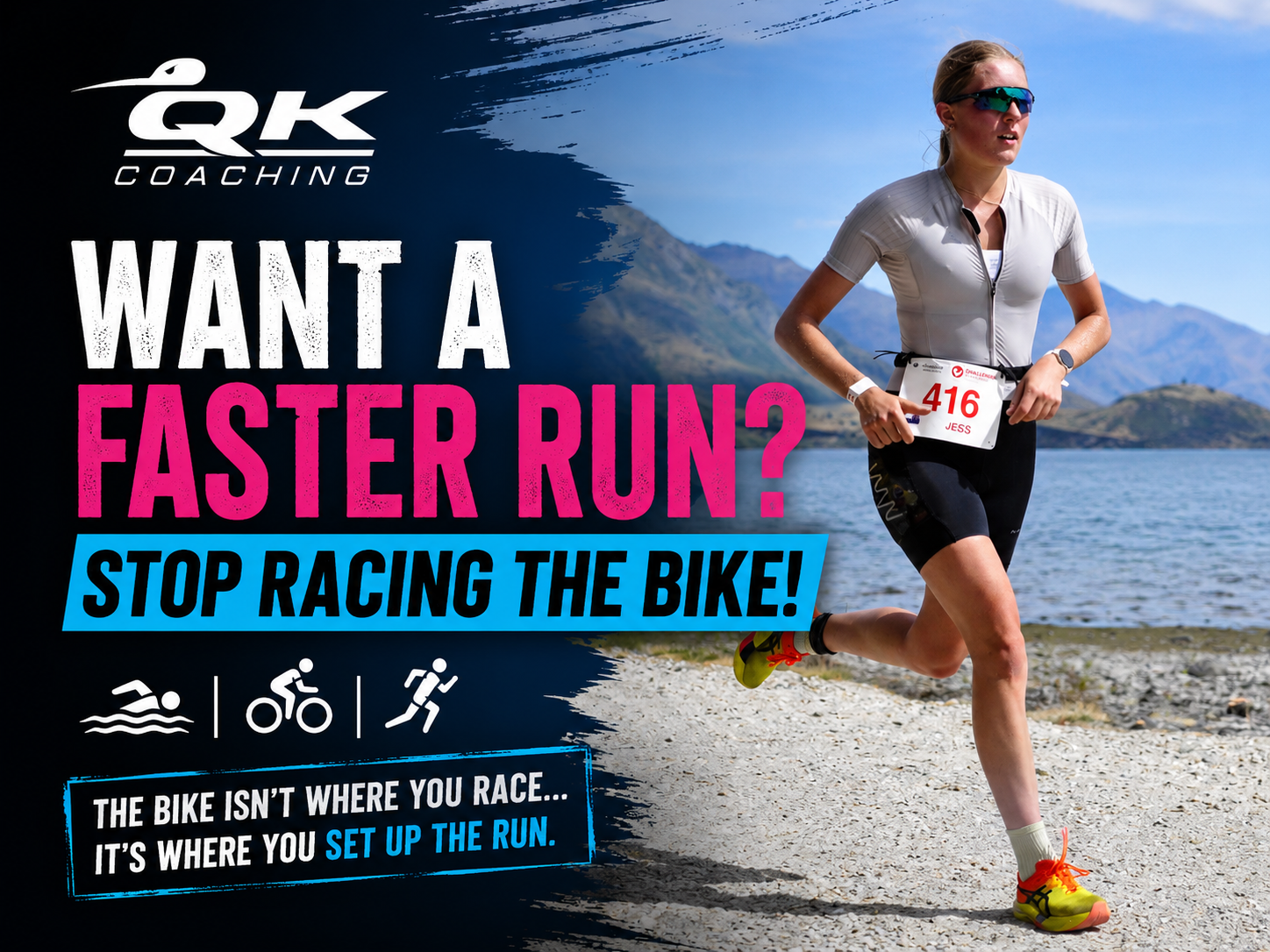
The 90km bike leg of an Ironman 70.3 can be incredibly tempting.
You’ve survived the swim, you’re finally on your bike, and suddenly you feel strong.
So you start racing.
You push a little harder on the hills. You chase the athlete who just passed you. You increase the power because your legs feel good.
And for a while, everything seems perfect.
Then you reach T2.
That’s when you discover whether you actually rode the bike well.
Because the goal of the Ironman 70.3 bike leg isn’t simply to ride 90km as fast as possible.
It’s to ride 90km as fast as you can while still being able to run well afterwards.
Your Bike Split Doesn’t Exist in Isolation
If you were competing in a 90km cycling time trial, the objective would be relatively straightforward: get to the finish as quickly as possible.
But you’re not.
There’s a 21.1km run waiting for you.
That changes everything.
Every decision you make during the bike needs to be considered in the context of what comes next.
A five-minute faster bike split isn’t much of an achievement if it contributes to a run that’s 15 minutes slower.
Your finishing time is what matters.
Not your bike split.
The Danger of Feeling Too Good Early
One of the traps with Ironman 70.3 racing is that the early stages of the bike can feel surprisingly comfortable.
You’ve tapered.
You’re rested.
You’ve got race-day adrenaline flowing.
And compared with your hardest training sessions, your planned race effort may initially feel conservative.
That’s exactly where discipline becomes important.
Feeling good isn’t an invitation to abandon your race plan.
It’s often confirmation that you’re executing it properly.
Ride at an Effort You Can Sustain
Your bike pacing should be based on an intensity you’ve practised during training.
Depending on how you train and race, that might be guided by:
- Power.
- Heart rate.
- Perceived exertion.
- Or a combination of all three.
The exact numbers will vary between athletes.
What shouldn’t vary is the principle:
Your effort needs to be sustainable.
You shouldn’t spend the first 30km repeatedly asking yourself whether you could ride harder.
Of course you could.
The better question is:
“How will this effort affect my ability to run?”
Stop Chasing Speed
Speed can be a terrible guide to effort on the bike.
A headwind can make you feel slow.
A tailwind can make you feel brilliant.
A hill can dramatically reduce your speed despite an increase in power.
That’s why trying to maintain a particular speed can lead to poor pacing decisions.
Instead, concentrate on maintaining the appropriate effort for the conditions.
Let your speed change.
Keep your effort under control.
Be Careful With the Hills
Hills are one of the easiest places to spend energy unnecessarily.
Athletes see their speed dropping and instinctively push harder.
There’s nothing wrong with allowing your effort to rise slightly when appropriate, but turning every climb into an interval session is a different story.
Shift early.
Maintain your rhythm.
Keep your effort controlled.
Then settle straight back into your planned race intensity.
The few seconds you might gain by attacking a hill aren’t worth much if your legs pay for them during the run.
Smooth Is Fast
A good Ironman 70.3 bike leg can look almost boring.
There aren’t endless attacks.
There aren’t huge surges.
There isn’t constant chasing.
Instead, there’s rhythm.
Steady effort.
Consistent nutrition.
Good positioning.
Smart decision-making.
That’s exactly what you want.
The athlete who looks spectacular at kilometre 30 isn’t necessarily the athlete who’s going to have the best race.
Pay attention to who’s still moving well at kilometre 15 of the run.
Fuel the Run While You’re Riding
The bike is also where much of your race-day fuelling happens.
Waiting until the run to fix a nutrition problem is usually too late.
Use the bike to stay on top of your carbohydrate and fluid intake according to the strategy you’ve practised during training.
And don’t let aggressive riding interfere with your nutrition.
If you’re constantly surging, attacking hills, and chasing athletes, it’s surprisingly easy to forget to eat or drink.
Pacing and nutrition aren’t separate strategies.
They work together.
Practise the Bike-to-Run Connection
This is why brick sessions are such an important part of Ironman 70.3 preparation.
A brick isn’t simply about teaching your legs what running feels like after cycling.
It’s also an opportunity to test your bike pacing.
If you finish a race-specific bike session and immediately struggle to run anywhere near your planned effort, ask yourself why.
It might not be your running fitness.
You may simply have ridden too hard.
Conversely, when you finish the bike and can settle into your planned running effort smoothly, that’s valuable feedback that your bike intensity was appropriate.
Use your training to learn where that balance sits.
Your Best Bike Leg Might Feel Too Easy
This can be difficult for competitive athletes to accept.
You may reach T2 feeling like you could have ridden harder.
Good.
That doesn’t necessarily mean you left time on the course.
It may mean you saved exactly what you needed for the run.
The real test comes over the next 21.1km.
If you’re running strongly while athletes who hammered past you earlier begin slowing down, your patience is paying dividends.
Think About Your Overall Race
Ironman 70.3 rewards athletes who understand that swim, bike and run aren’t three separate races.
They’re connected.
Your swim affects your bike.
Your bike affects your run.
And your decisions early in the day determine what you’re capable of doing later.
So when you’re feeling fantastic halfway through the bike, don’t ask:
“How much faster can I ride?”
Ask:
“What do I need to do now so I can still run strongly at 18km?”
That question will lead to much better decisions.
Final Thoughts
The fastest cyclist doesn’t necessarily have the fastest Ironman 70.3.
And your fastest possible 90km bike split isn’t necessarily part of your fastest possible Ironman 70.3.
Race the whole event.
Stay disciplined early.
Ride smoothly.
Fuel consistently.
Control your effort.
Then arrive at T2 ready to use the running fitness you’ve worked so hard to build.
Because the bike isn’t where you prove how strong you are.
It’s where you set yourself up to run strong.
Ready to Take the Guesswork Out of Your Ironman 70.3 Training?
A successful Ironman 70.3 isn’t simply about getting fitter. It’s about putting your swim, bike and run together with smart pacing, effective nutrition and good race-day execution.
If you’re preparing for your first Ironman 70.3, chasing a personal best, or want more confidence that you’re training and racing at the right intensities, I’d be happy to help.
Book a free, no-obligation coaching consultation and let’s talk about your goals, your current training, and where your biggest opportunities for improvement might be.
You’ll leave the call with practical advice and a clearer idea of your next steps, whether we end up working together or not.