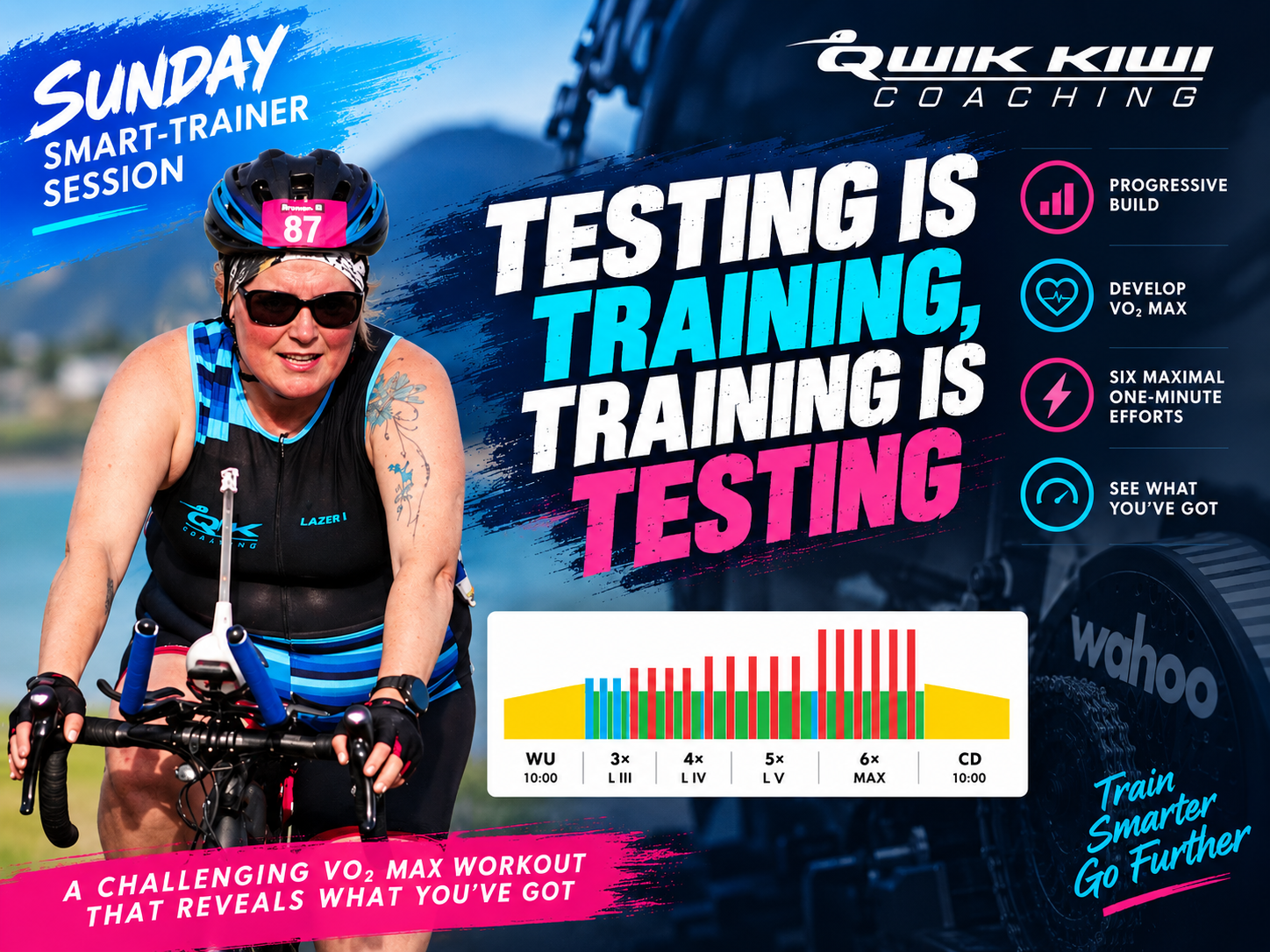
How much power can you produce when a workout finally asks you to give it everything?
This week’s Sunday Smart-Trainer Session, Testing is Training, Training is Testing, is first and foremost a challenging workout designed to help develop your VO₂ max.
The session progressively builds through Level III, Level IV and Level V. Those earlier repetitions aren’t tests in themselves. They’re deliberately structured to prepare you for the most important part of the workout: six maximal one-minute efforts.
That’s when the testing begins.
After progressively working your way through the intensities, how much power can you produce for one minute? Can you recover and do it again? And what happens to your power across all six repetitions?
That’s the idea behind the name.
You’re training your VO₂ max while simultaneously testing what you’re capable of producing towards the end of a demanding session.
And, as I’ve started collecting data from athletes who’ve ridden it, another interesting question has emerged.
There might eventually be something we can learn about FTP from those six efforts as well—but that’s a secondary question for another day and a much larger dataset.
Today’s Goal
The primary goal is to deliver a challenging VO₂ max training stimulus.
The workout builds progressively:
Level III → Level IV → Level V → Maximal
Each stage prepares you for the next.
Rather than asking you to jump from a warm-up directly into maximal one-minute efforts, we’re progressively increasing the physiological demand before reaching the final set.
Then comes the test:
What can you produce across six maximal one-minute efforts?
It’s not a formal FTP test.
It’s a chance to see what your body can produce when you’ve been properly warmed up, progressively loaded and are finally given permission to go for it.
Where This Session Came From
The inspiration for this workout came from discussions with a couple of my athletes.
The idea wasn’t to create another FTP testing protocol.
I wanted a good, challenging workout.
But there’s something useful about occasionally having a training session that allows you to see exactly what you’re capable of.
That’s particularly true when the workout can be repeated later.
Complete this session today and you establish a set of numbers from those final six efforts.
Return to it after another training block and you’ve got something to compare against.
Are you producing more power?
Can you maintain your power more consistently?
Does your power fall away less during the final repetitions?
Can you finish stronger?
That’s where Testing is Training, Training is Testing gets its name.
The testing occurs within the training rather than replacing it.
Today’s Workout
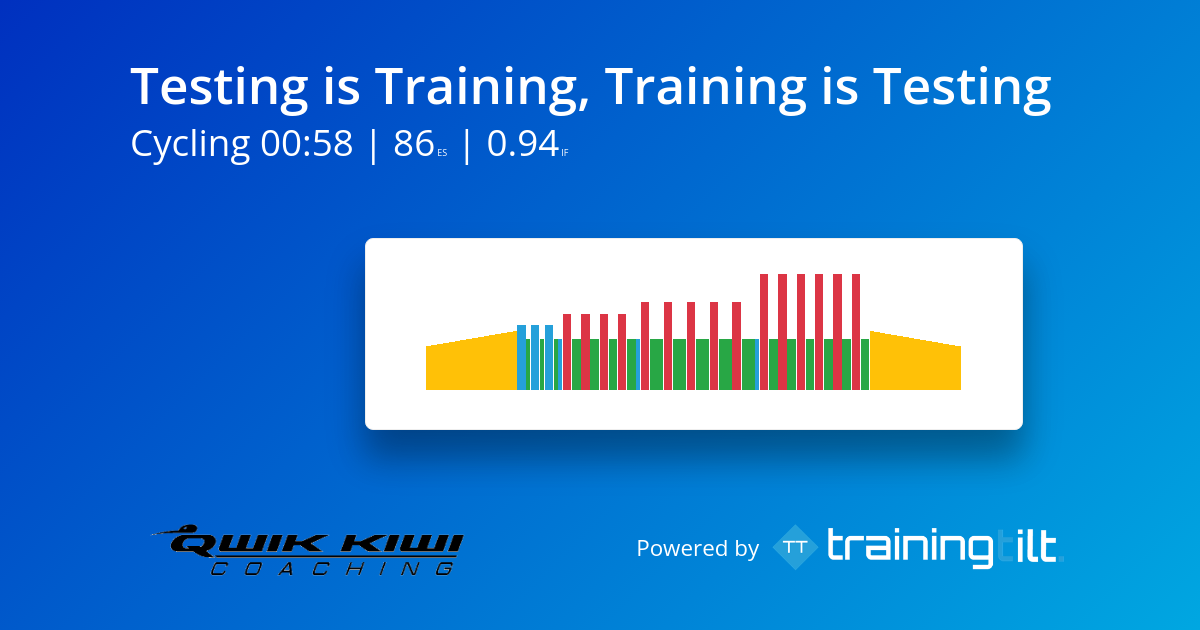
Warm-Up
10min – Level II
Progressive Set One
3x:
- 1min – Level III
- 30sec – Level II Rest Interval
Then:
- 30sec – Level II
Total: 5min
Progressive Set Two
4x:
- 1min – Level IV
- 1min – Level II Rest Interval
Then:
- 30sec – Level II
Total: 8min 30sec
Progressive Set Three
5x:
- 1min – Level V
- 90sec – Level II Rest Interval
Then:
- 30sec – Level II
Total: 13min
Main Set
6x:
- 1min – Maximal
- 1min – Level II Rest Interval
Total: 12min
Cool-Down
10min – Level II
Finish with 10 minutes of stretching.
Stretching isn’t included in the workout duration.
Total riding time: 58min 30sec.
Why the Workout Builds Through the Levels
The progression is one of the most important features of this workout.
The Level III, Level IV and Level V repetitions aren’t there because I’m trying to collect performance data from each intensity.
They’re there to build you towards the final set.
Think of them as stepping stones.
At Level III, you’re beginning to introduce some meaningful intensity above your warm-up effort.
At Level IV, the demand increases again.
At Level V, you’re now working hard and preparing your body for what comes next.
Only after you’ve progressed through all three do I ask you to ride maximally.
That progressive structure means you arrive at the main set thoroughly prepared for high-intensity work—but you’ve also accumulated some fatigue.
And that’s intentional.
The Real Workout Starts With Six Minutes to Go
The earlier sets matter, but they’re preparing you for this:
6x 1min Maximal / 1min Level II
These are the efforts that define the session.
One minute is long enough that you can’t simply sprint your way through it.
You need to produce very high power and keep producing it as the seconds tick away.
Then you’ve got one minute at Level II before doing it again.
And again.
Six times.
That combination of very hard work and incomplete recovery makes the final set an excellent high-intensity stimulus.
It also gives us six opportunities to see what you can produce.
What Does “Maximal” Mean?
Maximal doesn’t mean producing the biggest possible five-second power spike at the start of each repetition.
We’re interested in the complete minute.
You want to produce as much power as you can sustain across the full 60 seconds.
There’s another complication:
You’ve got six of them.
The aim isn’t necessarily to make all six identical. If you’re genuinely riding maximally, fatigue is going to influence what happens.
But don’t deliberately destroy the first repetition knowing you’ve got five more to complete.
Attack each effort with the intention of producing the best complete one-minute effort you’re capable of at that stage of the workout.
Recover at Level II.
Then find out what you’ve got again.
It Looks Worse on Paper Than It Feels
When athletes first see:
Level III → Level IV → Level V → 6x 1min Maximal
there can be a certain amount of apprehension. 😃
But there is considerably more recovery in this session than something like a Ramp Test—or plenty of my other workouts.
Every repetition has a Level II recovery.
There’s also an additional 30 seconds at Level II between the progressive sets.
That recovery is important because I’m not trying to grind you into submission before the main set.
I want you capable of producing quality high-intensity work when you get there.
And athletes who’ve ridden the workout on Velocity have rated it five stars ⭐⭐⭐⭐⭐. It’s one of the relatively few workouts in the library currently carrying a five-star rating.
So don’t let the workout prescription scare you.
Respect the recoveries and allow the session to build.
What You Should Focus On
During Level III
Keep it at Level III.
It should feel like the beginning of the progression, not an opportunity to prove how strong you’re feeling.
During Level IV
Let the intensity increase naturally.
You’re another step closer to the main set, but you’re still not trying to maximise anything.
During Level V
Now we’re getting serious.
These repetitions should be hard, but they’re still prescribed Level V efforts.
Don’t turn them into maximal efforts.
You need another gear available for the final set.
During the Maximal Efforts
Now you can find out what you’ve got.
Focus on producing the highest power you can sustain across the entire 60 seconds.
When the minute finishes, immediately return to Level II.
Use the recovery.
Then go again.
Common Mistakes to Avoid
Racing the Progressive Sets
The earlier work exists to prepare you for the main set.
Going above the prescribed Levels doesn’t make the workout better. It simply changes what you’ll be capable of producing later.
Making Level V Maximal
There’s an important distinction between Level V and maximal.
Respect it.
Starting Each Maximal Rep With a Huge Sprint
A massive initial power spike followed by 45 seconds of survival isn’t the goal.
Think about the complete minute.
Riding the Recoveries Too Hard
Those Level II recoveries allow you to produce more quality during the work intervals.
Make them genuine recoveries.
Holding Back Too Much Because There Are Six
There’s a balance here.
You need to respect the fact that six repetitions are coming, but this isn’t six controlled Level V efforts.
They’re maximal.
You’re supposed to find your limit.
Coach Ray’s Tips
Build patiently. The workout has been designed to become progressively harder.
Don’t skip ahead. Level III is Level III, Level IV is Level IV and Level V is Level V.
Save maximal for maximal. When you reach the final set, that’s when you’re allowed to empty the tank.
Recover properly. The easier you ride the Level II intervals, the better chance you have of producing quality during the next effort.
Look at all six efforts afterwards. Your best repetition is interesting, but so is the pattern across the complete set.
Repeat the workout in the future. That’s when the testing component becomes particularly useful.
So, What Are We Testing?
We’re primarily testing what sort of one-minute power you can produce at the end of this particular workout.
That distinction matters.
I’m not currently calling this an FTP test.
Instead, the six maximal efforts give us a performance snapshot.
If you repeat the same workout under similar conditions later, we can compare what happens.
For example, perhaps your first effort doesn’t change very much, but you can maintain substantially more power during repetitions five and six.
That’s useful information.
Perhaps all six repetitions improve.
That’s useful too.
Or perhaps your peak power increases but your repeatability declines.
Again, that’s something worth investigating.
The test isn’t necessarily about producing one magic number.
The pattern can tell a story too.
Coach Ray Rode This Session
I’ve completed Testing is Training, Training is Testing myself, which gives me the opportunity to look at the workout from both sides—as the coach who designed the session and as an athlete actually riding it.
The data below shows how my power responded as the workout progressed through Level III, Level IV and Level V before reaching the six maximal one-minute efforts.

What I’m particularly interested in isn’t simply the highest number I managed to produce.
I want to see what happens across the complete final set.
How much power could I produce during the first maximal minute? Could I reproduce that after only one minute at Level II? What happened by repetitions five and six as fatigue accumulated? And did I still manage to produce a genuinely maximal effort when I reached the end?
That’s one of the advantages of this workout. The session itself provides a challenging VO₂ max training stimulus, while the data from those final six efforts gives us something objective to examine afterwards.
See My Complete Ride on Strava
I’ve also uploaded the complete session to Strava, where you can see the ride and take a closer look at how the workout unfolded.
If you ride the workout yourself, compare your six maximal one-minute efforts afterwards. Don’t worry about comparing your watts with mine or anybody else’s—the more useful comparison is with your own performance when you return to this workout in the future.
And if you have a current FTP and power data from all six maximal efforts, send me your results. I’ll add them to the dataset as we continue investigating what these final six one-minute efforts might tell us.
An Interesting FTP Question Has Emerged
Although estimating FTP wasn’t the purpose of the workout, I’ve noticed something interesting while looking at the data.
So far, I have results from three athletes who have completed the session.
Here’s what they produced during their six maximal one-minute efforts compared with their known FTP:
| Rider 1 | Rider 2 | Rider 3 | |
|---|---|---|---|
| Known FTP | 219 W | 137 W | 220 W |
| 1st Rep | 295 W / 135% | 192 W / 140% | 288 W / 131% |
| 2nd Rep | 282 W / 129% | 187 W / 136% | 307 W / 140% |
| 3rd Rep | 290 W / 132% | 192 W / 140% | 310 W / 141% |
| 4th Rep | 281 W / 128% | 188 W / 137% | 311 W / 141% |
| 5th Rep | 275 W / 126% | 209 W / 153% | 331 W / 150% |
| 6th Rep | 278 W / 127% | 202 W / 147% | 378 W / 172% |
| Average % of FTP | 129% | 142% | 146% |
The average of those three individual percentages is approximately 139% of FTP.
That made me curious.
If we provisionally assume that average one-minute power from this particular set might sit somewhere around 140% of FTP, what happens?
| Known FTP | Estimated FTP at 140% | Difference | |
|---|---|---|---|
| Rider 1 | 219 W | 203 W | -16 W |
| Rider 2 | 137 W | 139 W | +2 W |
| Rider 3 | 220 W | 229 W | +9 W |
For two of the three athletes, that gives an estimate within approximately 10 watts of their known FTP.
That’s interesting.
But interesting isn’t the same as reliable.
This Isn’t an FTP Test
Three athletes are nowhere near enough to establish a dependable relationship.
There are also substantial differences between riders.
Rider 1’s power gradually falls as the set progresses.
Rider 2 finishes with some of their strongest efforts.
Rider 3 goes from 288 watts during the first repetition to 378 watts during the sixth.
Individual differences in anaerobic capacity, VO₂ max, pacing and fatigue resistance could all influence those results.
So I wouldn’t currently use:
Average one-minute power ÷ 1.40
to set an athlete’s FTP.
I certainly wouldn’t change someone’s training zones based on it.
But it’s an interesting secondary observation that’s worth continuing to investigate as more athletes complete the workout.
I Need More Riders
If you’ve got a reliable current FTP and ride Testing is Training, Training is Testing using power, I’d love to see your results.
Send me:
Your current FTP, and the average power from each of your six maximal one-minute efforts.
If you have a link to your Strava data or can send me a .FIT file for the workout that would be greatly appreciated, or you can ride it within the Velocity platform (see the details below). coachray@coachray.nz
As the dataset grows, I’ll keep looking at both the relationship with FTP and, perhaps more importantly, the different patterns athletes produce across the six repetitions.
Maybe the FTP relationship becomes clearer.
Maybe it disappears.
Either result is useful.
Three riders give us something interesting to investigate. More riders will give us a much clearer picture.
Ride Testing is Training, Training is Testing on Velocity
You can complete the full 58min 30sec workout with me as a coach-led video session on Velocity.
I’ll guide you through the progressive Level III, Level IV and Level V work before we reach the six maximal one-minute efforts that form the main challenge.
And if you’re new to Velocity, you can get 14 days completely free through Qwik Kiwi Coaching.
Velocity includes coach-led video workouts, with two live squad sessions each week at 6:00 am NZT on Tuesdays and Thursdays. Tuesday is 45 minutes or less, while Thursday is approximately an hour.
If you complete this particular workout with power, send me your results afterwards. I’d like to add them to the dataset.
Final Thoughts
Testing is Training, Training is Testing isn’t an FTP test disguised as a workout.
It’s a VO₂ max workout that happens to give us something interesting to test.
The Level III, Level IV and Level V repetitions progressively prepare you for the real challenge.
Then come six maximal one-minute efforts.
That’s where you discover what you’ve got.
The workout gives you the training stimulus today. Your six power numbers give you a performance marker you can compare in the future.
And perhaps, as more athletes contribute their data, we’ll discover something else useful hidden within those numbers.
Build through the Levels. Hit the final set. Find out what you’ve got.