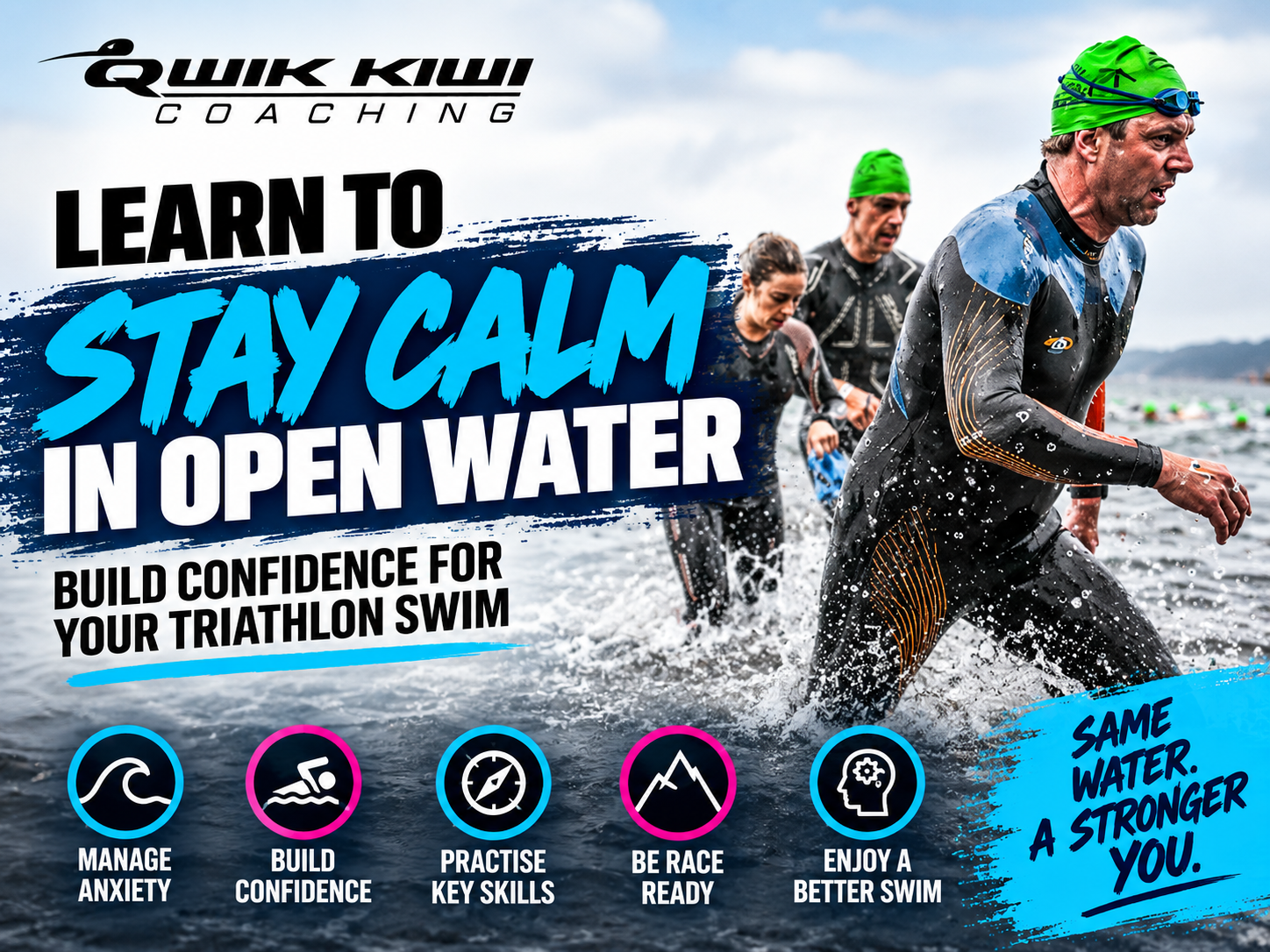
You can swim comfortably for kilometre after kilometre in the pool.
Then you arrive at the start of a triathlon, walk into a lake or ocean, put your face in the water…and suddenly everything feels different.
Your breathing becomes rushed. Your heart rate climbs. The water feels colder than expected. You can’t see the bottom. There are swimmers on either side of you. Someone’s hand hits your foot. You swallow some water.
And that comfortable pool swimmer suddenly feels anything but comfortable.
If you’ve experienced this, you’re far from unusual. Open-water swimming introduces conditions you simply don’t encounter when following a black line between lane ropes. Even experienced triathletes benefit from practising specifically in open water before racing.
The solution isn’t necessarily becoming a faster swimmer.
It’s learning how to stay calm when the water around you becomes uncomfortable or unpredictable.
Pool Fitness Doesn’t Automatically Create Open-Water Confidence
Your pool training is important.
It’s where you can develop your technique, aerobic endurance, threshold fitness and swimming speed in a controlled environment.
But open water removes many of the things you unconsciously rely on.
There’s no black line beneath you.
No wall every 25 or 50 metres.
Visibility may be poor.
There can be waves, currents and wind.
The water may be cold.
Other swimmers can be very close to you.
And during a race, you’re trying to deal with all of that while adrenaline is already pushing your effort higher.
That’s why being physically capable of swimming the race distance doesn’t necessarily mean you’ll immediately feel comfortable doing it in open water.
Open-water confidence is a skill—and skills can be trained.
Understand What’s Happening When You Feel Uncomfortable
One of the first things I want an athlete to understand is that feeling uncomfortable doesn’t automatically mean something is going badly wrong.
Cold water, a tight wetsuit, starting too hard and suddenly putting your face into cold water can all contribute to uncomfortable physical sensations. These can include breathlessness, chest tightness and an increased sense of anxiety.
Then the athlete notices their breathing.
That makes them worry.
The worry makes them tense.
Their stroke becomes shorter and less efficient.
They try to swim harder.
Now they’re using even more energy and struggling even more with their breathing.
A relatively small problem can quickly become a much bigger one.
Recognising this pattern gives you an opportunity to interrupt it.
Don’t Start by Fighting the Water
When athletes become anxious, their natural reaction is often to try harder.
That’s usually the opposite of what I want.
If you’re already breathing too quickly and feeling tense, hammering the next 100 metres isn’t likely to help.
Instead:
Slow things down.
Focus on getting your breathing under control.
Relax your shoulders.
Allow yourself to exhale properly into the water.
Think about taking long, controlled strokes rather than fighting your way forward.
If necessary, change stroke, tread water or float while you regain control.
You’re not trying to win an argument with the water.
You’re trying to restore control over your breathing and your thoughts.
Once you’ve done that, you can begin swimming normally again.
Get Your Face in the Water Before the Race Starts
When race organisers and conditions allow it, getting into the water before the start can be enormously useful.
Don’t wait until the starting horn to discover how cold the water feels.
Get in.
Let some water into your wetsuit.
Put your face under.
Blow bubbles.
Breathe.
Swim easily.
Allow your body to experience the temperature before you’re also dealing with hundreds of people trying to start a race.
Gradual acclimatisation and a gentle warm-up can help reduce some of the uncomfortable sensations athletes experience when suddenly entering colder open water.
You’re making the unfamiliar familiar before the race begins.
Your First Job Is to Breathe
The opening metres of a triathlon swim can be chaotic.
Athletes are excited.
Some start much faster than they should.
There’s splashing everywhere.
You might miss a breath because somebody’s arm or a wave sends water towards your face.
Don’t let one missed breath become a crisis.
Take another stroke.
Get your face back into the water.
Exhale.
Take your next breath when you can.
If necessary, breathe more frequently until you’ve settled.
Then gradually find your normal rhythm.
Your priority during those opening moments isn’t setting a personal best for the first 100 metres.
It’s getting yourself comfortably into the race.
Start Where You’ll Be Comfortable
You don’t have to start in the middle of the washing machine.
If you’re nervous about open water or uncomfortable swimming in close contact with other athletes, position yourself accordingly.
You might start towards the side.
Or towards the back.
Give yourself some space.
Let the more aggressive swimmers charge away if they want to.
Starting slightly farther back could cost you a handful of seconds.
Starting too aggressively, becoming overwhelmed and needing several minutes to recover can cost considerably more.
For newer or uncomfortable open-water swimmers, beginning away from the most competitive part of the group and concentrating on relaxed breathing can make the opening stages more manageable.
Your race doesn’t have to look like anybody else’s race.
Practise Being Bumped
One of the biggest differences between training and racing is physical contact.
Someone touches your feet.
An arm lands across your back.
You bump shoulders.
Another swimmer crosses in front of you.
Most of it isn’t deliberate. It’s simply what happens when a lot of athletes are trying to swim towards the same buoy.
But if you’ve never experienced it before, it can be unsettling.
You can prepare for this.
With suitable training partners, practise swimming close together.
Swim side-by-side.
Practise drafting.
Get accustomed to feet being close to your hands.
Practise going around a buoy with other swimmers nearby.
You don’t need to turn training into aquatic combat.
You’re simply teaching yourself:
“I’ve experienced this before. I know what to do.”
That familiarity can be powerful on race day.
Learn to Sight Without Creating More Stress
Swimming in the right direction also helps you stay calm.
If you’re continually lifting your entire head, desperately searching for the next buoy, you’re disrupting your stroke and potentially increasing your effort.
Instead, practise sighting efficiently.
Lift your eyes briefly above the surface, identify your landmark or buoy, then return your head to your normal swimming position. Depending on conditions, you can then turn normally to breathe. Keeping the head relatively low reduces the disruption to your body position.
And don’t wait until race week to practise.
Sighting can be incorporated into pool training as well as your open-water sessions.
The better you become at navigating, the less mental energy you need to spend wondering:
“Am I going the right way?”
Break the Swim Into Smaller Pieces
Looking across a lake and thinking, I’ve got to swim 1,900 metres through that, can feel intimidating.
So don’t.
Your immediate job might simply be to reach the first buoy.
Then the next buoy.
Then the turn.
Then the next landmark.
Then the swim exit.
Breaking the course into manageable sections keeps your attention on something useful and immediate.
The same approach works when conditions become challenging.
Don’t think about everything that could happen during the remainder of the swim.
Ask:
What do I need to do right now?
Usually the answer is remarkably simple.
Breathe.
Relax.
Stroke.
Sight.
Keep moving forward.
Practise Open Water Before Race Day
This is one of the most important points.
Don’t expect race day to teach you how to become comfortable in open water.
Whenever it is safe and practical, include open-water swimming during your preparation.
You can practise:
- entering the water calmly
- putting your face into colder water
- finding your breathing rhythm
- sighting
- swimming continuously without a wall
- drafting
- swimming near other athletes
- turning around buoys
- dealing with waves and chop
- exiting the water and finding your feet
- swimming in your race wetsuit and equipment
Pool swimming builds fitness and technique, but open-water practice gives you experience with the specific environment you’ll encounter when racing. (USA Triathlon)
The goal isn’t to eliminate every unexpected situation.
It’s to experience enough different situations that unexpected doesn’t automatically mean frightening.
Safety Comes Before Confidence
There’s an important distinction between learning to remain calm and ignoring genuine danger.
Open-water swimming carries risks that aren’t present in a swimming pool.
Whenever possible, swim with other people rather than alone, make yourself visible, understand local conditions, and choose an appropriate location for your ability. A brightly coloured swim buoy can also improve visibility.
If you’re genuinely in difficulty, stop swimming and seek assistance.
Being mentally tough doesn’t mean ignoring a dangerous situation.
Good open-water swimmers learn both how to remain calm and when they need help.
Confidence Comes From Experience
You don’t become confident in open water by repeatedly telling yourself not to be nervous.
You build confidence by collecting successful experiences.
The first might simply be getting into the water and swimming comfortably for five minutes.
Then ten.
Then practising some sighting.
Then swimming farther from shore in an appropriately supervised environment.
Then swimming beside somebody.
Then drafting.
Then practising a race-style start.
Gradually, something that once felt threatening begins to feel normal.
That’s what you’re trying to achieve.
Not fearlessness.
Familiarity.
Calm Is a Performance Skill
Staying calm isn’t only useful for athletes who are nervous about swimming.
It’s a performance skill for every triathlete.
The strongest swimmer can still have goggles knocked sideways.
The experienced athlete can still swallow water.
Conditions can change.
You can miss a buoy.
Someone can unexpectedly swim across you.
What matters is what happens next.
Can you recognise the problem without catastrophising it?
Can you control your breathing?
Can you make a sensible adjustment?
Can you return to your rhythm?
That ability can save far more than a few seconds.
It can transform your entire experience of the swim.
Don’t Fight the Water—Work With It
You don’t need perfect conditions to have a good triathlon swim.
You need the skills and confidence to respond when conditions aren’t perfect.
Practise open water.
Practise sighting.
Practise swimming around other people.
Learn how to regain control of your breathing.
Start races sensibly.
And remember that slowing down briefly to regain control isn’t failure.
Sometimes it’s the smartest thing you can do.
Stay calm. Find your rhythm. Then keep moving forward.
Want More Confidence in Your Triathlon Training?
If open-water swimming is one of the parts of triathlon that makes you nervous—or you’re unsure how to prepare properly for the demands of your next event—I can help you develop a training approach that builds both fitness and race-day confidence.
Book a free, no-obligation 40-minute coaching call, and we can talk about your current training, your upcoming event and where you can make the biggest improvements.
👉 Book your free 40-minute coaching call
Train for the conditions you’ll race in—not just the conditions you’re comfortable in.