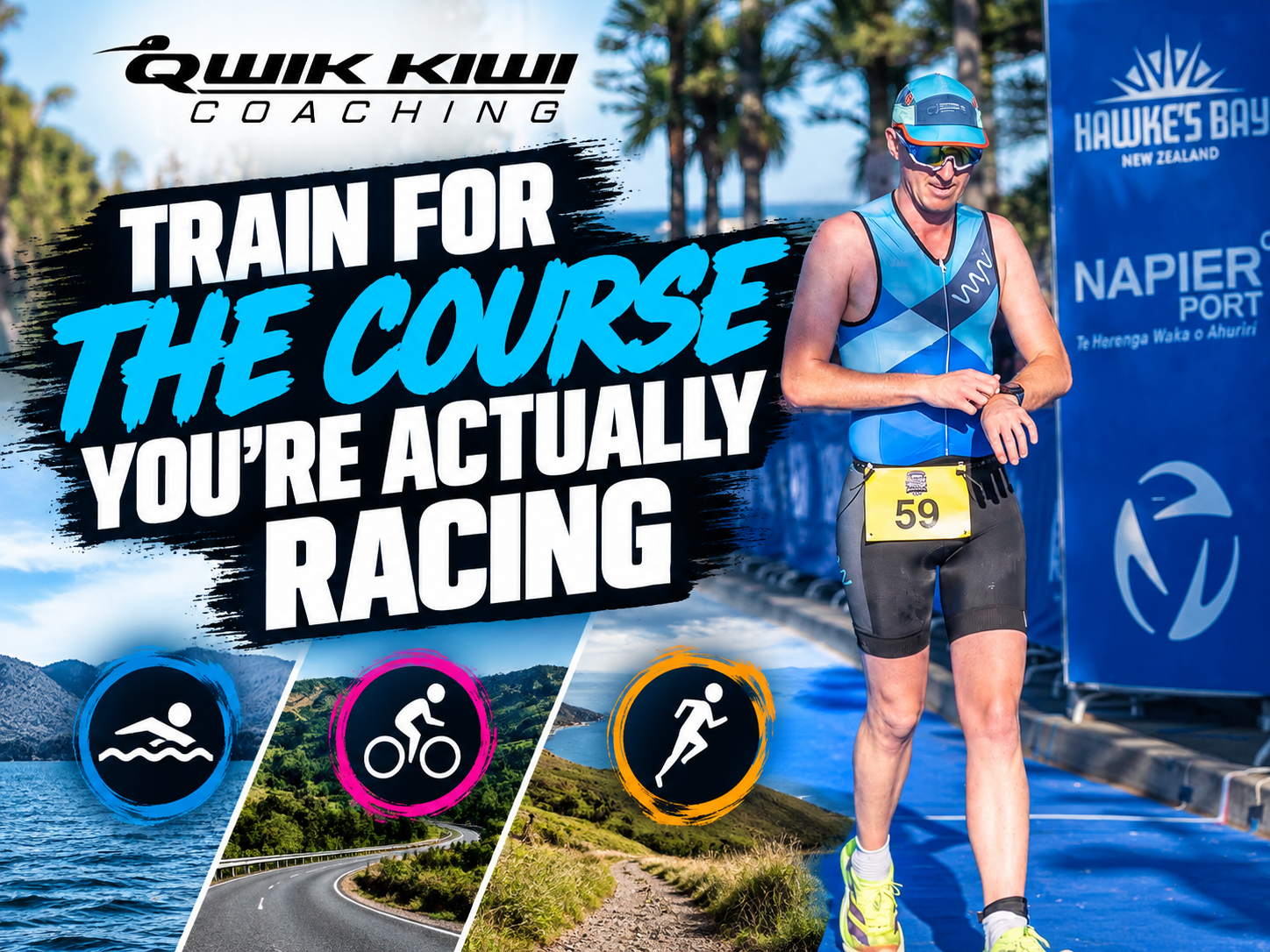
You can be extremely fit and still arrive at a triathlon poorly prepared.
Not because you haven’t trained enough.
Not because you haven’t worked hard.
But because you’ve trained for a different race from the one you’re actually going to do.
If your race has a hilly bike course, but nearly all your riding has been flat, that’s a problem.
If you’re racing an exposed, windy course but you’ve spent months avoiding the wind, you’re leaving an important part of your preparation to chance.
If the run is rolling and you’ve done almost everything on flat paths, your legs are going to discover something new on race day.
And if your event involves an open-water swim but almost all your swimming has been between lane ropes, race morning can feel very different from training.
One of the fundamental principles of training is specificity: as you move closer to your goal event, your training should increasingly prepare you for the actual demands you’ll encounter on race day. TrainingPeaks
Don’t train for an imaginary triathlon.
Train for the course you’re actually racing.
Start by Knowing Your Course
Before you can prepare specifically for an event, you need to know what you’re preparing for.
Don’t simply look at the distances and think:
1.5 km swim. 40 km bike. 10 km run.
Two Olympic-distance triathlons can have identical distances and be completely different races.
Look at the course maps.
Study the elevation profile.
Find out what the swim is likely to be like.
Look at the road surface.
Identify major climbs and descents.
Find out whether the bike course is technical or straightforward.
Look at the run surface and terrain.
Consider typical weather conditions.
Find out where the aid stations are.
If previous athletes have raced the event, learn from their experiences too.
Knowing details such as elevation, expected weather and opportunities to take nutrition can help you make better decisions about both training and race execution. TrainingPeaks
You’re effectively conducting a needs analysis of your race.
Once you understand what the event is asking you to do, you can start preparing your body to do it.
A Hilly Bike Course Requires More Than Fitness
Suppose your race contains several significant climbs.
You could arrive with an excellent FTP and strong aerobic fitness, but if you’ve spent nearly every training ride cruising along flat roads at a steady cadence, climbing may still expose you.
Hills change the demands.
Your cadence may drop.
Torque increases.
Your position changes.
Power fluctuates.
You need to manage your effort on the climb rather than becoming carried away and riding well above what you can sustain.
Then there’s the descent.
Can you descend confidently?
Can you corner?
Can you select your gears appropriately?
Can you maintain speed without constantly braking?
These aren’t things you want to discover on race morning.
If you’re preparing for a hilly triathlon, include hills in your training.
You don’t necessarily need an exact replica of the course outside your front door. You can reproduce its demands with suitable routes, intervals and indoor sessions.
But your body should know what climbing feels like before race day.
Don’t Forget the Downhills
Athletes naturally focus on climbing when preparing for a hilly event.
But what goes up usually comes back down.
A technical descent can expose athletes who are physically strong but uncomfortable handling their bike.
Practise descending safely.
Learn where and when to brake.
Look through the corner rather than directly in front of your wheel.
Develop confidence at speed progressively rather than suddenly trying to become an expert descender the week before your race.
The same applies to running.
Running downhill isn’t simply free speed.
Your muscles have to absorb the load of every step, and repeated descents can become demanding as fatigue accumulates.
Course-specific preparation should therefore consider both the climbs and the descents.
Flat Courses Have Their Own Demands
A flat course isn’t necessarily an easy course.
In fact, some athletes find relentlessly flat bike courses surprisingly difficult because there are fewer natural opportunities to change position or briefly ease the pressure on the pedals.
You may need to hold a consistent aerodynamic position and maintain steady power for a long time.
That requires specific preparation too.
If you’re racing a long, flat bike course, spend time developing your ability to ride steadily.
Practise maintaining your aero position.
Develop your cadence.
Learn to produce controlled power without constantly surging.
Practise fuelling while remaining aerodynamic.
The training required for a flat, sustained bike course can look quite different from preparation for a mountainous event. Race-specific training should progressively reflect the intensity and duration you’ll need to sustain on race day. TrainingPeaks
Prepare for the Run You’ll Actually Encounter
The same principle applies once you leave T2.
Is the run flat?
Rolling?
Hilly?
On sealed roads?
Trails?
Grass?
Does it contain repeated short climbs or one significant hill?
If your race is on pavement but almost every run you complete is on soft trails, your cardiovascular fitness might be excellent while your legs remain underprepared for the repetitive loading they’ll experience on race day.
Conversely, if you’re racing off-road, constantly running smooth pavement doesn’t develop the same stability, strength or confidence required on uneven terrain.
As your event approaches, at least some of your important sessions should increasingly resemble the terrain and surface you’ll race on. Preparing for the specific run profile and surface helps condition your legs for what they’ll experience during the event. Triathlete
Again, this doesn’t mean every run needs to mimic your race.
It means the course should influence your preparation.
Prepare for the Swim Environment
Swimming 1,500 metres is one thing.
Swimming 1,500 metres in open water can be another.
Is your event in a lake?
River?
Ocean?
Is it likely to be calm?
Choppy?
Cold?
Will you probably wear a wetsuit?
Is the swim a beach start, deep-water start or rolling start?
Where will the sun be?
How easy are the turn buoys to see?
You won’t necessarily be able to reproduce every detail, but you can practise the skills the environment requires.
If it’s an open-water race, include open-water swimming when it’s safe and practical.
Practise sighting.
Practise swimming continuously without relying on the wall.
Practise in your wetsuit.
Practise swimming close to other people.
Even when open water isn’t available, some race-specific skills can be incorporated into pool sessions—for example, swimming without pushing off the wall to reproduce the uninterrupted nature of open-water swimming. Triathlete
The pool builds your swimming fitness.
Specific preparation teaches you how to use that fitness on race day.
Wind Is Part of the Course Too
Athletes often look at elevation but forget about wind.
An exposed bike course can feel completely different when the wind arrives.
You may have a fast tailwind in one direction and then spend what feels like forever grinding into a headwind on the way back.
Crosswinds can make bike handling more challenging, particularly with deeper wheels.
Wind can also tempt you into pacing mistakes.
You see your speed dropping into a headwind and instinctively push harder because the number on your computer doesn’t look good.
Then you turn around, see a much higher speed and push again.
Instead, learn to manage your effort, not chase a predetermined speed.
If your event is likely to be windy, don’t avoid every windy training day.
Used sensibly and safely, some of those unpleasant rides can be valuable preparation.
Heat Changes the Race
You should also consider the likely environmental conditions.
If you’re travelling from a cool climate to race somewhere hot and humid, the environment itself becomes part of the challenge.
Heat can influence pacing, hydration, fuelling and perceived exertion. Environmental specificity is therefore another component of race preparation, particularly when the expected conditions differ substantially from where you normally train. TrainingPeaks
You can’t control race-day weather.
But you can avoid being completely surprised by predictable conditions.
Depending on your event, that might mean preparing for:
- heat
- humidity
- cold
- wind
- rain
- altitude
The objective isn’t to become obsessed with the weather forecast months in advance.
It’s to recognise that your race doesn’t happen in a laboratory.
Practise Your Race-Day Pacing
Course specificity isn’t only about terrain.
It’s also about effort.
If you’re preparing for a long-course triathlon, you need to become comfortable sustaining an appropriate race effort for increasingly race-relevant durations.
You can improve your threshold enormously with short intervals, but that doesn’t automatically teach you how to sustain controlled race intensity for several hours.
As the event approaches, appropriately designed sessions should increasingly develop the ability to execute your race.
That might involve:
- extended race-effort intervals on the bike
- race-pace running
- race-specific bricks
- sustained climbing
- practising pacing over undulating terrain
- race simulations
Simulation sessions can combine elements such as terrain, duration, intensity, fuelling and hydration to test how well prepared you are for the actual event. Triathlete
You’re not trying to race your race before race day.
You’re removing unknowns.
Practise Your Fuelling on Similar Terrain
Fuelling can also be course-specific.
Imagine you’ve planned to eat every 20–30 minutes during the bike.
That might sound straightforward while sitting at your kitchen table.
But what happens if the point when you’re supposed to eat occurs halfway down a technical descent?
Or while climbing?
Or through a section where you need both hands securely controlling the bike?
Suddenly your beautifully calculated nutrition plan doesn’t work quite as neatly.
Look at the course and identify where you’ll have good opportunities to eat and drink.
Then practise.
If your race has long climbs, learn whether you prefer to fuel before them, during them or immediately afterwards.
If the course is technical, know where the safer opportunities are.
If the run has aid stations at specific intervals, think about how that fits your plan.
Your fuelling strategy should work on the course, not just on paper.
Use Brick Sessions to Rehearse the Course
Brick sessions can become even more valuable when you add race specificity.
If your event has a hilly bike followed by a flat run, occasionally reproduce that combination.
If the final kilometres of the bike contain a long climb before T2, practise running after sustained climbing.
If the bike is flat and fast, practise transitioning to running after spending extended time in your aero position.
You’re teaching your body what the transition will feel like in your race.
That knowledge builds confidence.
When you reach T2 on race day and your legs feel strange, your response becomes:
I’ve felt this before.
That’s far more useful than:
What on earth is happening to my legs?
Specific Doesn’t Mean Identical
There’s an important distinction here.
Not every training session needs to look like your race.
In fact, it shouldn’t.
You still need easy aerobic sessions.
You may need Level III tempo work.
Level IV threshold training.
Level V VO₂ Max sessions.
Technique work.
Strength training.
Recovery.
General fitness development gives you the physical capacity you need.
Specific training then teaches you how to apply that fitness to your event.
A well-periodised programme should therefore become increasingly specific as race day approaches rather than trying to replicate the race from the beginning of your preparation. TrainingPeaks
Early in your preparation, the emphasis may be broader.
Closer to race day, specificity becomes increasingly important.
You Don’t Need the Exact Course to Train Specifically
One common problem is geography.
Perhaps your race is mountainous but you live somewhere flat.
Maybe you’re preparing for a hot race during a New Zealand winter.
Perhaps your ocean swim is months away and you only have access to a pool.
That doesn’t mean you can’t prepare specifically.
You simply need to identify the demand and find another way to reproduce it.
No hills?
Use low-cadence resistance work or sustained climbing intervals on an indoor trainer.
No open water?
Practise sighting, continuous swimming and appropriate race-start efforts in the pool.
No technical roads nearby?
Find a safe location where you can deliberately work on cornering and bike handling.
Preparing for heat?
Use an appropriate heat-acclimation strategy rather than hoping your body magically copes on race day.
Think about the adaptation you’re trying to create rather than believing you must reproduce every metre of the course.
Do Your Homework Before Race Day
One of the easiest performance gains available to a triathlete doesn’t require another training session.
Study your race.
Know where the climbs are.
Know where the descents are.
Know where you’ll fuel.
Know where the aid stations are.
Know which sections require patience.
Know where you’ll need to concentrate.
Know what the final kilometres of the bike look like.
Know what you’re going to encounter when you leave T2.
Understanding the race environment early allows you to identify gaps between your current skills and what the event will demand, then address those gaps during training. TrainingPeaks
The goal isn’t to remove every surprise.
Race day will always provide a few.
The goal is to avoid being surprised by things you could easily have prepared for.
Train for Your Race
Fitness matters enormously.
But fitness needs context.
A strong swimmer still needs to deal with open water.
A powerful cyclist still needs to climb, descend, corner and pace appropriately.
A fast runner still needs to cope with the terrain they’ll encounter after swimming and cycling.
The closer you get to your goal race, the more you should be asking:
Does my training prepare me for what this course will actually demand?
If the answer is no, don’t simply train harder.
Train more specifically.
Study the course.
Understand its demands.
Practise the skills.
Rehearse your pacing.
Test your fuelling.
Prepare for the environment.
Don’t train for an imaginary triathlon. Train for the course you’re actually racing.
Want to Make Your Training More Race-Specific?
If you’ve entered a triathlon but aren’t sure how to adapt your training to the course, terrain and demands of your event, I can help.
Book a free, no-obligation 40-minute coaching call, and we can talk about your upcoming race, your current training and the areas that could make the biggest difference to your preparation.
👉 Book your free 40-minute coaching call
Train for the demands you’ll face on race day—not the race you wish you were racing.