Strength on the bike isn’t always developed by lifting heavier weights or riding steeper hills. Sometimes, you can create a very specific muscular-strength stimulus simply by changing how you produce your power.
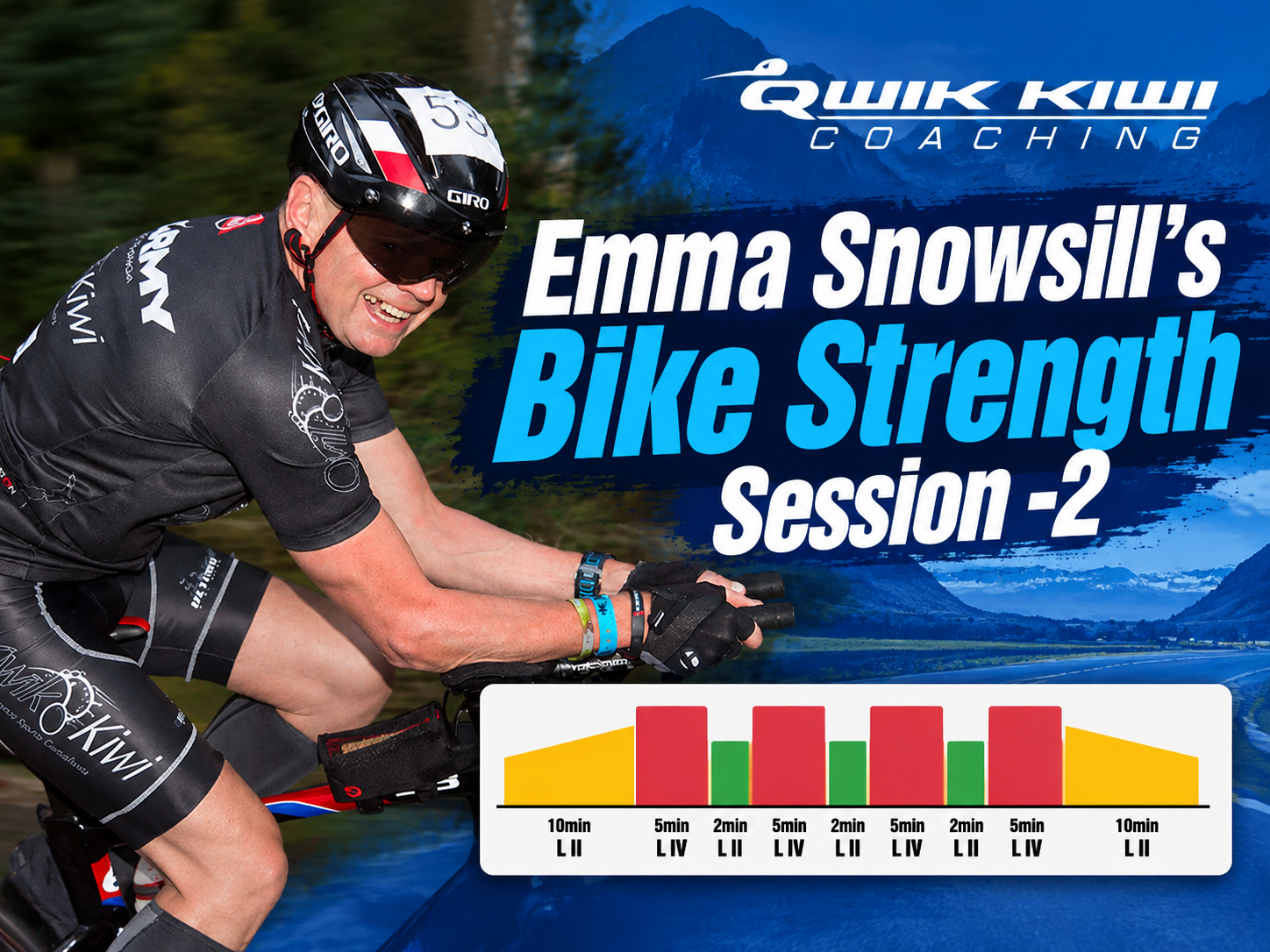
Emma Snowsill’s Bike Strength Session -2 uses four five-minute Level IV efforts ridden in a deliberately bigger gear at 65–75 rpm. Rather than relying on a naturally high cadence to generate your power, the lower cadence increases the force required with each pedal stroke.
The result is a demanding 58-minute cycling-specific strength session that combines threshold intensity with sustained low-cadence riding.
This isn’t about grinding the biggest gear you can turn. The goal is controlled power, deliberate pressure through the pedals and good technique from the beginning of the first repetition to the end of the fourth.
Today’s Goal
Today we’re developing cycling-specific muscular strength.
You’ll complete four five-minute efforts at Level IV while maintaining a cadence of 65–75 rpm. The combination of threshold intensity and deliberately lower cadence means you’ll need to produce considerably more force with each pedal stroke than you normally would at 90–100 rpm.
The challenge is to maintain that combination without allowing your technique to deteriorate as fatigue accumulates.
Think:
Big gear. Low cadence. Controlled power.
Where This Session Came From
The inspiration for this workout comes from a Beginner’s Guide to Triathlon published by Triathlon Plus, which was included with Issue 42 in the summer of 2012.
The guide featured advice from Emma Snowsill, one of the outstanding triathletes of her generation. Snowsill was a three-time World Champion and won both Olympic and Commonwealth Games gold medals in triathlon.
This is my -2 variation of the bike-strength concept.
If you want the full version of the session, you can find that here:
The shorter -2 version retains the central training stimulus while reducing the overall workload.
Today’s Workout
Warm-Up — 10min
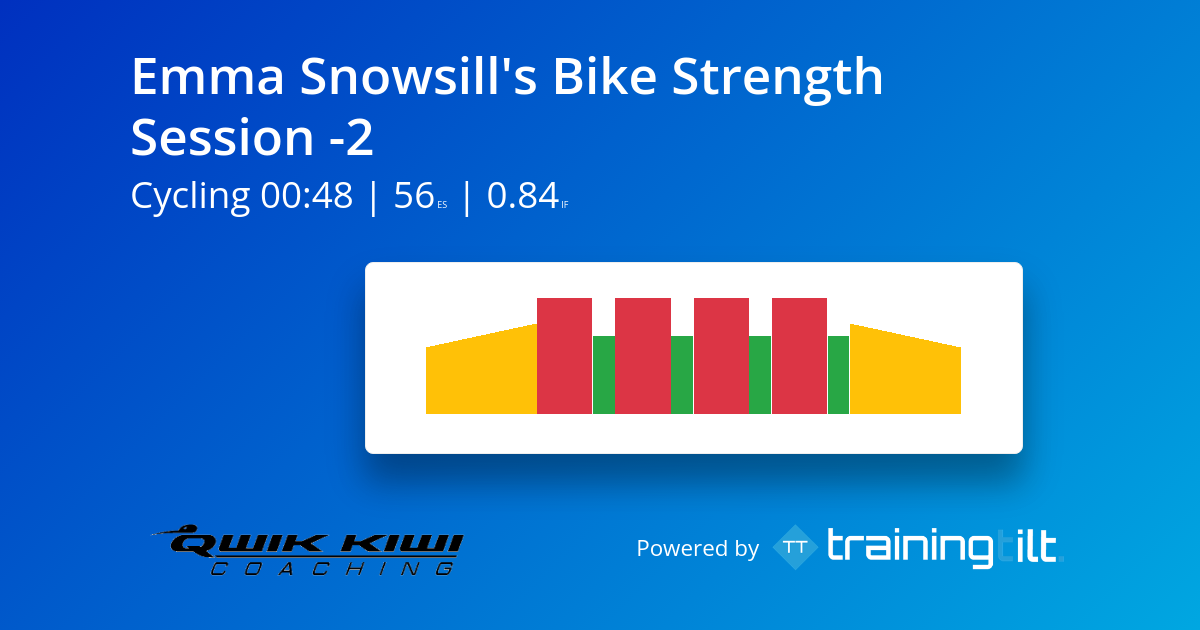
- 10min Level II
Keep the intensity comfortable and controlled while gradually preparing yourself for the heavier muscular loading to come.
Main Set — 4x
- 5min Big Gear, Level IV @ 65–75 rpm
- 2min Level II Rest Interval
Complete the two-minute Level II recovery after every repetition, including the fourth.
Cool-Down — 10min
- 10min Level II
Total riding time: 58 minutes
Finish with 10 minutes of stretching to assist your recovery.
Why You’re Doing This Session
Most of the time, I encourage cyclists to develop the ability to pedal smoothly at approximately 90–100 rpm.
This workout deliberately takes you away from that.
When you maintain the same power at a lower cadence, you need to produce more torque with each pedal stroke. Instead of generating your power through lots of relatively quick pedal strokes, each revolution requires greater muscular force.
That’s what gives this session its cycling-specific strength emphasis.
Importantly, though, low cadence doesn’t mean maximum resistance.
We’re not trying to find the biggest gear you can somehow force around.
The target remains Level IV at 65–75 rpm.
The gear is simply the tool you use to achieve the combination of power and cadence we want.
Why Level IV?
There’s an important balance here.
If the intensity were too easy, you could ride at 65–75 rpm without creating enough muscular demand.
Push the intensity excessively high and the workout can quickly become something quite different, with technique deteriorating as you fight against the resistance.
Level IV provides sustained, purposeful work while allowing you to concentrate on producing strong, controlled pedal strokes for the full five minutes.
And you need to do it four times.
The first repetition may feel relatively manageable.
The fourth is where you discover whether you selected the right gear and controlled the earlier efforts properly.
What You Should Focus On
Intensity comes first. Your primary goal during each five-minute repetition is to ride at the prescribed Level IV intensity.
Once you have established the correct intensity, the next requirement is to produce that power while maintaining the deliberately lower 65–75 rpm cadence. That combination—Level IV power at a lower cadence—is what creates the cycling-specific muscular-strength stimulus we’re looking for.
Choose a gear that allows you to achieve both targets. If the gear is so big that your power drops below Level IV or your cadence falls beneath 65 rpm, you’ve gone too heavy. Equally, don’t allow the cadence to gradually creep upwards simply because your legs are becoming fatigued.
Your upper body should remain controlled rather than rocking from side to side as you try to force the pedals around. Keep your shoulders, arms and hands relaxed, maintain a stable position on the bike, and concentrate on applying pressure smoothly throughout each pedal stroke.
You should feel the increased muscular demand in your legs, particularly as the repetitions accumulate.
But you shouldn’t feel as though you’re wrestling with the bike.
The goal is Level IV power first, then maintain that power with a controlled 65–75 rpm cadence and good technique.
Common Mistakes to Avoid
Choosing too big a gear.
Big Gear doesn’t mean the biggest gear available. If you’re struggling to maintain smooth technique or your cadence is dropping below the target range, reduce the resistance.
Letting cadence creep upwards.
It’s natural to want to spin faster as your legs fatigue. Stay focused on the 65–75 rpm target.
Riding above Level IV.
More power isn’t automatically better. The training stimulus comes from combining the correct intensity with the lower cadence.
Making the first repetition your best.
You’ve got four five-minute efforts. Control the first so you can maintain quality through the fourth.
Turning the recoveries into extra training.
The two minutes at Level II give your legs an opportunity to recover before the next strength effort. Use them.
Coach Ray’s Tips
1. Choose the gear carefully
You want enough resistance that 65–75 rpm produces Level IV power, but not so much that every pedal stroke becomes a battle.
2. Settle before judging the resistance
Give yourself a few seconds at the beginning of each repetition to establish your cadence and power before making small adjustments.
3. Keep your pedal stroke smooth
Heavy doesn’t need to mean ugly.
Aim to maintain controlled pressure through the pedals rather than stomping down on them.
4. Watch your upper body
Excessive rocking or pulling against the handlebars can be a sign that the resistance is too high or fatigue is affecting your technique.
5. Make the fourth repetition look like the first
Power, cadence and technique should remain as consistent as possible across all four efforts.
That repeatability is a much better sign of good execution than producing an enormous first repetition and progressively fading.
How This Differs From Emma Snowsill’s Bike Strength Session -3
If you’ve completed my Emma Snowsill’s Bike Strength Session -3, you’ll recognise the same basic training concept.
The -3 version uses three five-minute Big Gear Level IV repetitions, whereas this -2 version increases that to four.
That gives you 20 minutes of low-cadence Level IV work, compared with 15 minutes in the -3 version.
The extra repetition might not sound like a dramatic increase, but it represents 33% more work in the main strength set.
That makes pacing and gear selection increasingly important.
If three repetitions already leave your technique deteriorating badly, adding a fourth isn’t necessarily progress. Build the ability to execute the work well before adding more of it.
Coach Ray Rode This Session
I’ve completed Emma Snowsill’s Bike Strength Session -2 myself, allowing me to look at how the workout actually behaves rather than relying solely on the written prescription.

When reviewing this workout, power is only part of the picture.
I’d particularly look at whether cadence remained within 65–75 rpm across all four repetitions, whether power remained consistent at Level IV, and whether there was any obvious deterioration during the later efforts.
Heart rate can also be interesting. Because the muscular demand is different from riding the same power at a higher cadence, your perceived effort and heart-rate response may not always behave exactly as you expect.
Most importantly, I want to see whether I could still produce the required power with good technique during the final five-minute repetition.
See My Complete Ride on Strava
Ride It With Me on Velocity
Ride This Workout on Velocity
Want to try Emma Snowsill’s Bike Strength Session -2 yourself?
You can ride the complete workout with me on Velocity, where I’ll coach you through the four Level IV Big Gear efforts and help you focus on the two things that matter most: getting the intensity right and then maintaining that power at 65–75 rpm.
The workout is already available on demand, so you can ride it whenever it suits your training schedule.
🚴 Ride Emma Snowsill’s Bike Strength Session -2 on Velocity:
Not using Velocity yet? You can also start a 14-day free trial and access this workout along with the other coach-led sessions in the Qwik Kiwi library.
Final Thoughts
Emma Snowsill’s Bike Strength Session -2 is straightforward on paper: four five-minute Level IV efforts in a big gear.
But the value of the workout comes from how you execute them.
Don’t chase the biggest gear.
Don’t chase the highest power.
Find the resistance that allows you to produce Level IV power at 65–75 rpm, then concentrate on maintaining smooth, controlled technique as fatigue builds.
Twenty minutes of low-cadence threshold work is plenty when every repetition is performed properly.
Choose the right gear. Control the cadence. Produce the power.
If you know another cyclist or triathlete who could benefit from developing more cycling-specific strength, share this session with them so they can give it a go too.