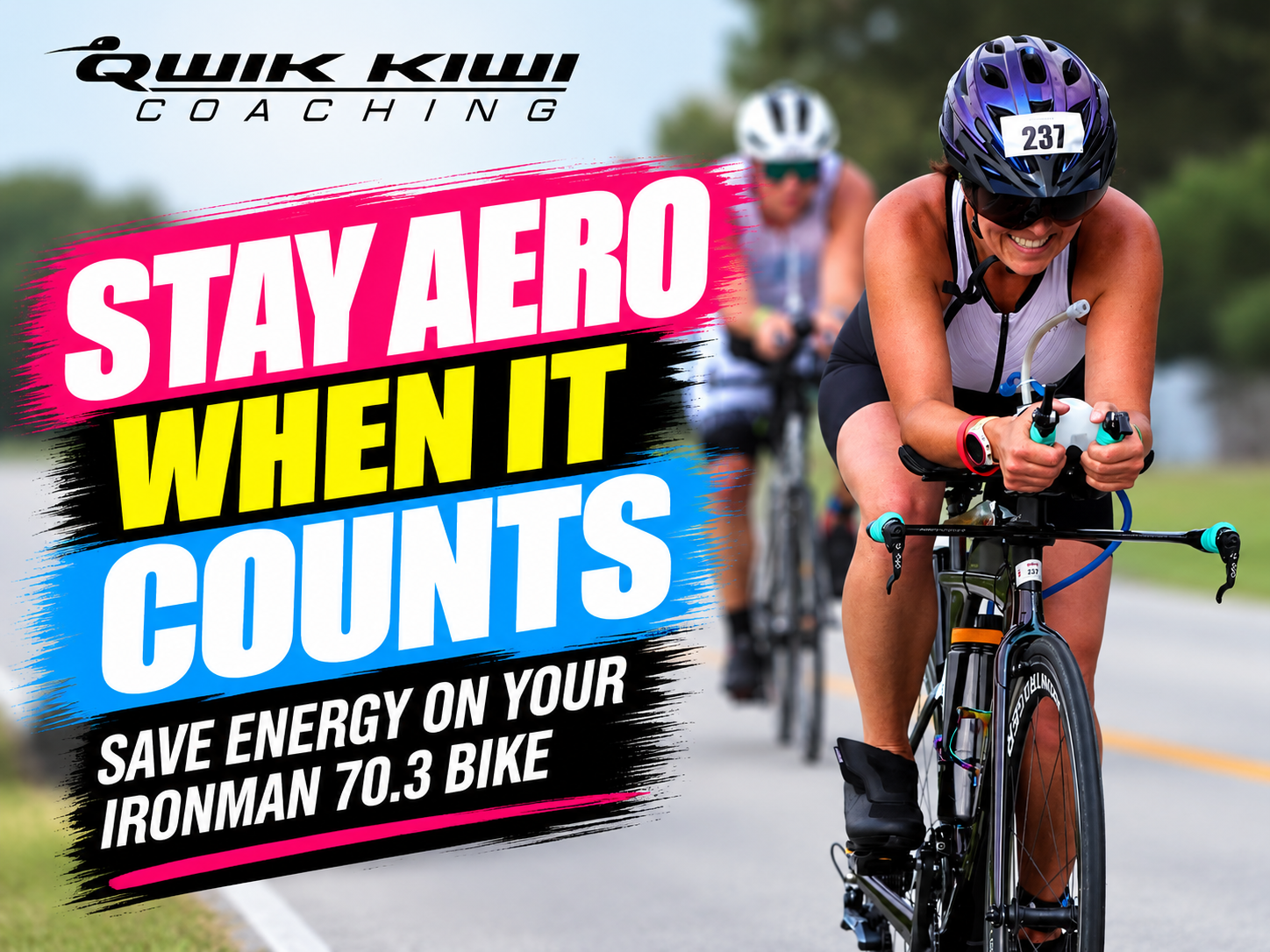
You’ve invested in a triathlon bike.
You’ve got aero bars. Maybe you’ve spent time getting your bike fit dialled in. Perhaps you’ve bought an aero helmet, deeper wheels or other equipment designed to make you faster.
Then race day arrives.
You settle into your aero position…and 10 minutes later you’re sitting upright.
Then you sit up again to drink.
Then because there’s a headwind.
Then because your neck is getting uncomfortable.
Before long, you’re spending a surprisingly large portion of your 90km Ironman 70.3 bike leg sitting up.
Having an aerodynamic position only helps if you can actually use it.
That doesn’t mean staying glued to your aero bars regardless of the terrain or conditions. It means learning when aerodynamics matter, developing a position you can sustain, and staying aero when it counts.
Your Body Is a Big Part of the Aero Equation
When athletes think about cycling aerodynamics, attention often goes straight to equipment.
Aero wheels. Helmets. Bottles. Frames. Clothing.
All of those can matter.
But you are a substantial part of the aerodynamic equation.
Research examining cycling posture has consistently shown that rider position can have a major influence on aerodynamic drag. One study of competitive cyclists and triathletes found meaningful changes in frontal area and drag simply by changing aero-bar position. PubMed
That gives you an important question to ask before chasing the next aerodynamic upgrade:
Can I comfortably maintain my aero position when it matters?
If not, improving that ability may be more useful than buying another piece of equipment.
Aero Doesn’t Mean Getting as Low as Possible
There’s a trap here.
If a lower position can reduce frontal area, surely lower must always be better?
Not necessarily.
Your fastest Ironman 70.3 position isn’t simply the one that produces the lowest aerodynamic drag in isolation.
It needs to balance:
- Aerodynamics
- Sustainable power production
- Comfort
- Breathing
- Visibility
- Bike control
- Your ability to fuel and hydrate
- Your ability to maintain the position for long periods
Research into time-trial positions highlights this trade-off between aerodynamic drag, power production and metabolic cost. There is also substantial individual variation in what position works best. DOI
You aren’t trying to win a photograph of the most aggressive aero position.
You’re trying to complete 90km efficiently and then run 21.1km.
What Does “Stay Aero When It Counts” Actually Mean?
It does not mean never leaving your aero bars.
There are plenty of good reasons to sit up.
You might need greater control through a technical corner. You may be braking, navigating a tricky descent, moving through congestion, taking nutrition or dealing with road conditions.
Safety comes first.
There may also be slower climbs where the aerodynamic benefit of remaining tucked down becomes less important.
But on a long, open, relatively fast stretch of road, ask yourself:
Why am I sitting up?
If you have a good reason, stay up.
If the answer is simply habit, discomfort you could have trained for, or because you weren’t thinking about it, settle back into your race position.
Aerodynamics Matter More as Speed Increases
The faster you’re travelling through the air, the more significant aerodynamic resistance becomes.
That means you don’t necessarily need to obsess about staying aero while grinding slowly up a steep climb.
But when you’re travelling quickly across flat or rolling terrain, or riding down a safe and straightforward section where you can maintain good control, your position can become increasingly important.
This is why the idea isn’t:
Stay aero everywhere.
It’s:
Stay aero when it counts.
Don’t Sit Up and Fight the Headwind
A headwind can play games with your head.
You look at your bike computer and your speed has dropped.
The natural reaction can be:
I need to push harder.
You sit up, grip the bars and start fighting the wind.
Now you’ve potentially created two problems.
You’re riding harder than planned and presenting more frontal area to the wind.
Instead, stay disciplined.
Maintain the appropriate race effort. Stay aero where conditions allow. Accept that your speed may be lower.
You don’t need to win an argument with the speed displayed on your bike computer.
Race your effort, not the headwind.
“Free Speed” Isn’t Really Free
You’ll often hear aerodynamics described as free speed.
There’s some truth in that. If you can reduce drag while producing the same sustainable power, you may travel faster without needing to generate additional watts.
But there’s an important qualification.
You need to be capable of holding the position.
That requires training.
Your neck and shoulders need to tolerate it. Your hips need to function effectively in the position. You need enough stability to remain comfortable. You need to maintain your position without constantly shifting around.
You also need to see where you’re going, concentrate, handle your bike safely, drink and fuel.
So perhaps a better way to describe aero speed is:
You don’t buy it on race morning. You earn it in training.
Train in the Position You Plan to Race In
This is where many triathletes leave performance on the table.
They own a triathlon bike but complete much of their training sitting upright.
That can be particularly easy when training indoors.
You’re watching a screen. There’s no aerodynamic penalty for sitting upright. Your hands gradually migrate away from the aero bars.
You might complete a fantastic physiological workout.
But you’ve missed an opportunity to develop your ability to produce that effort in your race position.
As your Ironman 70.3 approaches, appropriate race-specific bike sessions should include meaningful time in the position you intend to use on race day.
That doesn’t mean every minute of every ride needs to be aero.
But if you plan to spend a substantial amount of your 90km race in the aero bars, you should have spent substantial time there during training.
Practise Fuelling While Aero
Nutrition is another common reason athletes spend unnecessary time sitting upright.
You reach for your bottle.
Sit up.
Drink.
Put it away.
Then remain upright for another couple of minutes.
Later, you repeat the process with a gel.
Over 90km, those little interruptions can accumulate.
Practise accessing your race nutrition during training.
Can you safely reach your bottles?
Can you drink comfortably?
Can you access your gels or other nutrition without turning it into a prolonged interruption?
The goal isn’t to remain aero while doing something unsafe.
It’s to make your fuelling controlled, familiar and efficient.
Come out of your aero position when necessary.
Fuel.
Then, when conditions allow, return to it.
Comfort Matters
If you’re coming out of your aero position every five minutes because your neck, back, shoulders or hips are uncomfortable, that’s useful information.
Don’t simply tell yourself you’ll tough it out on race day.
Work out why.
It could be that you haven’t spent enough time adapting to the position.
It could be a mobility or strength issue.
It could also be that your position simply isn’t appropriate for you.
An extremely aggressive position that you can hold for 10 minutes may be less useful in an Ironman 70.3 than a slightly less aggressive position you can comfortably maintain for much of the race.
The best position on paper isn’t necessarily the best position once you’re several hours into an endurance event.
Remember: You Still Need to Run
This is perhaps the most important part.
Your bike leg doesn’t finish at 90km.
It finishes when you’ve completed the 21.1km run that follows it.
The objective isn’t to use improved aerodynamics as an excuse to push harder.
If your position allows you to travel slightly faster at the same sustainable effort, take the efficiency.
Don’t immediately spend it by increasing your power until you’re back at your previous speed-to-effort relationship.
The goal is to arrive at T2 having ridden quickly and efficiently.
Aerodynamics should help you conserve resources, not provide another reason to over-bike the course.
Don’t Make Major Changes During Race Week
Reading about aerodynamics seven days before your race doesn’t mean you should immediately lower your front end dramatically.
Your body needs time to adapt.
Any meaningful position change should be made early enough that you can train with it, assess comfort, check your power production, practise fuelling and then run off the bike.
If you’re considering substantial changes, working with a competent triathlon bike fitter can be worthwhile.
Race week isn’t the time for experimentation.
Your position should already feel familiar.
Ask Yourself One Question
Here’s something simple you can start doing in training.
Every time you come out of your aero position, ask:
Why?
Sometimes you’ll have an immediate answer.
Corner.
Braking.
Climb.
Traffic.
Nutrition.
Safety.
Perfect.
But occasionally the answer will be:
No particular reason.
That’s the habit you’re trying to identify.
You don’t need to obsess over every second.
Just become more conscious of when you’re giving away an aerodynamic position that you’ve already spent time and money developing.
Stay Aero When It Counts
You don’t need to spend your entire Ironman 70.3 bike leg locked into an aggressive aero position.
You need a position that works for you.
Develop it.
Train it.
Get comfortable in it.
Practise producing your race effort in it.
Practise fuelling from it.
Learn when to come out of it.
And when you’re on that long, open stretch of road with no good reason to be sitting upright?
Stay aero when it counts.
Ride efficiently.
Save your energy.
And give yourself the best opportunity to arrive at T2 ready to run.
Want Help Preparing for Your Ironman 70.3?
If you’re preparing for an Ironman 70.3 and want personalised guidance with your training, bike pacing or overall race execution, you can book a free, no-obligation 40-minute coaching consultation with me.
We can discuss your goals, where your training is currently at, and practical ways to improve your preparation and race-day execution.
Book your free 40-minute coaching consultation with Coach Ray
Train smart. Race efficiently. Run strong.