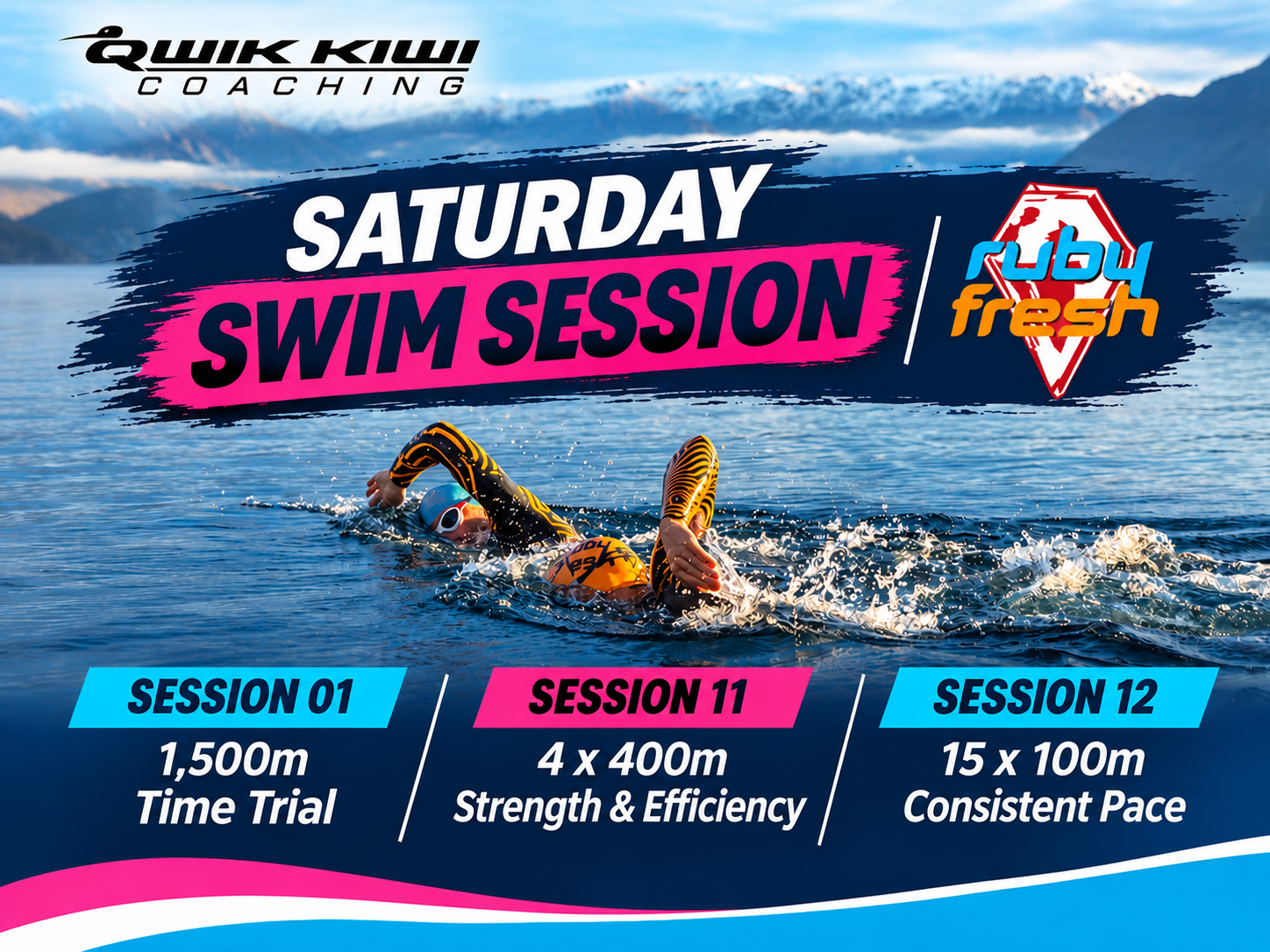
Three Qwik Kiwi Performance Swim workouts to improve your triathlon swimming
Are you getting faster in the water, or simply swimming more metres?
It’s an important question for any triathlete. Swimming fitness is about more than accumulating distance. You also need to understand your current ability, develop an efficient freestyle stroke, and learn to maintain your swimming speed as fatigue builds.
This week’s Saturday Swim Session brings together three workouts from the Qwik Kiwi Performance Swim series, each targeting a different aspect of swimming performance.
- Workout One – Qwik Kiwi Performance Swim Session 01: 1,500m time trial to assess your current swimming performance.
- Workout Two – Qwik Kiwi Performance Swim Session 11: 4 × 400m session using paddles and a pull buoy to explore swimming strength, technique and efficiency.
- Workout Three – Qwik Kiwi Performance Swim Session 12: 15 × 100m interval session to develop consistent pacing and repeatable swimming performance.
Together, these sessions provide a useful combination of testing, strength-focused swimming and endurance development.
Let’s dive into the workouts.
Workout One: Qwik Kiwi Performance Swim Session 01 – 1,500m Time Trial 🏊♂️⏱️
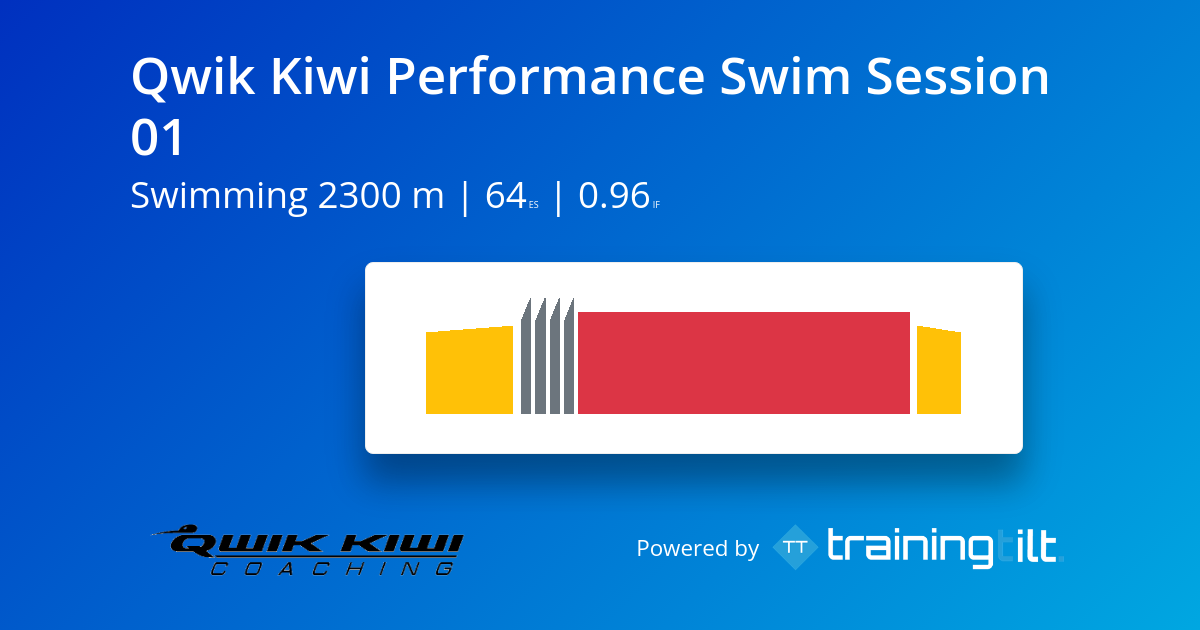
Today’s Goal: Establish a reliable benchmark of your current swimming fitness and practise pacing a sustained effort.
Today’s Workout
- 400m Warm-Up (WU)
- 4x 50m Pickups, 15sec Rest Interval (RI)
- 1,500m Time Trial (TT)
- 200m Cool-Down (CD)
How to Complete This Workout
400m Warm-Up
Begin with 400m of comfortable swimming. This is an opportunity to gradually increase your heart rate, loosen your shoulders and prepare your body for the harder swimming ahead.
You don’t need to swim the entire 400m continuously. Feel free to change strokes, pause between lengths or include some gentle stretching.
Start easily and gradually settle into a smooth freestyle rhythm.
4x 50m Pickups — 15sec RI
The pickups prepare you for the faster swimming required during the time trial.
A pickup is a progressive acceleration. Rather than swimming the entire 50m at one speed, you gradually increase your pace throughout the repetition.
For each 50m:
- Begin with a few strokes at an easy, relaxed pace.
- Gradually increase your stroke rate and swimming speed.
- Continue accelerating through the middle of the repetition.
- Finish the final few metres with a strong, fast sprint into the wall.
The important point is that you’re building your speed throughout the 50m, rather than starting flat out.
Take 15 seconds of rest after each repetition.
Repeat this four times.
Although the final metres should be fast, maintain good swimming technique. Avoid simply thrashing your arms through the water. Focus on maintaining your body position, effective catch and controlled breathing as your stroke rate increases.
By the end of the fourth pickup, you should feel ready to swim quickly without feeling excessively fatigued.
1,500m Time Trial
This is the main event.
Swim 1,500m continuously, covering the distance as quickly as you can while maintaining a sustainable, consistent pace.
The objective isn’t to sprint the first 100m and then struggle through the remaining distance. You want to distribute your effort intelligently.
Start with a controlled effort over the opening 100–200m. Settle into your rhythm, concentrate on your breathing and maintain an efficient stroke.
Through the middle of the swim, focus on holding a consistent pace. Avoid unnecessary surges and concentrate on keeping your technique together.
As you approach the final 200–300m, assess how you’re feeling. If you’ve paced the swim correctly, you should be able to increase your effort and finish strongly.
Record your total time for the 1,500m.
If your watch provides 100m or 500m splits, record those as well. They can help you identify whether you started too quickly, slowed through the middle or maintained a consistent pace.
When you repeat this workout in a few weeks, aim to compare your performance under similar conditions, ideally in the same pool.
200m Cool-Down
Finish with 200m of very easy swimming.
Use whatever strokes you find comfortable, and feel free to pause between lengths.
The aim is to gradually reduce your effort and finish the session feeling relaxed.
Common Mistakes to Avoid
- Starting the time trial too quickly.
- Treating every pickup as a flat-out 50m sprint.
- Allowing your technique to deteriorate as you accelerate.
- Forgetting to record your time and splits.
Coach Ray’s Tip
A good 1,500m time trial is about more than fitness. It’s also a test of pacing discipline. A slightly conservative start often produces a better overall result than an aggressive opening that you cannot sustain.
Workout Two: Qwik Kiwi Performance Swim Session 11 – 4 × 400m Swimming Strength & Efficiency 💪🏊♂️
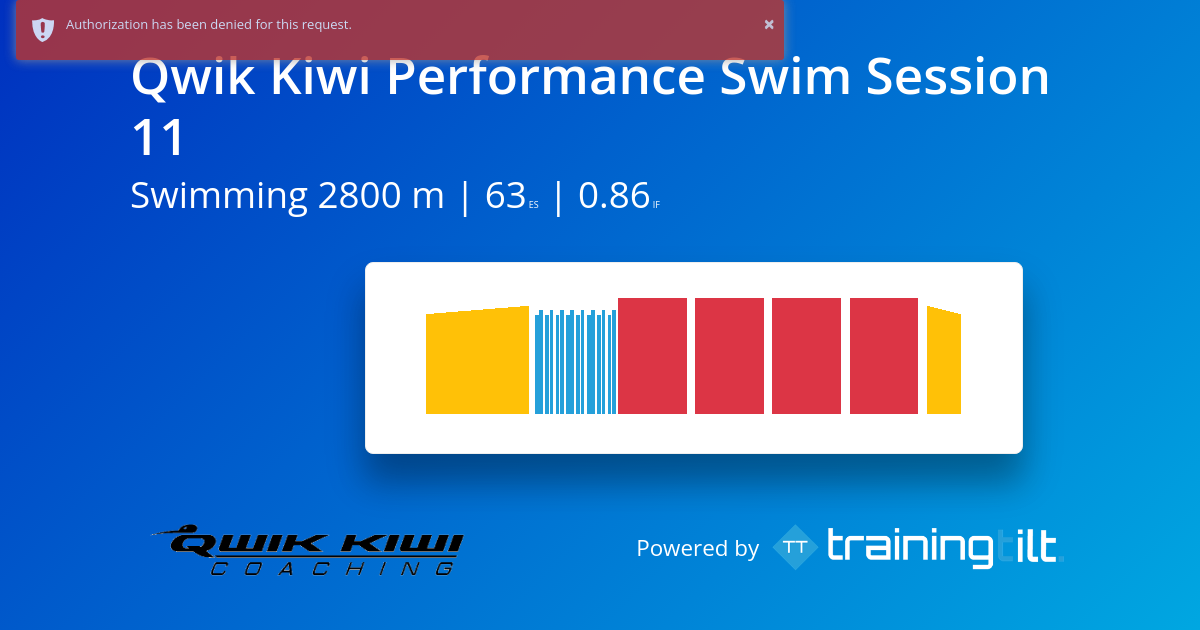
Today’s Goal: Develop swimming-specific strength, improve body position and explore how different equipment affects your freestyle technique.
Today’s Workout
- 600m Warm-Up (WU)
- 8x 50m Drill/Swim
- 400m Pull Buoy + Paddles, 45sec RI
- 400m Pull Buoy Only, 45sec RI
- 400m Paddles Only, 45sec RI
- 400m Normal Freestyle
- 200m Cool-Down (CD)
How to Complete This Workout
600m Warm-Up
Start with 600m of comfortable swimming.
Use a mixture of strokes if you wish, and gradually build into a smooth freestyle rhythm.
You can pause and stretch as required. The warm-up doesn’t need to be continuous.
The purpose is to prepare your shoulders, back and swimming muscles for the longer efforts that follow.
8x 50m Drill/Swim — Technique Preparation
This is an important part of the workout, not simply an extra 400m to complete before the main set.
Each 50m repetition is divided into two parts:
- First 25m: Complete the specified swimming drill.
- Second 25m: Swim normal freestyle, concentrating on applying what you practised during the drill.
Pause for approximately 10 seconds between repetitions. You can take a little longer if needed to prepare for the next drill.
You may use fins during this section if they help you maintain good body position and concentrate on the technique.
Complete the following four drills twice through.
Repetitions 1 and 5: Kick on Side — Left
Push off the wall and rotate onto your left side, with your left arm extended in front of you and your right arm resting alongside your body.
Keep your head aligned with your spine, looking towards the bottom of the pool except when rotating slightly to breathe.
Use a small, relaxed flutter kick to maintain forward movement.
Concentrate on maintaining a long, balanced body position rather than kicking as hard as possible.
After 25m, return to normal freestyle for the remaining 25m, trying to maintain that same balanced position.
Repetitions 2 and 6: Kick on Side — Right
Repeat the same drill on your right side.
Extend your right arm forward and keep your left arm alongside your body.
Focus on balance, body alignment and a relaxed kick.
After 25m, swim 25m normal freestyle.
Repetitions 3 and 7: 6/1/6 Drill
This drill develops body rotation, balance and coordination.
Begin in a side-kicking position with one arm extended forward.
Complete six kicks while maintaining that position.
Take one freestyle arm stroke to rotate onto the opposite side.
Complete another six kicks before taking the next stroke.
Continue this pattern for 25m:
Six kicks — one stroke — six kicks.
Finish with 25m normal freestyle, maintaining the same controlled body rotation.
Repetitions 4 and 8: 6/3/6 Drill
This is a progression of the previous drill.
Begin with six kicks on one side.
Then complete three normal freestyle arm strokes, rotating through to the opposite side.
Hold that position for another six kicks.
Continue repeating the sequence for 25m:
Six kicks — three strokes — six kicks.
Finish with 25m normal freestyle.
Concentrate on smooth rotation and maintaining your body position as you transition between kicking and swimming.
Why These Drills Matter
The four drills focus on balance, body rotation and maintaining an effective position in the water.
These skills become particularly important during the main set, where the use of a pull buoy and paddles changes how you move through the water.
The objective is to transfer the improved body awareness from the drills into your normal freestyle stroke.
Remove your fins before beginning the main set.
Main Set: 4x 400m
Complete four 400m repetitions, changing equipment between each one.
Take 45 seconds of rest between repetitions. Use that time to remove or adjust your equipment, take a drink and prepare for the next effort.
400m #1 — Pull Buoy and Paddles
Place a pull buoy between your thighs and put on your hand paddles.
Swim 400m freestyle at a controlled, sustainable effort.
The pull buoy helps support your legs, while the paddles increase the surface area of your hands.
Concentrate on a controlled catch and effective pull through the water.
Avoid forcing the paddles or applying excessive pressure through your shoulders. Use paddles of an appropriate size and reduce or remove them if you experience shoulder discomfort.
400m #2 — Pull Buoy Only
Remove your paddles but keep the pull buoy.
Swim another 400m freestyle.
Without the paddles, pay attention to how your hands and forearms engage with the water.
Try to maintain the same smooth body position and controlled stroke you developed during the previous repetition.
400m #3 — Paddles Only
Remove the pull buoy and put your paddles back on.
Swim 400m freestyle.
Your legs now need to contribute to maintaining your body position while your paddles provide additional resistance through the pull.
Concentrate on keeping your hips high, maintaining a controlled kick and avoiding excessive shoulder strain.
400m #4 — Normal Freestyle
Remove all equipment.
Swim the final 400m using your normal freestyle stroke.
This is where you bring everything together.
Focus on maintaining the body position practised during the drill set, the controlled catch developed with the paddles and the smooth rhythm established during the earlier repetitions.
Try to swim efficiently rather than simply increasing your effort to compensate for the removal of the equipment.
200m Cool-Down
Finish with 200m of easy swimming.
You may use different strokes, pause between lengths and stretch as required.
Common Mistakes to Avoid
- Using paddles that are too large.
- Trying to swim every 400m as fast as possible.
- Rushing through the drill set without concentrating on technique.
- Allowing your body position to deteriorate when the pull buoy is removed.
- Failing to transfer the technical improvements into the final 400m without equipment.
Coach Ray’s Tip
Pay particular attention to the difference between the first 400m, using both a pull buoy and paddles, and the final 400m without equipment.
The goal is to learn from the assistance and resistance provided by the equipment, then reproduce an efficient freestyle stroke when you’re swimming normally.
Workout Three: Qwik Kiwi Performance Swim Session 12 – 15 × 100m Consistent Swimming 🏊♂️🔥
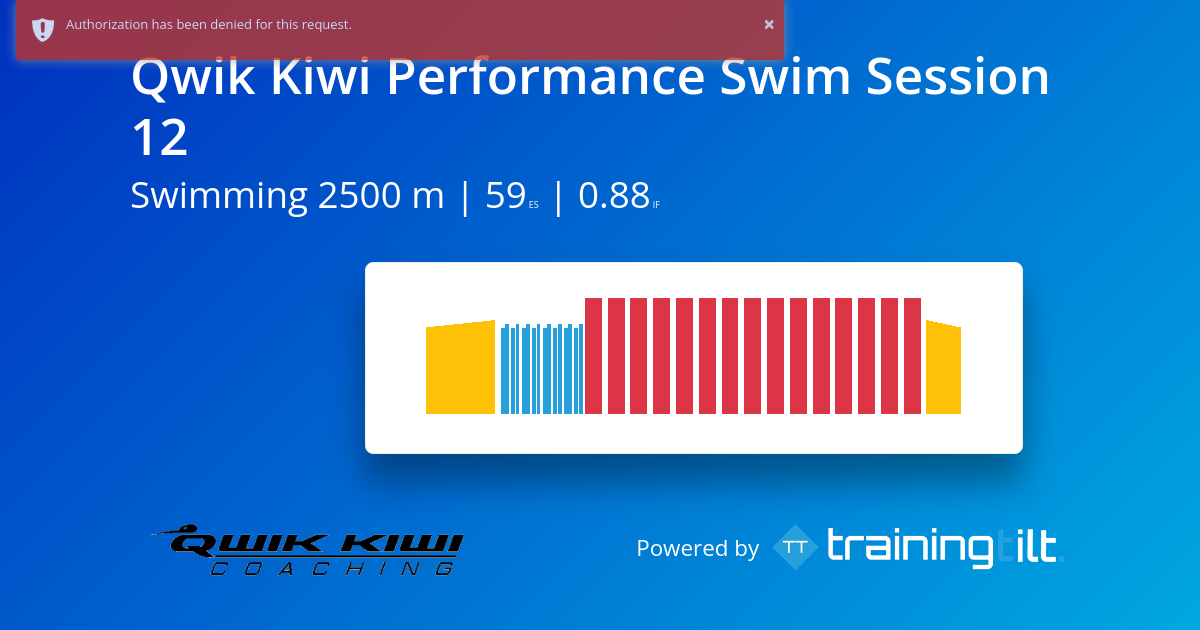
Today’s Goal: Improve your ability to maintain a consistent swimming pace and efficient freestyle technique across repeated efforts.
Today’s Workout
- 400m Warm-Up (WU)
- 8x 50m Drill/Swim
- 15x 100m, 30sec Rest Interval (RI)
- 200m Cool-Down (CD)
How to Complete This Workout
400m Warm-Up
Begin with 400m of easy swimming.
Use this time to gradually increase your heart rate and settle into a comfortable freestyle rhythm.
You can include different strokes and pause between lengths as required.
Towards the end of the warm-up, begin concentrating on your breathing, body position and maintaining a smooth stroke.
8x 50m Drill/Swim — Technique Preparation
Before starting the 100m intervals, complete eight repetitions of 50m Drill/Swim.
Each repetition consists of:
- 25m of the specified drill.
- 25m of normal freestyle, applying the technique you have just practised.
Take approximately 10 seconds of rest between repetitions, or slightly longer if you need time to prepare.
As with Session 11, fins may be used during the drill section.
Complete these four drills twice through.
Repetitions 1 and 5: Kick on Side — Left
Swim 25m kicking on your left side, with your left arm extended forward and your right arm alongside your body.
Concentrate on maintaining a long, balanced position in the water.
Follow with 25m normal freestyle, maintaining the same body alignment.
Repetitions 2 and 6: Kick on Side — Right
Repeat the drill on your right side.
Keep your head aligned, maintain a relaxed kick and concentrate on balance.
Follow with 25m normal freestyle.
Repetitions 3 and 7: 6/1/6 Drill
Complete six kicks on one side, take one freestyle stroke to rotate onto the other side, then complete another six kicks.
Continue for 25m before swimming 25m normal freestyle.
Focus on smooth body rotation and maintaining your balance throughout the movement.
Repetitions 4 and 8: 6/3/6 Drill
Complete six kicks on one side, followed by three freestyle strokes to transition to the opposite side.
Complete another six kicks and repeat.
After 25m, finish with 25m normal freestyle.
Concentrate on linking your body rotation with your arm strokes.
Why These Drills Matter
The main set contains 1,500m of interval swimming.
As fatigue builds, swimmers often begin to lose their body position, shorten their stroke or rush their arm movements.
These drills reinforce the technical skills you want to maintain throughout all fifteen 100m repetitions.
Remember that swimming efficiently isn’t just about how you move when you’re fresh. It’s also about how well you maintain your technique when you’re tired.
Remove your fins before beginning the main set.
Main Set: 15x 100m — 30sec RI
The main set consists of fifteen repetitions of 100m freestyle.
After each 100m, take a 30-second Rest Interval before starting the next repetition.
The aim is to swim as fast as you can sustainably maintain across all fifteen repetitions, rather than making the first few repetitions exceptionally fast.
Your final repetition should be at least as strong as your first.
Repetitions 1–5: Establish Your Pace
Use the first five repetitions to settle into a consistent swimming rhythm.
Avoid sprinting the opening 100m.
Choose a challenging but sustainable pace that you believe you can maintain for the entire set.
Concentrate on:
- Controlled breathing.
- Good body position.
- A smooth, effective catch.
- Consistent pacing from one repetition to the next.
Record your times if you have a pace clock or swimming watch.
Repetitions 6–10: Maintain Your Rhythm
By the middle of the set, fatigue will begin to accumulate.
Your challenge is to maintain the same pace without allowing your swimming technique to deteriorate.
Avoid increasing your stroke rate unnecessarily.
Instead, concentrate on maintaining an effective catch, good rotation and a consistent rhythm.
If your times are becoming slower, consider whether you’re losing efficiency rather than simply needing to work harder.
Repetitions 11–15: Finish Strong
The final five repetitions are where the workout becomes particularly valuable.
Maintain your concentration and continue aiming for consistent 100m times.
If you’ve paced the workout correctly, you should still be swimming strongly.
The final repetition can be your fastest, provided you maintain good technique.
The objective isn’t to sprint one final 100m after struggling through the previous fourteen. It’s to demonstrate that you can maintain your swimming speed and technique throughout the entire set.
How to Measure Your Performance
Record the time taken for each 100m repetition.
For example, an athlete might complete the first repetition in 1min 50sec and aim to keep the remaining repetitions close to that pace.
If their times progressively slow to 2min 00sec or slower, it’s a sign they may have started too quickly or are struggling to maintain their swimming efficiency.
Look for consistency across the set rather than focusing only on your fastest repetition.
When you repeat this workout in future, you can compare your average 100m time and how consistently you maintained it.
200m Cool-Down
Complete 200m of easy swimming.
You may change strokes, pause between lengths and stretch as required.
Common Mistakes to Avoid
- Sprinting the first few 100m repetitions.
- Ignoring the drill set and rushing into the main workout.
- Allowing your technique to deteriorate as fatigue builds.
- Taking inconsistent rest intervals.
- Focusing on one fast repetition rather than maintaining consistent times throughout the set.
Coach Ray’s Tip
The best swimmer in this session isn’t necessarily the person who produces the fastest opening 100m.
It’s the swimmer who can maintain a strong, repeatable pace while preserving good technique across all fifteen repetitions.
That consistency is particularly valuable for triathletes, where an efficient swim can help you exit the water ready to perform well on the bike and run.
Bringing the Three Workouts Together
Each session develops a different aspect of your swimming.
Session 01 — 1,500m Time Trial: Establishes your current performance and helps you evaluate your pacing over a sustained effort.
Session 11 — 4x 400m: Develops swimming-specific strength and encourages better body position, catch and stroke efficiency.
Session 12 — 15x 100m: Challenges you to maintain a consistent pace and effective swimming technique as fatigue develops.
Together, these three workouts provide 7,600m of purposeful swimming.
You don’t need to complete all three in one day. Spread them across your training week, allowing appropriate recovery between demanding sessions.
The key is to approach every workout with a clear purpose. Understand what you’re trying to improve, concentrate on the technical details and record your results so you can measure your progress over time.
Getting the Most From Your Swimming Training
One of the most common mistakes triathletes make is treating every swim session the same way.
They get into the pool, complete their usual distance and leave without a clearly defined purpose.
While consistent swimming is important, simply accumulating metres doesn’t guarantee that you’re addressing the factors limiting your performance.
A more effective approach is to give each session a specific objective.
Sometimes that means testing your performance.
Sometimes it means slowing down and concentrating on technique.
And sometimes it means completing repeated intervals while maintaining a consistent pace.
The important thing is understanding what you’re trying to achieve before you start.
Final Thoughts From Coach Ray
Becoming a better swimmer isn’t simply about swimming harder or covering more distance.
It’s about making your training purposeful.
This week’s three Qwik Kiwi Performance Swim sessions provide opportunities to measure your performance, improve your technical awareness and develop more consistent swimming.
Whether you’re training for your first triathlon or preparing for a longer-distance event, those are useful qualities to develop.
Remember that the best training session isn’t always the one that leaves you most exhausted.
It’s the one that helps you make progress towards your goals.
Train smarter, swim stronger!
🏊♂️ Ready to Take Your Triathlon Swimming to the Next Level?
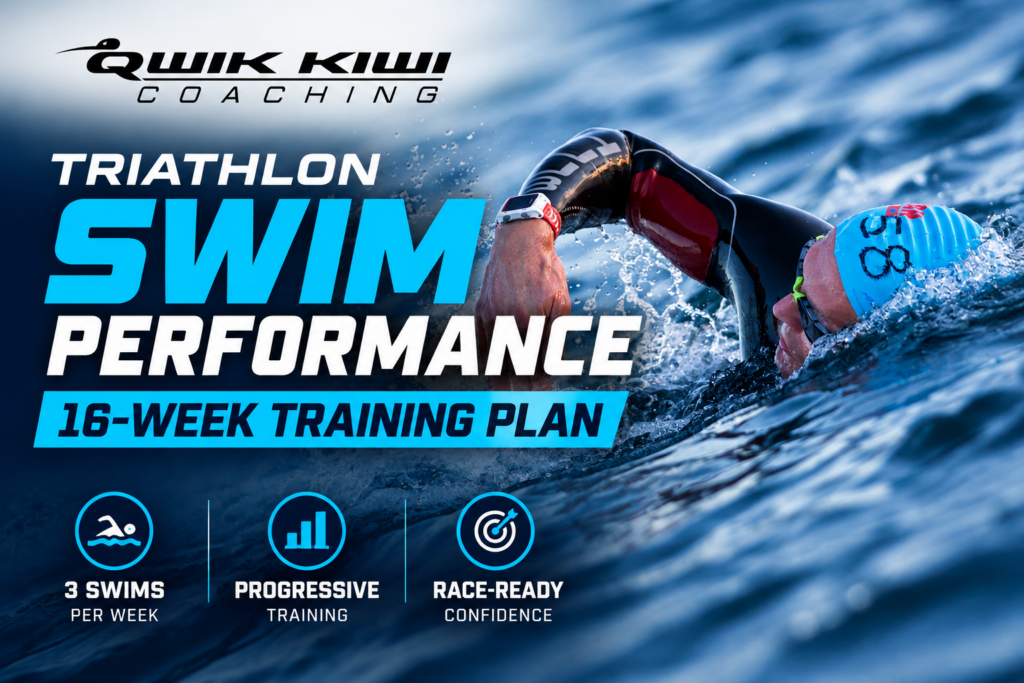
Enjoying these Saturday Swim Sessions but want a structured programme that brings everything together?
The 16-Week Triathlon Swim Performance Plan from Qwik Kiwi Coaching takes the guesswork out of your swimming training.
With three purposeful swim sessions each week, you’ll follow a progressive training programme designed to help you:
✅ Build the endurance to swim strongly over longer distances.
✅ Improve your freestyle technique and swimming efficiency.
✅ Develop better pacing and maintain your speed as fatigue builds.
✅ Arrive at your next triathlon feeling fitter, stronger and more confident in the water.
Whether you’re preparing for an Olympic-distance triathlon, Ironman 70.3 or T100, this programme provides the structure and progression to make every swim count.
🏊 16 Weeks | 3 Swim Sessions Per Week | Just NZ$59
Stop simply swimming more metres. Start swimming with purpose!
Coach Ray
Qwik Kiwi Coaching