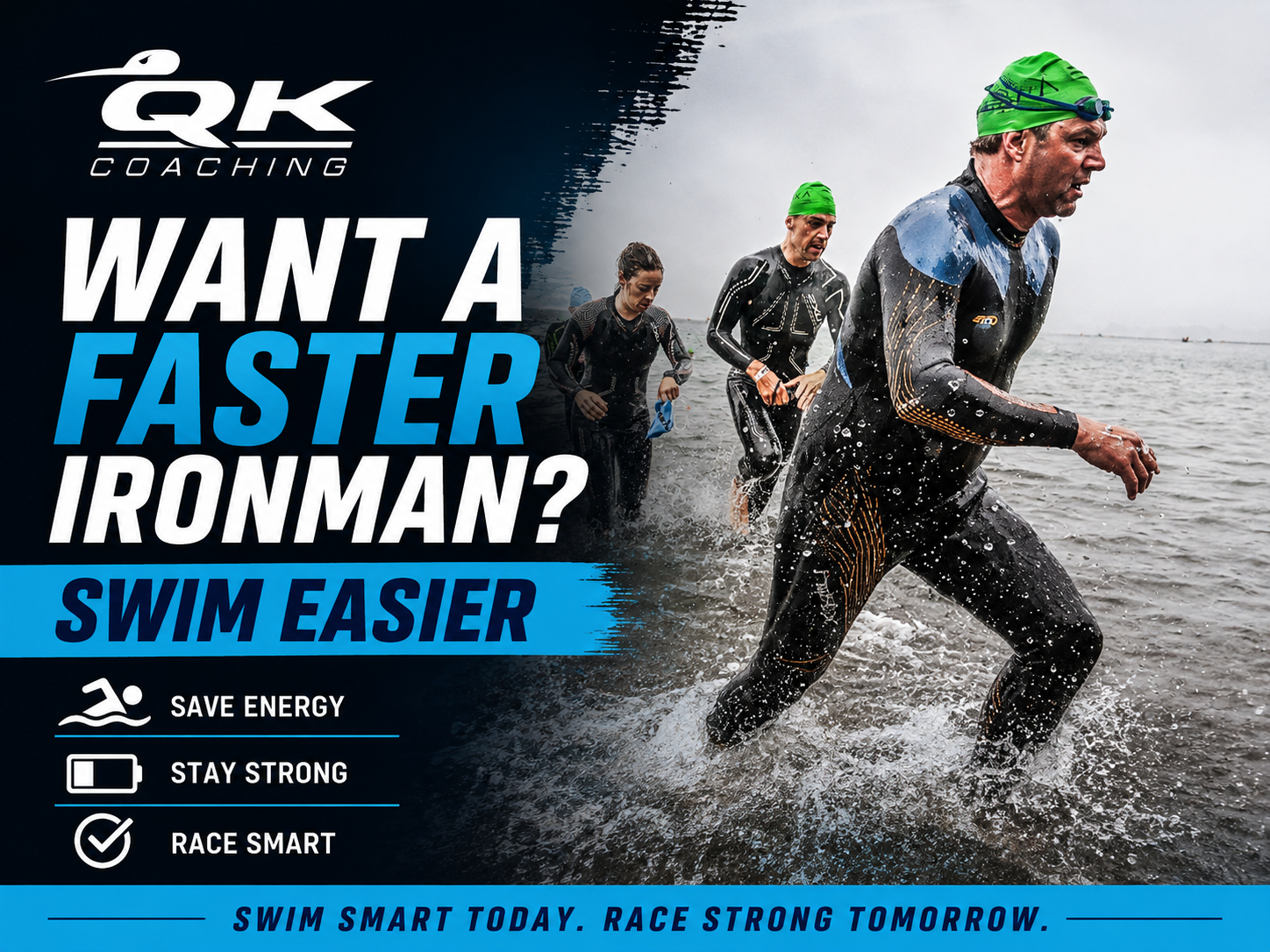
“If you want a better Ironman swim, stop trying to win it.”
That might sound strange. After all, this is a race. Surely the goal is to swim as fast as possible?
Not necessarily.
In an Ironman, the swim is only the beginning of a very long day. Your goal isn’t to produce the fastest 3.8km swim you’re physically capable of. Your goal is to swim efficiently, exit the water in good condition, and still have plenty left for 180km on the bike and a marathon.
Sometimes the smartest way to achieve a faster overall Ironman is to swim a little easier.
Your Ironman Doesn’t End at T1
One of the biggest pacing mistakes athletes make is treating each discipline as an individual race.
They race the swim.
Then they race the bike.
Then they try to survive the marathon.
That’s backwards.
An Ironman is one continuous event consisting of a swim, bike, and run. Every decision you make early in the day affects what you’ll be capable of doing later.
A few minutes gained by swimming harder than you should can become very expensive if that effort increases fatigue for the hours that follow.
Your objective isn’t to achieve your best possible swim split.
It’s to achieve your best possible Ironman.
The Opening Minutes Are Critical
Race morning brings plenty of adrenaline.
You’ve spent months preparing for this moment. You’re surrounded by other athletes. The starter cannon goes and suddenly everyone starts swimming.
It’s incredibly easy to get caught up in the excitement.
You start harder than planned.
Your breathing rate increases.
Your heart rate climbs.
Your stroke becomes shorter and less efficient.
And within a few hundred metres, you’re already working harder than you intended.
Instead, concentrate on being controlled from the beginning.
Find your rhythm.
Relax your breathing.
Lengthen your stroke.
Give yourself time to settle into the race.
Easy Doesn’t Mean Slow
When I tell athletes to swim easier, I’m not suggesting they casually float around the course.
I’m talking about swimming at a controlled, sustainable intensity.
For most recreational Ironman athletes, the swim should feel predominantly aerobic. You should be working, but you shouldn’t feel as though you’re constantly fighting to maintain your pace.
Think smooth rather than hard.
Good technique allows you to maintain speed without unnecessarily increasing effort.
That’s the sweet spot.
Efficiency Beats Aggression
Swimming harder doesn’t automatically mean swimming proportionally faster.
Once technique begins to deteriorate, you can expend significantly more energy for relatively little additional speed.
Your stroke rate increases.
Your body position deteriorates.
You create more drag.
You start fighting the water rather than moving efficiently through it.
That’s a poor trade when you still have most of an Ironman ahead of you.
The best Ironman swimmers often look remarkably relaxed because they’re focusing on efficiency rather than brute force.
Drafting Can Save Energy
Where race rules and conditions allow, drafting another swimmer can be an excellent way to reduce the energy cost of your swim.
Rather than constantly searching for someone faster, try finding an athlete travelling at approximately your intended pace.
Sit behind their feet or slightly off their hip while maintaining awareness of your own direction and effort.
The objective isn’t necessarily to use drafting to swim faster.
It can be even more valuable to maintain your planned speed while using less energy.
That’s energy you can use later.
Don’t Waste Energy Fighting for Position
Another common mistake occurs when athletes become overly concerned about other swimmers.
Someone bumps you.
Someone crosses in front of you.
Someone swims past.
Suddenly you’re accelerating to regain a position that doesn’t really matter.
Let them go.
Unless you’re competing for an overall placing or qualification position, fighting another athlete for a few metres of water is unlikely to improve your race.
Stay focused on your own rhythm and effort.
You’ll have many hours to catch people later.
Train the Way You Want to Race
Your Ironman swim strategy shouldn’t begin on race morning.
Practise it in training.
During longer endurance swims, work on maintaining a sustainable rhythm while keeping your stroke efficient.
Practise:
- Controlled pacing
- Sighting
- Drafting when appropriate
- Swimming continuously
- Maintaining technique when fatigued
- Settling quickly after harder efforts
Open-water sessions are particularly valuable because they allow you to practise the skills that aren’t easily replicated in a swimming pool.
The more familiar your race effort becomes, the less likely you’ll be to get carried away by adrenaline on race morning.
Think About How You Want to Feel at T1
This is one of my favourite ways to think about Ironman swim pacing.
Don’t ask:
“How fast can I swim 3.8km?”
Ask:
“How do I want to feel when I reach my bike?”
Ideally, you should exit the water feeling as though you’ve completed a solid warm-up for the rest of your day.
You should feel composed.
Your breathing should settle quickly.
And you should be ready to start fueling and riding according to your plan.
If you stagger into T1 completely exhausted because you’ve just produced the swim of your life, you’ve probably spent energy in the wrong place.
The Race Gets Longer as the Day Goes On
Consider the relative importance of each discipline.
The swim may take roughly an hour or more for many athletes.
The bike could take five, six, seven hours or longer.
Then you’ve still got 42.2km to run.
A small amount of additional effort during the shortest discipline can have consequences across the much longer sections that follow.
That’s why patience matters from the moment the race begins.
Ironman rewards athletes who manage their effort rather than those who simply demonstrate how much effort they can produce.
Final Thoughts
You don’t need to win the Ironman swim.
You need to complete it efficiently.
Start controlled.
Find your rhythm.
Swim smoothly.
Avoid wasting energy fighting other athletes.
And think about the entire race rather than your swim split.
There will be plenty of opportunities later in the day to work hard.
Your job during the swim is to arrive at T1 ready to take advantage of them.
Sometimes swimming a little easier really can help you race faster.
Ready to Build Your Best Ironman Yet?
Whether you’re preparing for your first Ironman, chasing a personal best, or trying to put together a smarter race-day strategy, getting the pacing right across all three disciplines can make an enormous difference.
If you’d like to talk through your swim pacing, overall training, nutrition, bike strategy, or how to put together your complete Ironman race plan, I’d love to help.
Book a free, no-obligation 40-minute coaching consultation and let’s talk about where you are now, where you want to get to, and how we can make your training work around the rest of your life.