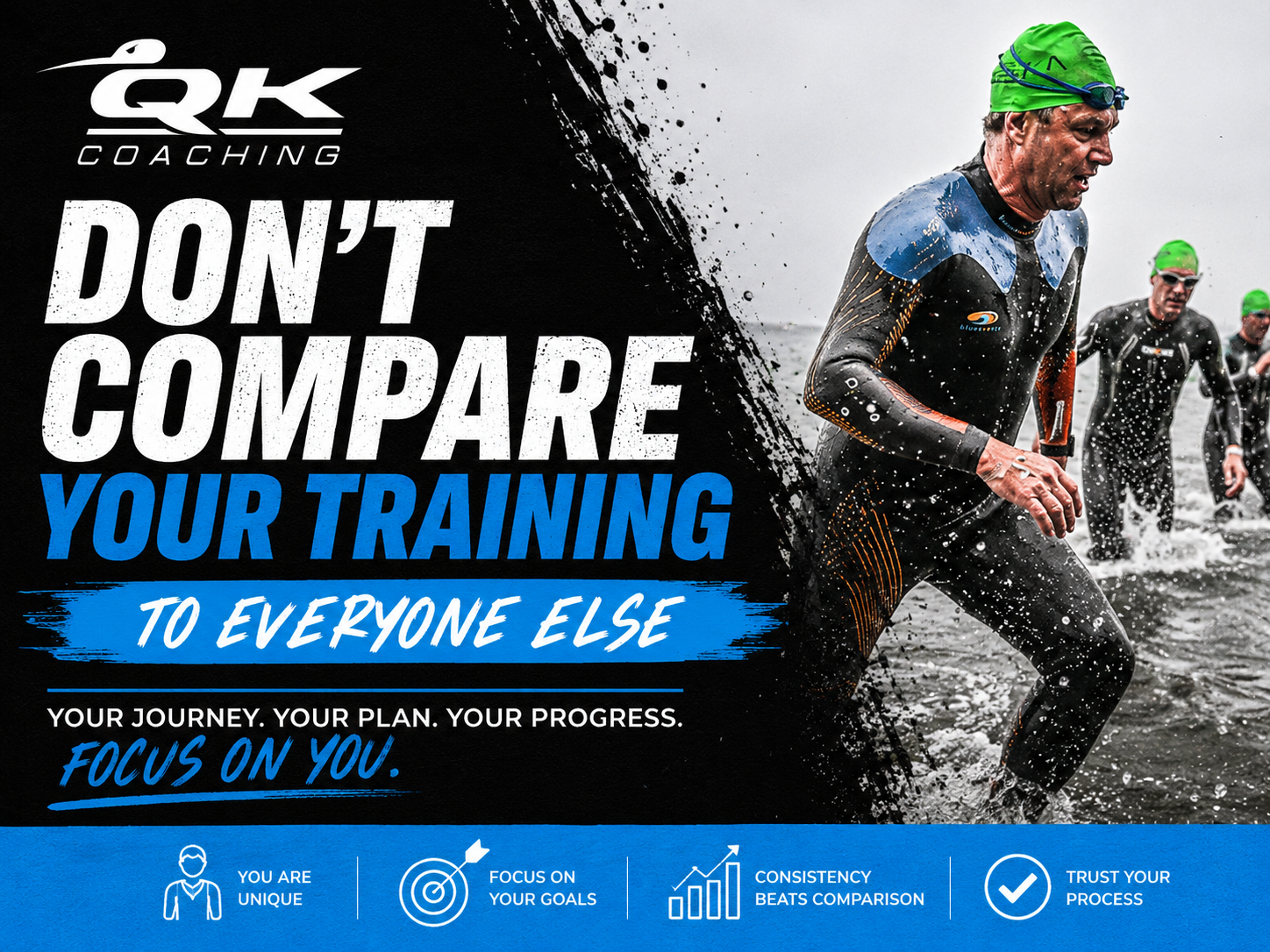
One of the quickest ways to lose confidence in your triathlon training is to look at what everyone else is doing.
Open Strava or social media and it doesn’t take long.
Someone has just completed a five-hour ride.
Someone else swam 5,000 metres before breakfast.
Another athlete has run more kilometres this week than you’ve managed all month.
Suddenly, the training programme that you were perfectly happy with yesterday doesn’t seem good enough.
You start wondering:
Should I be doing more?
Maybe.
But probably not because somebody on Strava did.
Someone Will Always Be Training More Than You
No matter how much training you do, you’ll always find someone doing more.
There will always be someone swimming further, riding longer, running faster or completing more sessions each week.
Trying to match them is a race you can never win.
More importantly, you have no idea why they’re doing that training.
They may be preparing for a completely different event.
They may have years more training experience.
They may have fewer work or family commitments.
They may recover faster than you.
They may simply be making poor training decisions.
Seeing somebody’s workout tells you almost nothing about whether that workout would be appropriate for you.
Training Is Individual
One of the fundamental principles of training is individuality.
Two athletes can complete exactly the same workout and respond completely differently.
Your training needs to take into account things such as:
- Your current fitness.
- Your training history.
- Your strengths and weaknesses.
- Your available training time.
- Your ability to recover.
- Your goal event.
- Your lifestyle and commitments.
- Where you currently are within your training programme.
That’s why copying another athlete’s training rarely makes sense.
The right amount of training isn’t the most training you can possibly squeeze into your week.
It’s the amount of training that moves you towards your goals while allowing you to recover and remain consistent.
Don’t Let Strava Become Your Coach
Strava can be fantastic.
It provides motivation, allows us to connect with other athletes and gives us somewhere to share our training.
But it can also create problems.
You finish an easy ride feeling good about your session.
Then you upload it.
Someone you know has ridden twice as far.
Suddenly your perfectly appropriate recovery ride feels inadequate.
So next time you ride further.
Or harder.
Not because your training programme required it.
Because somebody else’s training made you feel like you should.
That’s when comparison starts interfering with good training.
Your training plan should determine what you do.
Not your social media feed.
You Don’t See the Whole Picture
There’s another problem with comparing training online.
You only see what people choose to show you.
You see the impressive long ride.
You don’t necessarily see the exhausted athlete afterwards.
You see the fast interval session.
You don’t see the missed workout two days later because they haven’t recovered.
You see the enormous training week.
You don’t see the niggle that becomes an injury three weeks later.
And you certainly don’t know whether the training they’re doing is producing better race performances.
Training volume looks impressive.
Consistency produces results.
More Isn’t Automatically Better
Triathletes are particularly vulnerable to the belief that more training must be better.
After all, we’re training for three sports.
There’s always something else we could be doing.
Another swim.
Another ride.
Another run.
Another strength session.
But every training session creates fatigue as well as fitness.
If you continually add training without allowing your body to recover, eventually the quality of your training declines.
Your hard sessions aren’t as good.
Your easy sessions become harder than they should be.
You feel tired all the time.
Motivation disappears.
And eventually you may be forced to stop training altogether.
Sometimes doing less allows you to achieve more.
Compare Yourself With the Right Athlete
There is one athlete whose training is worth comparing yourself with.
You.
Look back three months.
Six months.
Twelve months.
Are you swimming more efficiently?
Are you producing more power on the bike?
Are you running faster at the same effort?
Can you complete training sessions that once seemed difficult?
Are you recovering better?
Are you racing better?
Those comparisons actually tell you something useful.
Progress doesn’t require you to be better than the athlete training next to you.
It requires you to become better than the athlete you used to be.
Your Training Needs to Fit Your Life
Most age-group triathletes aren’t professional athletes.
They have jobs.
Families.
Relationships.
Responsibilities.
And hopefully interests outside triathlon as well.
Your training programme needs to exist within that life.
A theoretically “perfect” 15-hour training week isn’t a good programme if you can only realistically sustain eight hours.
You’ll spend every week feeling like you’ve failed.
A well-designed eight-hour programme that you can consistently complete may produce far better results.
The best programme isn’t the one that looks most impressive.
It’s the one you can execute consistently.
Trust the Purpose of the Session
Instead of asking how your training compares with someone else’s, ask a much more useful question:
What is this session supposed to achieve?
If today is an easy aerobic ride, ride easy.
It doesn’t matter that your friend is doing threshold intervals.
If today is a recovery run, recover.
It doesn’t matter that someone else just uploaded a 25-kilometre long run.
If today is a rest day, rest.
You don’t become fitter by winning training.
You become fitter by completing the right training at the right time and allowing your body to adapt to it.
Race Day Is Where the Comparison Matters
Training isn’t the competition.
Race day is.
You don’t receive a medal for having the biggest weekly training volume.
Nobody cares how impressive your Strava looked six weeks earlier.
What matters is whether your training prepared you to perform when it counted.
Sometimes the athlete doing less training arrives at the start line healthier, fresher and better prepared than the athlete who spent months trying to win every workout.
Keep that in mind the next time somebody else’s training makes you question your own.
Final Thoughts
Someone will always train more than you.
Someone will always swim faster.
Someone will always produce bigger bike numbers.
Someone will always run more kilometres.
Let them.
Your job isn’t to copy their training.
Your job is to complete the training that’s appropriate for you.
Train according to your fitness, your goals, your ability to recover and the life you actually live.
Then measure your progress against the athlete you were yesterday.
Because the best training programme isn’t the hardest programme.
It’s the programme that helps you become a better triathlete.
Is Your Triathlon Training Right for You?
If you’re constantly wondering whether you’re doing enough—or you’re trying to fit somebody else’s idea of triathlon training into your life—I’d be happy to help.
Book a free, no-obligation 40-minute coaching call and we can discuss your goals, your current training, the time you realistically have available, and how to build a programme that works for you.
You don’t need to train like everybody else.
You need to train in the way that gives you the best opportunity to succeed.