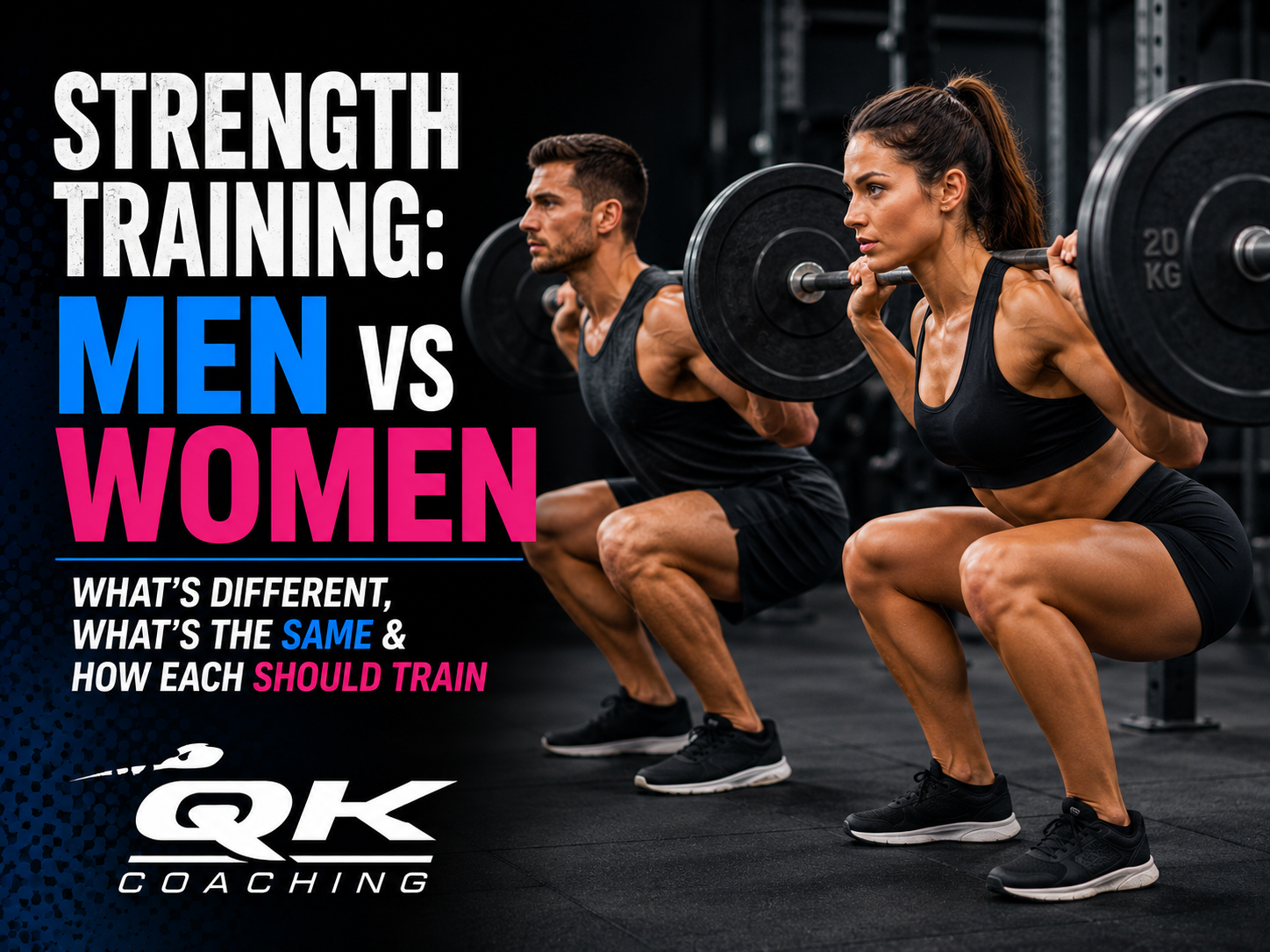
Do men and women really need to strength train differently?
There is plenty of information suggesting that women need one style of strength training while men need another. But when we look beyond the stereotypes and consider the physiology, the answer is much more nuanced.
There are genuine physiological differences between men and women that can influence strength, fatigue, recovery and how our bodies change with age. But the fundamental mechanisms that make us stronger are remarkably similar.
Understanding both sides of that equation allows us to stop thinking in terms of “men’s strength training” and “women’s strength training” and instead concentrate on giving each athlete the training stimulus they actually need.
We’re More Similar Than Different
The most important point to establish is that the basic mechanism for becoming stronger is the same for both men and women.
We expose the muscles to an appropriate training stimulus. We recover. The body adapts. Then, over time, we progressively increase that stimulus.
Women don’t need special “women’s exercises”, just as men don’t need special “men’s exercises”.
A squat is a squat.
A deadlift is a deadlift.
A split squat, calf raise, row or press doesn’t suddenly become a different exercise depending on who is performing it.
Both men and women can benefit from appropriately heavy resistance training, and both should generally build their strength training around good-quality compound movements.
Where we begin to see differences isn’t so much in how a muscle becomes stronger. The differences are found in the physiological environment surrounding that training.
The Differences That Actually Matter
There are some obvious physiological differences between men and women.
On average, men carry more muscle mass and have greater absolute strength, particularly through the upper body. Testosterone is one important contributor to this difference.
But there’s an important distinction to make:
Absolute strength isn’t the same as the ability to improve strength.
Someone who can squat 150kg isn’t necessarily capable of making greater relative improvements than someone currently squatting 60kg.
When men and women undertake similar resistance-training programmes, their relative improvements in strength and muscle size can be remarkably similar.
There are other differences as well.
Women can demonstrate greater resistance to fatigue during repeated muscular contractions and may recover relatively well between repeated efforts. Hormonal differences can also influence muscle, connective tissue, bone, metabolism and recovery.
However, there is enormous variation within each sex.
That is why we shouldn’t look at an athlete and think:
“You’re a woman, therefore you need this programme.”
Or:
“You’re a man, therefore you need that programme.”
We’re still coaching the individual.
Do Women Need to Strength Train Around Their Menstrual Cycle?
The menstrual cycle has received a lot of attention within training discussions in recent years—and unfortunately, it has also been oversimplified.
You may have encountered recommendations suggesting that women should train hard during one phase of their menstrual cycle and automatically reduce their training during another.
Current research doesn’t provide sufficient evidence to prescribe strength training rigidly according to menstrual-cycle phase.
Even Dr Stacy Sims, who has been one of the strongest advocates for recognising female physiology within sports training, has moved away from rigid calendar-based recommendations.
The individual’s response is much more useful.
If an athlete consistently experiences significant fatigue, cramping, poorer sleep or reduced performance at a particular point in her cycle, that is valuable information.
We can take it into account when making training decisions.
But we shouldn’t automatically reduce someone’s training simply because an app tells us which day of her cycle she’s on.
Track the athlete, not just the calendar.
Age Changes the Equation
Age is where some of the differences between men and women become increasingly important.
Unless we actively train to maintain them, both men and women gradually lose muscle mass, strength and, particularly, power as they get older.
Men generally experience a relatively gradual hormonal change with ageing.
For women, menopause creates a more pronounced change in the hormonal environment, particularly through declining oestrogen. This has implications not only for muscle but also for bone.
This is an area that Dr Stacy Sims emphasises strongly.
As women approach and move through menopause, the answer isn’t necessarily to make strength training easier.
In fact, there is a strong argument for making high-quality strength training increasingly important.
The same broad principle applies to ageing men.
Rather than thinking:
“I’m getting older, so I should stop lifting heavy things,”
we should be thinking:
“I’m getting older, so maintaining my ability to lift heavy things is becoming increasingly important.”
Age isn’t a reason to abandon strength training. It’s one of the strongest reasons to keep doing it.
Don’t Just Get Strong – Train for Power
There’s another important distinction that both men and women should understand.
Strength and power aren’t the same thing.
Strength is our ability to produce force.
Power is our ability to produce that force quickly.
We tend to lose power faster than strength as we age, and that’s important for sporting performance as well as everyday life.
For runners and triathletes, every stride involves producing force quickly. Having lots of strength isn’t as useful to performance if we can’t express that strength rapidly enough when we run.
Power training doesn’t necessarily mean performing complicated Olympic lifts.
Depending on the athlete’s experience and ability, it might include:
- jumps and hops;
- medicine-ball throws;
- kettlebell swings; or
- appropriate resistance exercises performed explosively.
The important consideration with power training is quality rather than fatigue.
We’re generally looking for a small number of high-quality explosive repetitions performed while relatively fresh.
Don’t turn power training into another endurance workout.
So, How Should Men and Women Strength Train?
After discussing all these physiological differences, we arrive at a surprisingly simple conclusion.
Men and women don’t necessarily need dramatically different strength programmes.
Both should lift sufficiently heavily to stimulate genuine strength development.
Both should use good-quality compound movements.
Both should progressively increase the training stimulus as they adapt.
And both should include some form of power development when appropriate.
What changes is how we apply those principles to the individual athlete.
A younger athlete who is learning to strength train might require a very different programme from an experienced 55-year-old athlete.
But that difference isn’t necessarily because one is male and the other female.
For women approaching, experiencing or beyond menopause, we may place particular importance on maintaining heavy resistance training, power and appropriate impact loading for bone health.
But those aren’t things that men should avoid.
Men benefit from developing and maintaining strength and power as well.
The important lesson is:
Don’t programme according to stereotypes. Start with the training principle, then modify it for the athlete in front of you.
The Strength-Training Principles That Matter Most
If you take nothing else from this article, remember these five principles.
1. Train the individual, not simply their sex
Being male or female provides useful physiological context, but it doesn’t tell us everything we need to know about an athlete.
Training history, age, current strength, sporting goals, injury history, life stage, recovery and individual responses all matter.
2. Strength requires an appropriate stimulus
If the objective is to become stronger, the resistance eventually needs to be challenging enough to stimulate strength development.
Doing endless repetitions with a very light weight isn’t necessarily strength training.
You don’t have to start heavy—but over time you need to develop the capacity to handle meaningful resistance.
3. Progressively overload
You don’t need to add weight every time you enter the gym.
Progressive overload can be achieved in different ways, and progression should be appropriate to the athlete.
But as your body adapts, the training stimulus needs to progress if you want further adaptation.
4. Maintain power as well as strength
Don’t concentrate exclusively on how much force you can produce.
Your ability to produce force quickly matters too—particularly as you get older.
Appropriate power training can complement your strength work and is highly relevant to endurance-sport performance.
5. Support the training with nutrition and recovery
The strength session is the stimulus.
The adaptation occurs afterwards.
You need sufficient energy, protein, nutrition and recovery to allow your body to respond to the work you’ve performed.
Continually adding training without providing the resources to recover from it doesn’t create better adaptation.
Different Physiology, Similar Foundations
The physiology of men and women isn’t identical, and good coaching shouldn’t pretend that it is.
Sex, hormones, menstrual symptoms, menopause, ageing, bone health, fatigue and recovery can all provide important context when deciding how an athlete should train.
But we shouldn’t allow those differences to obscure the fundamentals.
The recipe for becoming stronger remains remarkably similar:
Apply an appropriate training stimulus.
Recover from it.
Allow the body to adapt.
Then progressively challenge it again.
That’s ultimately how both men and women should strength train.
Want Strength Training That Complements Your Endurance Training?
Strength training should support your running, cycling or triathlon training—not simply leave you exhausted for your next key session.
If you’re unsure how much strength work you should be doing, how heavy you should lift, or how to fit strength and power training around your endurance sessions, book a FREE 40-minute coaching consultation with Coach Ray.
We’ll discuss your current training, your goals and how to build an approach that works for you.