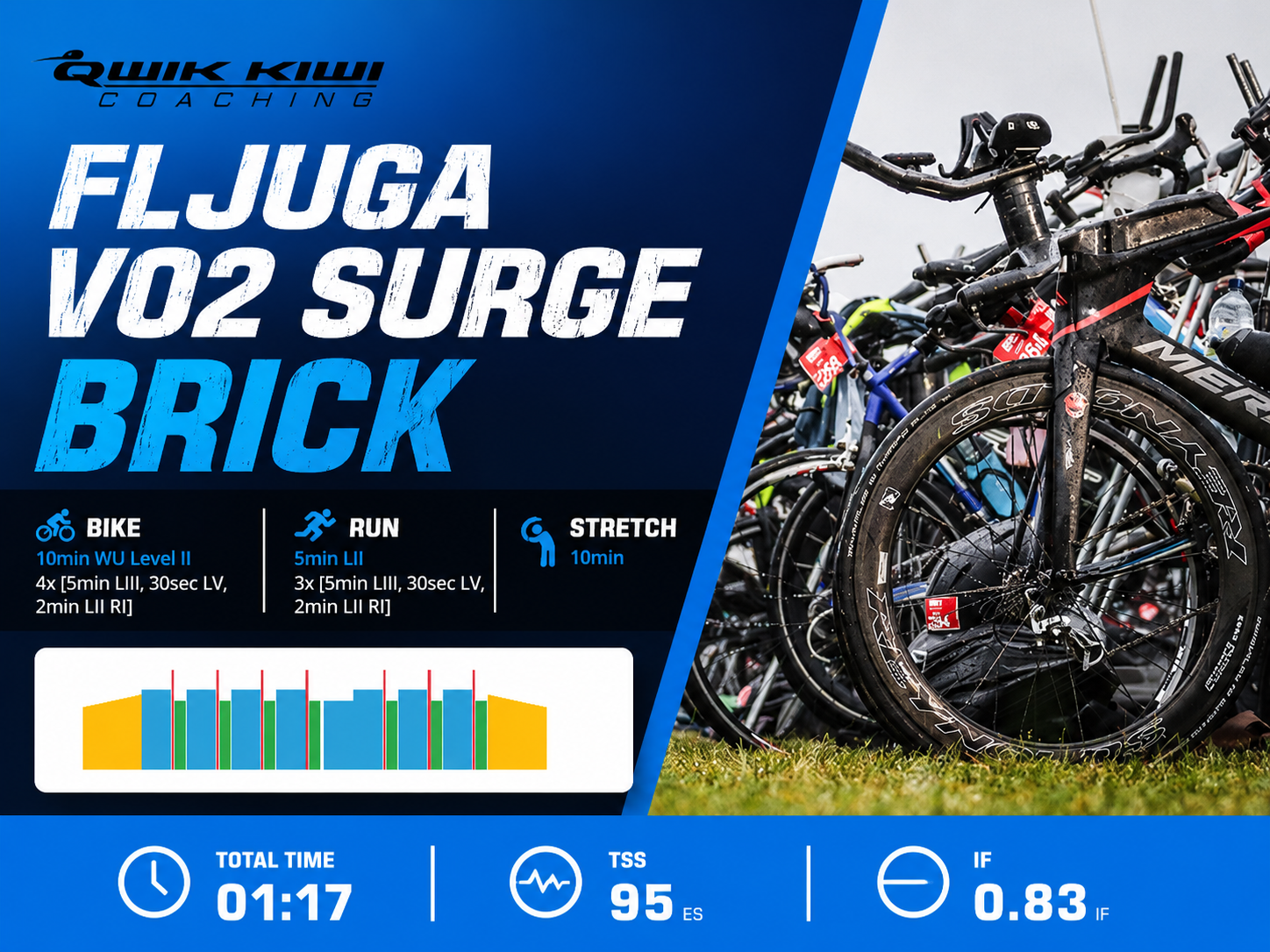
Triathlon racing rarely involves holding exactly the same effort from start to finish.
Hills, corners, overtaking, changes in terrain and other athletes can all force you to increase your effort temporarily before settling back into your rhythm. The important skill isn’t simply being able to surge—it’s being able to surge without allowing that harder effort to compromise everything that follows.
This week’s Monday’s Brick is designed around exactly that challenge.
The FLJUGA VO₂ Surge Brick combines sustained Level III efforts with short 30-second surges at Level V, first on the bike and then again on the run. You’ll therefore practise changing gears while cycling before having to repeat the same skill after you’ve transitioned onto tired running legs.
Why You’re Doing This Session
Unlike a steady aerobic brick, today’s workout deliberately introduces changes in intensity.
Each main effort begins with five minutes at Level III before finishing with a short 30-second surge at Level V. You then get two minutes at Level II to recover before doing it again.
That combination teaches you to:
- Maintain a strong, controlled effort at Level III.
- Accelerate into Level V without losing control.
- Recover while continuing to move at Level II.
- Handle repeated changes in intensity.
- Transition from cycling to running after harder riding.
- Produce controlled surges when your legs are already fatigued.
The short Level V efforts are important, but they shouldn’t dominate the workout. The real challenge is what happens before and after each surge.
Session Inspiration
The inspiration for this workout came from an article about Sprint-distance brick workouts published by FLJUGA. You can read that article here.
Their session provided the basis for combining sustained work with short, harder surges across both the bike and run. I’ve structured the workout using my Levels intensity system so that each part has a clearly defined purpose.
What You Should Focus On
On the Bike
Start with 10 minutes at Level II and use this time properly.
Gradually get yourself ready for the work ahead rather than treating the warm-up as something you simply need to get through.
The main set contains four repetitions.
For each one, settle into Level III for five minutes. This should feel purposeful and controlled. Don’t allow the effort to creep towards Level IV simply because you know there’s a harder surge coming.
At the end of the five minutes, accelerate into Level V for 30 seconds.
Make the change in intensity decisive, but stay smooth. This isn’t a maximal sprint. You’re increasing to Level V and maintaining control rather than throwing everything you have at those 30 seconds.
Then return to Level II for two minutes.
Use that recovery. Get your breathing under control, relax and prepare yourself to repeat the sequence.
During the Transition
After completing the fourth bike repetition and its Level II recovery, transition promptly onto the run.
You don’t need to race through transition, but don’t use it as an opportunity for additional recovery either.
Have everything organised beforehand so you can move efficiently from one discipline to the next.
On the Run
Your first five minutes are at Level II.
Don’t underestimate their importance.
You’ve just completed four Level III efforts and four Level V surges on the bike. Give yourself these five minutes to establish good running form and allow your legs to adjust before beginning the harder work.
You’ll then complete three repetitions using the same structure as the bike:
5 minutes Level III → 30 seconds Level V → 2 minutes Level II.
Again, the Level III portion needs to remain controlled.
When the 30-second surge arrives, increase your effort to Level V while maintaining good running technique. Think about becoming quicker rather than simply trying harder.
Once the surge finishes, immediately bring yourself back to Level II and use the two minutes to regain control.
Common Mistakes to Avoid
Turning the Level V Surge Into a Sprint
Level V is very hard, but it isn’t an uncontrolled maximal effort.
Going too hard during the first few surges will make it increasingly difficult to maintain the quality of the Level III work that follows.
Riding the Level III Efforts Too Hard
Five minutes at Level III should remain Level III.
If you drift towards Level IV, you’re changing the purpose of the session and accumulating unnecessary fatigue before the run.
Wasting the Level II Recoveries
Recovery doesn’t mean switching off completely.
Continue moving smoothly, bring your breathing under control and prepare yourself for the next repetition.
Attacking the Run Immediately
The first five minutes of running are deliberately Level II.
Use them.
Trying to prove how well you can run immediately after the bike can leave you struggling once the structured run intervals begin.
Allowing Running Technique to Fall Apart
The final Level V surges will come when you’re already carrying fatigue.
That’s exactly when good technique matters most.
If increasing your effort causes your posture and running form to deteriorate significantly, you’ve gone too hard.
Tips for Completing This Session Successfully
Think of every repetition as three connected parts rather than three separate efforts.
The Level III section establishes your rhythm. The Level V surge challenges that rhythm. The Level II recovery gives you the opportunity to regain control.
How well you move between those intensities is an important part of the workout.
On the bike, change gear appropriately before each surge rather than simply grinding harder in the same gear.
On the run, concentrate on good posture and quick, controlled movement as you increase your intensity.
Most importantly, don’t judge the workout by how hard you can make the first repetition.
Judge it by whether you can maintain the quality of the last one.
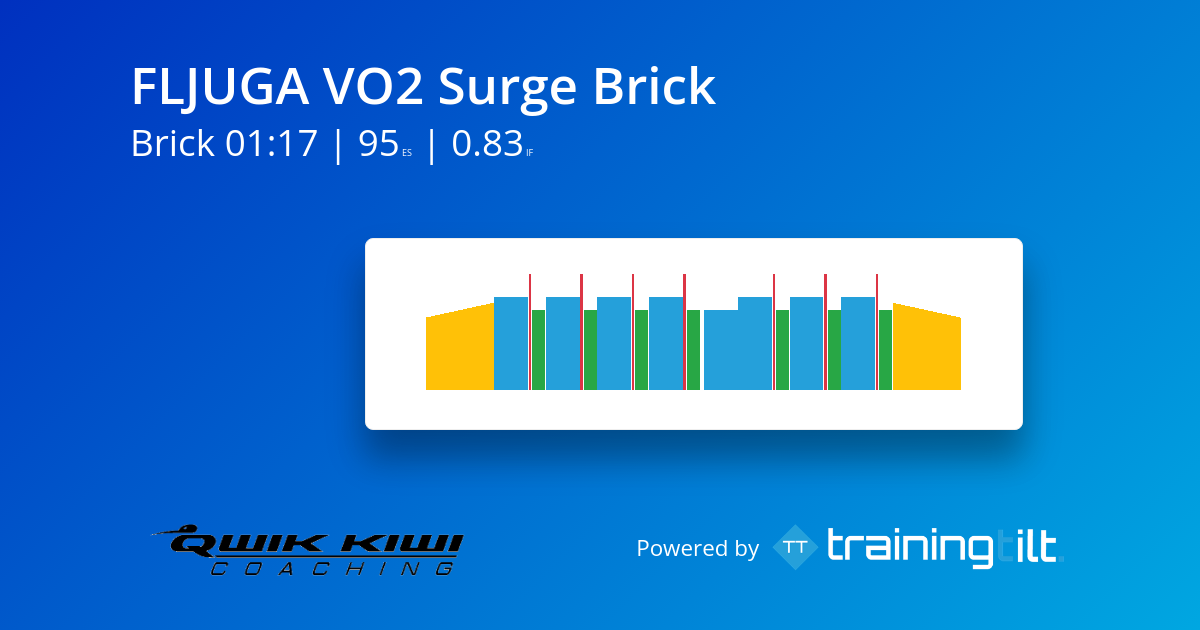
Today’s Workout
FLJUGA VO₂ Surge Brick
Bike
Warm-Up
10 minutes – Level II
4x:
- 5 minutes – Level III
- 30 seconds – Level V
- 2 minutes – Level II Rest Interval
Transition
Move promptly from the bike into the run.
Run
Settle In
5 minutes – Level II
3x:
- 5 minutes – Level III
- 30 seconds – Level V
- 2 minutes – Level II Rest Interval
Cool-Down
8 minutes – Level II
Recovery
10 minutes stretching
How This Session Should Feel
This workout should become progressively challenging without becoming chaotic.
The Level III efforts should feel strong but sustainable. Each 30-second Level V surge should provide a noticeable jump in intensity before you deliberately bring yourself back under control during the Level II recovery.
Once you reach the run, the accumulated bike work will make those same changes in intensity more demanding.
That’s part of the purpose.
The final running repetition should certainly feel harder than the first, but you should still be capable of completing the five minutes at the correct intensity and producing a controlled 30-second Level V surge with good technique.
If your final repetition is comparable in quality to your first, you’ve paced the session well.
Want to Get More From Your Brick Sessions?
Want to run better off the bike and use brick workouts properly?
Get my FREE Brick Session Blueprint.
Inside you’ll discover:
- Smarter brick sessions.
- Better pacing.
- Stronger triathlon runs.
- Sessions suitable for Sprint through to Ironman-distance athletes.
Get your free Brick Session Blueprint and start making every brick session count.