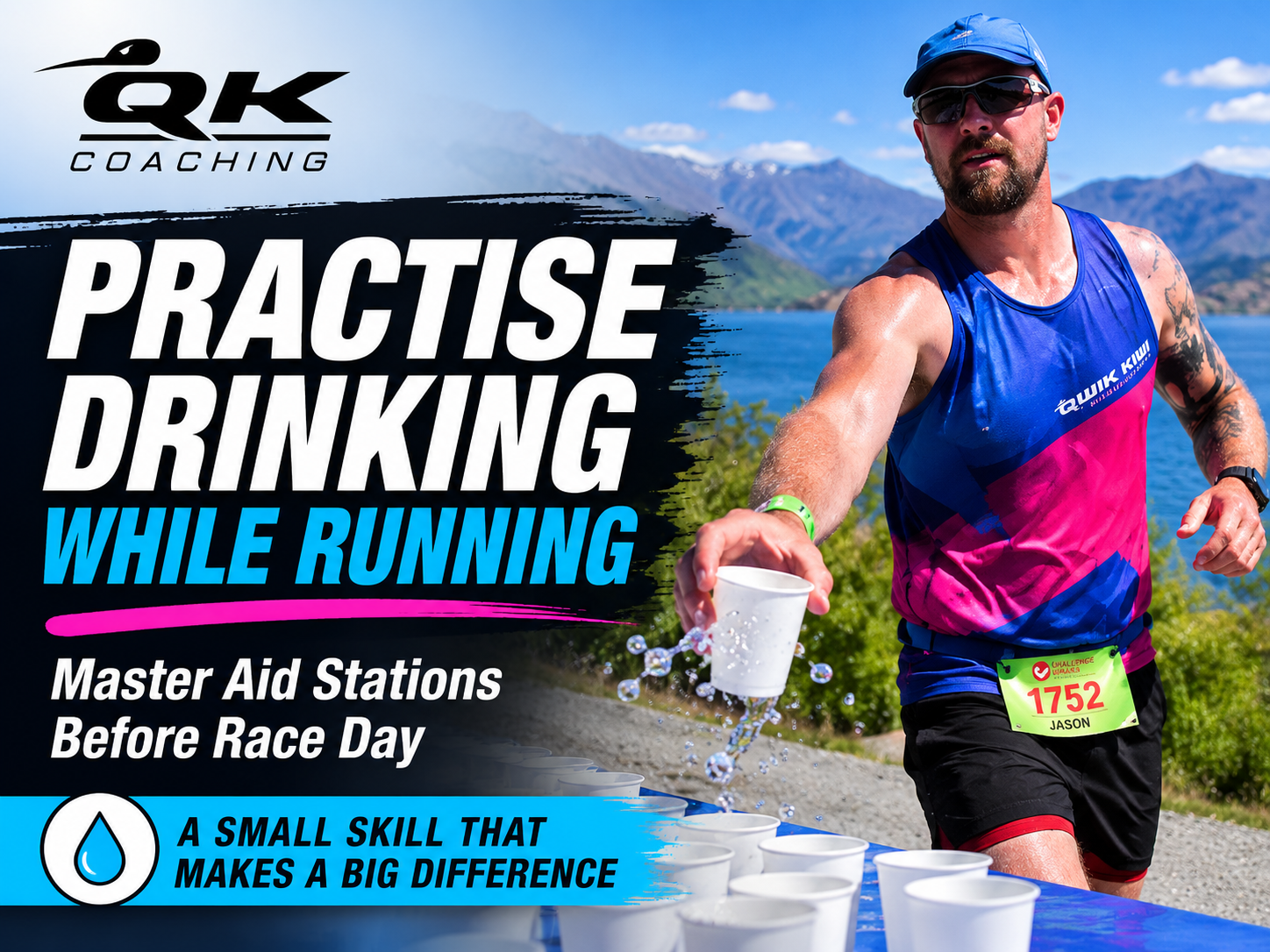
You can spend months preparing your legs for a marathon.
You can practise your pacing.
You can complete your long runs.
You can test your gels.
But there’s another race-day skill that’s surprisingly easy to overlook:
Actually drinking while you’re running.
It sounds simple.
Then you reach a crowded marathon aid station with runners changing direction in front of you, volunteers holding out cups, discarded cups underfoot, and your heart rate elevated.
You grab a drink, attempt to swallow it while maintaining your pace—and pour half of it down your shirt.
That’s why drinking while running is something worth practising before race day.
Aid Stations Are a Skill
Marathon aid stations can be chaotic, particularly during larger events.
Runners suddenly slow down.
Some stop completely.
Others cut across the road to reach a table.
You’re trying to identify whether you’re approaching water or sports drink while simultaneously avoiding everyone around you.
None of this is particularly complicated.
But it becomes much easier when you’ve practised it.
Your marathon shouldn’t be the first time you’ve tried to grab a drink while running.
Find Out What’s Available at Your Marathon
Before race day, look at the athlete information provided by your marathon organiser.
Find out:
- Where the aid stations are located.
- Whether drinks are provided in cups or bottles.
- What sports drink is available.
- Which tables provide water and which provide sports drink.
- Whether nutrition is available at particular stations.
World Athletics road-running guidance generally places water stations at regular intervals, commonly around every 5km, although actual arrangements vary between events and conditions.
Knowing what’s coming means you can make decisions before reaching the station instead of reacting at the last second.
Practise During Your Long Runs
Your long runs provide an ideal opportunity to rehearse your hydration strategy.
If your marathon provides cups, try practising with cups.
If it provides bottles, practise drinking from the type of bottle you’re likely to receive.
You could arrange a looped long run where you pass your drinks regularly, have someone hand you a drink, or carry fluid and practise drinking without completely disrupting your running rhythm.
You’re not just training your stomach to tolerate fluid.
You’re developing the practical skill of drinking while moving.
Learn How to Drink From a Cup
Trying to drink normally from an open cup while running often results in water going everywhere except your mouth.
One useful technique with a paper cup is to gently pinch the top edges together.
This creates a smaller opening that can make the fluid easier to control.
Then take several smaller sips rather than attempting to swallow the entire cup at once.
Practise this before relying on it during your marathon.
And remember: you don’t necessarily have to keep running.
Walking Through an Aid Station Is Okay
Some runners seem to think slowing down at an aid station represents failure.
It doesn’t.
If slowing down or walking briefly allows you to drink properly, take your nutrition, and then return calmly to your planned pace, that can be a perfectly sensible race strategy.
You might lose a few seconds.
But compare that with grabbing a cup at full speed, spilling most of it, barely drinking anything, and continuing down the road without getting what you needed.
Over a marathon, execution matters far more than looking fast through an aid station.
Don’t Suddenly Cut Across Other Runners
Good aid-station technique isn’t just about drinking.
It’s also about awareness.
If you need to move towards a drinks table, look around you and move across gradually rather than suddenly cutting in front of another runner.
Once you’ve collected your drink, avoid stopping abruptly in the middle of the running line.
If you plan to walk while drinking, move through the station predictably and give the runners around you space.
A little awareness makes aid stations safer and less stressful for everyone.
Your Hydration Strategy Should Be Individual
There’s no single amount of fluid that every marathon runner should consume.
Your needs can be influenced by your sweat rate, body size, running speed, environmental conditions, race duration, and other individual factors.
A cool marathon and a hot, humid marathon can present very different hydration demands.
That’s another reason practising during training matters.
Training in different conditions helps you learn how your needs change rather than relying on a rigid strategy that ignores what’s happening around you.
More Isn’t Always Better
There’s also an important misconception worth addressing:
If some fluid is good, more fluid isn’t automatically better.
Drinking excessive amounts during prolonged exercise can be dangerous.
The goal isn’t to consume as much as you possibly can at every aid station.
It’s to develop an appropriate hydration strategy for your individual needs and the conditions you’re racing in.
Avoid turning hydration into a competition.
Your plan should support your marathon, not become another source of problems.
Combine Hydration With Your Fuelling Plan
Your drinking strategy shouldn’t exist separately from your marathon nutrition strategy.
If you’re taking gels during the race, consider when you’ll take them in relation to aid stations.
For example, you may choose to take a gel shortly before reaching a water station so you can follow it with fluid.
If you’re relying partly on sports drink for carbohydrate, you need to understand how that fits into your overall fuelling strategy.
Practise the combination during training.
That means testing:
gel + running + drinking + pace.
It’s the complete sequence you’re going to perform on race day.
Don’t Try to Make Up for a Missed Station
Sometimes things don’t go perfectly.
You might miss a cup.
An aid station might be crowded.
You might spill most of your drink.
Don’t panic.
And don’t automatically compensate by consuming a huge amount at the next station.
Return to your strategy and continue making sensible decisions based on your needs and the conditions.
One imperfect aid station doesn’t have to become a marathon-ending problem.
Rehearse the Whole Process
As your marathon approaches, some of your long runs can become race-day rehearsals.
Wear the gear you’re planning to race in.
Use the nutrition you’re planning to carry.
Practise your marathon pace where appropriate.
And practise your drinking.
Think through the entire process:
You see the aid station ahead.
You know what you want.
You move across gradually.
You collect your drink.
You slow down if necessary.
You drink properly.
You dispose of the cup or bottle appropriately.
Then you smoothly return to your rhythm.
By race day, that sequence should feel familiar rather than stressful.
Final Thoughts
Marathon preparation isn’t only about developing fitness.
It’s about removing as many unnecessary surprises as possible.
Drinking while running might seem like a tiny detail during months of training, but race day is made up of dozens of these tiny details.
Practise grabbing a drink.
Practise drinking from a cup.
Practise slowing or walking if that’s what works best for you.
Practise combining hydration with your fuelling strategy.
Then, when you reach that first crowded aid station on race day, you won’t be trying to figure it out.
You’ll simply be executing something you’ve already practised.
Train your hydration strategy just like you train your legs.
Ready to Run Your Best Marathon?
Your marathon plan is about much more than completing enough kilometres. Pacing, fuelling, hydration, recovery, and race-day execution all need to work together.
If you’d like help developing a marathon strategy that suits your fitness, goals, experience, and upcoming race, book a free, no-obligation coaching consultation.
We’ll discuss where your training is currently at, what you’re preparing for, and how you can arrive on race day with a plan you’ve already practised.
Book your free marathon coaching consultation: