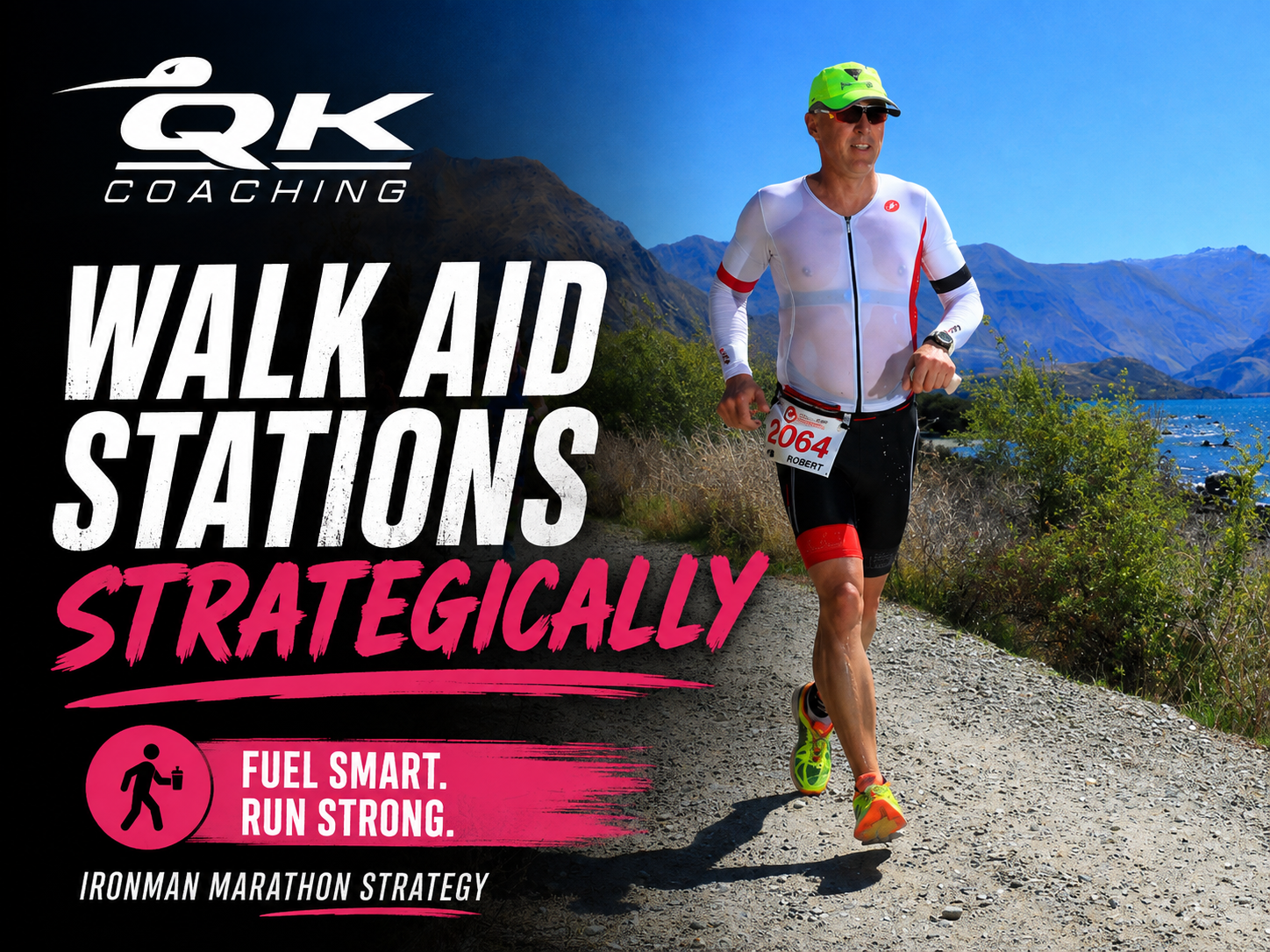
Walking during an Ironman marathon isn’t necessarily a sign that your race has gone wrong.
Sometimes it’s part of a very good race plan.
In fact, one of the strategies I encourage some Ironman athletes to consider is incredibly simple:
Walk the aid stations from the beginning.
Not because you’re exhausted.
Not because you’ve blown up.
And not because you’ve given up on running the marathon.
You walk them because it’s part of your strategy.
Those short, deliberate walking breaks can help you fuel properly, hydrate properly, control your effort, and break 42.2km into much more manageable pieces.
And for some athletes, that can result in a faster overall marathon.
Walking Is Different When It’s Planned
There’s an important difference between choosing to walk and being forced to walk.
If you reach 30km completely exhausted and start walking because you can no longer maintain your running pace, that’s a response to fatigue.
Strategically walking aid stations is different.
You might run comfortably between aid stations, deliberately walk while taking on nutrition and fluid, and then immediately return to your planned running pace.
The walking is part of the race plan.
That’s a completely different mindset.
Start Before You Need To
One of the biggest mistakes athletes make with a run/walk strategy is waiting until they’re tired before introducing it.
By then, much of the damage may already have been done.
Instead, if walking aid stations is part of your plan, start doing it at the first aid station.
You’ll probably feel ridiculous.
You’ll be fresh.
People will run past you.
You may feel as though you’re giving away time unnecessarily.
That’s okay.
Ironman isn’t about who looks strongest during the opening kilometres of the marathon.
It’s about who can keep moving effectively when the race gets difficult.
Use the Aid Station for What It’s There For
Running through an aid station while trying to drink from a cup can be surprisingly inefficient.
You grab the cup.
Half of it goes over your face.
Another quarter goes down your shirt.
And you might actually drink very little.
A short walk allows you to slow everything down.
Grab what you need.
Drink properly.
Take your nutrition.
Use ice or cooling if conditions require it.
Then get moving again.
Those few seconds can make your race execution considerably more consistent.
Don’t Turn It Into a Rest Stop
There is one important qualification.
Walk the aid station. Don’t move into it.
Your planned walk should have a clear beginning and end.
For example:
Run to the aid station.
Walk while you collect and consume what you need.
Reach your predetermined point.
Start running again.
No negotiation.
The danger comes when a 20-second planned walk becomes 30 seconds, then a minute, then two minutes.
Keep it purposeful.
Practise the Run/Walk Strategy in Training
Don’t introduce this strategy for the first time during your Ironman.
Practise it during your longer training runs and brick sessions.
If your race has aid stations at reasonably predictable intervals, you can replicate that pattern during training.
Run for your planned interval.
Walk briefly.
Fuel and drink.
Then immediately resume running.
This teaches you something particularly important:
How to start running again.
Stopping isn’t usually the difficult part.
Restarting can be.
Practising that transition repeatedly makes it familiar.
It Can Help Control Your Early Pace
The opening kilometres of an Ironman marathon can feel deceptively good.
You’ve finally got off the bike.
Your legs are moving differently.
The crowd is cheering.
And your running pace can easily creep faster than planned.
A scheduled aid-station walk can act as a useful circuit breaker.
It interrupts that early enthusiasm and reminds you that you’ve still got a marathon ahead.
Rather than chasing pace early, you’re concentrating on execution.
That discipline can become extremely valuable later.
Break the Marathon Into Smaller Pieces
Thinking about running 42.2km after completing a 3.8km swim and 180km bike ride can be intimidating.
So don’t think about 42.2km.
Think about reaching the next aid station.
Run.
Aid station.
Reset.
Run.
Aid station.
Reset.
Instead of one enormous marathon, you’ve created a series of smaller, achievable targets.
That can be incredibly useful mentally when fatigue starts accumulating.
The Goal Is Your Fastest Overall Marathon
Athletes sometimes reject walking because they assume continuous running must always be faster.
In theory, perhaps.
But your Ironman marathon isn’t happening in theory.
It’s happening after hours of swimming and cycling.
The question isn’t whether running continuously is faster than walking for 20 or 30 seconds.
The question is:
Which strategy allows you to maintain the best overall pace for 42.2km?
If short planned walks allow you to run more consistently between aid stations, maintain your nutrition, control your effort, and avoid an extended walk later in the marathon, they can be an excellent trade.
Losing seconds strategically can potentially prevent you from losing minutes—or considerably more—later.
Don’t Worry About Other Athletes
This is another strategy that requires discipline.
You’ll walk into an aid station and other athletes will continue running.
Let them.
Your job isn’t to respond to what they’re doing.
Your job is to execute your race.
There’s every chance you’ll see some of those athletes again later.
Ironman rewards patience.
Have a Specific Plan
Don’t simply decide:
“I’ll walk the aid stations.”
Make the strategy specific.
Know:
- Which aid stations you’ll walk.
- Approximately how long you’ll walk.
- What nutrition you’ll take.
- What you’ll drink.
- Where you’ll start running again.
- Whether the strategy changes later in the race.
The more decisions you make before race day, the fewer decisions you’ll need to make when you’re tired.
Check Your Specific Race
Not every Ironman course is identical.
Aid-station spacing and the products available can vary between events, so check the Athlete Guide for your race before finalising your strategy.
Know where the stations are and what will be available.
Then build your plan around the actual race you’re doing rather than assuming every event operates the same way.
Final Thoughts
Walking an Ironman aid station isn’t failure.
Done deliberately, it can be smart race execution.
The important word is strategically.
Start before you’re tired.
Keep the walks short and purposeful.
Use them to fuel, hydrate, cool yourself, and mentally reset.
Then get straight back into your running rhythm.
Don’t judge the success of the strategy by the handful of seconds somebody gains on you while you’re walking through an aid station.
Judge it by how you’re running several hours later.
Sometimes the smartest way to keep running strongly is to deliberately spend a few seconds walking.
Want Help Building Your Ironman Race Strategy?
A successful Ironman isn’t simply about becoming fitter.
Pacing, nutrition, hydration, race execution, and knowing when to hold back can have an enormous influence on how your day unfolds.
If you’re preparing for an Ironman and would like to talk through your training or race-day strategy, book a free, no-obligation 40-minute coaching consultation with me.
We can discuss where your training is currently at, what you’re preparing for, and where the biggest opportunities may be to improve your performance.
Train smart. Race strong.