Not every race is going to go to plan.
You can arrive on the start line fit, motivated and with a clear target, yet still finish wondering why the result didn’t reflect the fitness you thought you had.
The temptation is to label the race as a failure, forget about it and move on.
But a disappointing race can actually be one of the most useful parts of your training — if you take the time to understand what happened and use those lessons to improve what comes next.
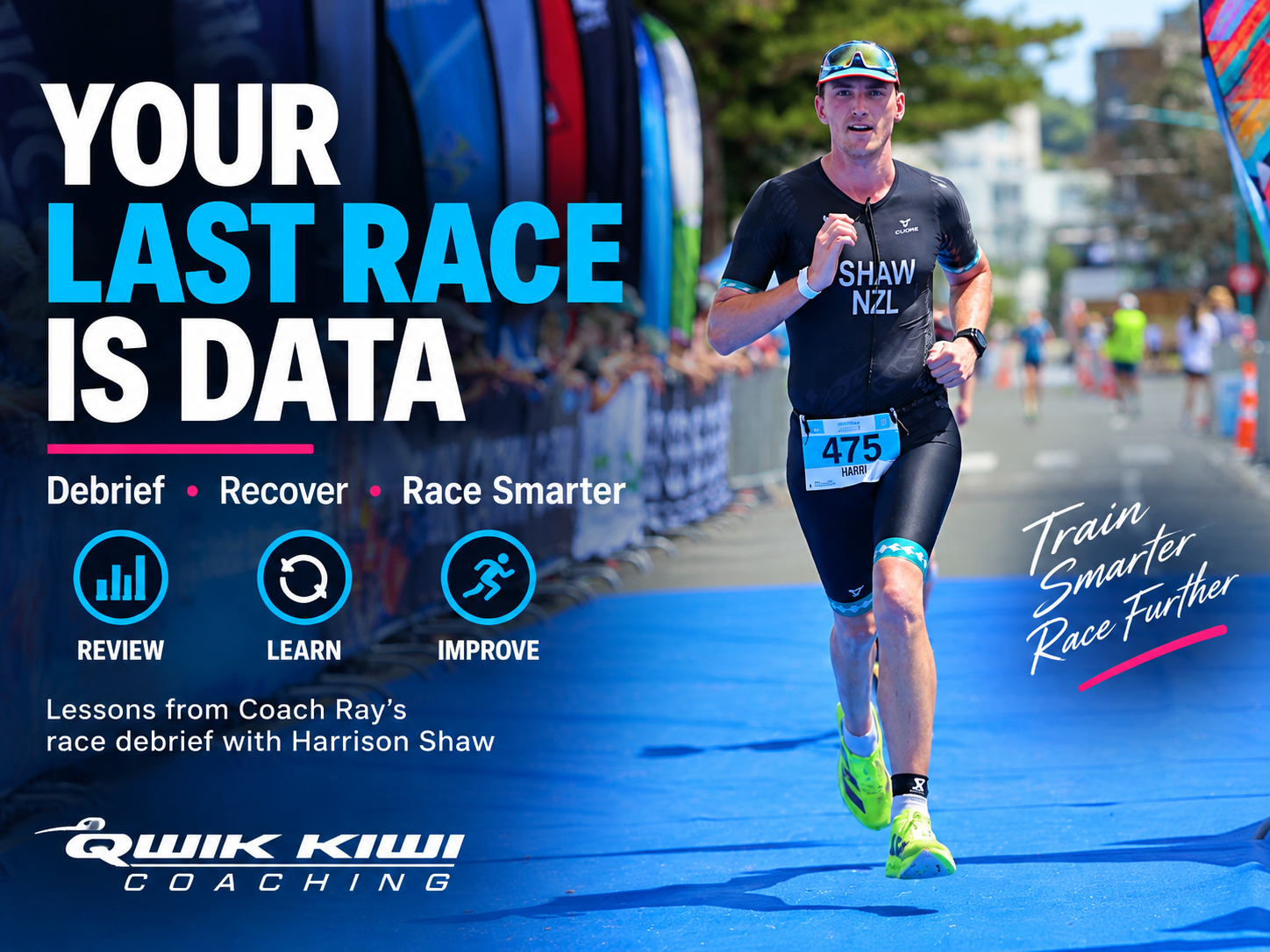
I recently sat down with Qwik Kiwi athlete Harrison Shaw after his harrier club 10km road championships. Harrison hadn’t achieved the time we’d hoped for, but we weren’t simply looking backwards. He has the Cambridge Half Marathon coming up this weekend.
That gave us two jobs: work out what happened in the 10km, then use that information to make better decisions for the half marathon.
The principles we discussed apply whether you’re preparing for a 5km, 10km, half marathon, marathon or triathlon.
Don’t Judge Your Fitness From One Result
One of the most important distinctions after a disappointing race is the difference between:
“I wasn’t fit enough”
and
“I couldn’t express my fitness on the day.”
They’re not necessarily the same thing.
In Harrison’s case, we’d already identified something earlier in the week that potentially contributed to his performance. He’d produced an excellent result during an FTP test, but had continued pushing afterwards. That added unnecessary fatigue.
Looking at his race data and his comments afterwards, there wasn’t an obvious indication that aerobic fitness was the limiting factor. Instead, his legs simply didn’t have the ability to push as hard as he wanted them to.
That’s an important coaching distinction.
If you automatically conclude that you’re not fit enough, your reaction might be to train harder.
But if fatigue is actually the problem, more training could make the situation worse.
Before changing your programme because of one disappointing performance, look at the wider picture.
Start Your Race Debrief Before You Analyse the Splits
GPS watches provide enormous amounts of information, but your race debrief shouldn’t begin and end with pace, heart rate and power.
Ask yourself:
How did training go in the lead-up?
How was my recovery?
How did I sleep?
Was there additional work, family or life stress?
How was my nutrition and hydration?
Did I understand the race plan?
How did my body feel?
What happened mentally when things became difficult?
What went well?
What would I change?
Those questions provide context for the numbers.
Harrison, for example, identified recovery and getting a good night’s sleep as positives before his 10km. He also recognised that nutrition was still an area he could improve.
The goal isn’t to find someone or something to blame.
The goal is to find something useful.
A Race Plan Still Has Value When You Can’t Complete It
Harrison went into the 10km with a progressive pacing strategy.
The intention was to control the opening kilometres, gradually increase the pace through the middle of the race and then finish strongly.
The opening kilometres were almost exactly where we’d planned them. When Harrison attempted to increase the pace, however, he discovered that the planned progression wasn’t sustainable on that particular day.
That last phrase matters.
Your limit today isn’t necessarily your limit next month — or even next weekend.
What Harrison did well was recognise what was happening and adjust.
Instead of stubbornly forcing the original plan until the wheels completely fell off, he settled into the best pace he could maintain. His fastest and slowest kilometres were separated by only 14 seconds, and he was still able to increase his pace towards the finish.
That’s good racing.
A race plan gives you structure, but it shouldn’t remove your ability to make decisions.
Plan the race before the start. Race the athlete you are on the day.
Don’t Abandon the Race When Your A Goal Disappears
One of the most valuable parts of Harrison’s debrief had nothing to do with physiology.
During the final lap, he knew his sub-38-minute target was disappearing. His motivation dropped and thoughts of effectively giving up started creeping in.
Another runner helped pull him through those difficult final kilometres.
Many runners experience something similar.
You’ve trained for a particular time. You’ve imagined seeing it on the finish clock. Then somewhere during the race you realise it probably isn’t going to happen.
At that moment, the race can suddenly feel meaningless.
That’s why I like athletes to have A, B and C goals.
Your A goal might represent an exceptional day when everything comes together.
Your B goal represents a strong performance that you’d still be pleased with.
Your C goal gives you something meaningful to chase when circumstances aren’t allowing A or B to happen.
The important thing is that losing your A goal doesn’t mean losing your race.
There is almost always something left to race for.
Learn to Adjust Without Calling It Failure
One of Harrison’s observations after the 10km was simple but important:
Races aren’t going to go perfectly every time.
That’s sport.
Training teaches your body to perform. Racing teaches you how to use that fitness when circumstances aren’t perfect.
Sometimes you’ll misjudge your pacing.
Sometimes the weather won’t cooperate.
Sometimes you’ll carry more fatigue than expected.
Sometimes nutrition won’t sit properly.
And occasionally you’ll execute everything beautifully and still won’t produce the number you wanted.
A useful debrief separates outcome from execution.
You can have a great result after making poor decisions.
You can also execute intelligently and finish with a disappointing result.
Your finishing time matters, but it isn’t the only information worth taking away.
When Another Race Is Close, Recovery Becomes Training
Harrison didn’t have several weeks before his next event.
The Cambridge Half Marathon is the following weekend.
That changed our priorities.
There wasn’t enough time to meaningfully improve his fitness. Trying to squeeze extra fitness out of a few days would have been counterproductive.
Instead, the goal was to arrive fresher.
We reduced his training load, kept his cycling predominantly at Level I and Level II with some cadence work, including a rest day and using a stride-out run before race day to get the legs moving without creating unnecessary fatigue.
This is an important principle whenever races are close together:
You won’t create much new fitness in race week, but you can certainly create fatigue.
Sometimes the best preparation is doing less.
Start Conservatively and Earn the Right to Run Faster
For the half marathon, we returned to a pacing principle Harrison had already attempted to use in the 10km: breaking the race into thirds.
Rather than thinking about 21.1km as one continuous effort, you can divide it roughly into three 7km sections.
First Third: Control
The opening kilometres should feel almost too comfortable.
Adrenaline is high. Everyone around you is fresh. Goal pace can feel ridiculously easy.
That’s exactly when runners tend to make mistakes.
Your job isn’t to prove your fitness in the opening kilometres.
Your job is to protect it.
Middle Third: Settle
Once you’re established in the race, gradually move towards the effort you believe you can sustain.
This is where patience begins paying you back.
You’ve avoided wasting energy early and can now start racing with purpose.
Final Third: Race
Only now do you find out what you’ve really got.
If you’re having a great day, start winding things up.
If conditions are tougher than expected, maintain your rhythm.
If you’re struggling, focus on keeping the race together.
For Harrison, we discussed exactly this type of progression for Cambridge: conservative through the opening 7km, moving towards target pace through the middle 7km, then assessing what was available for the final section.
The exact pace will be different for every runner.
The principle remains the same:
Don’t spend energy early that you’re going to desperately want back later.
Race-Day Fuelling Should Be Practised, Not Invented
Harrison had already been practising taking a gel approximately every 30 minutes during his long runs.
So we weren’t going to suddenly invent a completely different nutrition strategy for race day.
Instead, we looked at how to make his existing routine work with the course.
That included checking where the aid stations were located and, where practical, taking a gel shortly before reaching one so he could wash it down with water.
That’s another useful principle:
Your training isn’t just preparation for your legs. It’s rehearsal for race day.
Use long training sessions to practise:
- what you eat beforehand;
- what products you’ll use;
- when you’ll take them;
- how much fluid you need; and
- what your stomach tolerates while exercising.
Race morning isn’t the ideal time for experimentation.
Good Race Preparation Happens Before Race Morning
Hydration is another area where athletes sometimes try to fix everything at the last minute.
Rather than suddenly drinking large quantities the evening before a race, build regular hydration into your normal routine.
Similarly, the pre-race evening meal doesn’t need to be an enormous bowl of pasta.
The emphasis should be on carbohydrate-rich foods that you know sit comfortably — perhaps rice, potatoes or pasta — alongside an appropriate protein source, without unnecessarily loading the meal with large quantities of fat.
Race morning follows the same principle.
Stick predominantly with familiar foods.
Harrison normally eats rolled oats and has coffee before racing. Rather than changing that because this particular event was a half marathon, the plan was to keep his established breakfast routine and have it around 90 minutes to two hours before the race.
Familiar and proven usually beats exciting and new on race morning.
Warm Up Without Racing Before the Race
Your warm-up should prepare you to run, not become another workout.
For Harrison’s half marathon, we discussed easy jogging followed by some short, controlled stride-outs before some light stretching.
The purpose is simply to increase blood flow, loosen the legs and prepare the body for the intensity that’s coming.
You want to arrive on the start line feeling switched on — not tired.
The Most Important Question After Your Next Race
Once you’ve looked at the training, recovery, pacing, nutrition, mindset and result, ask yourself one final question:
What will I do differently next time?
That’s where a race debrief becomes useful.
Maybe you need to start more conservatively.
Maybe you need to practise fuelling.
Maybe you need clearer A, B and C goals.
Maybe your taper needs adjusting.
Maybe you need to improve sleep or recovery.
Or perhaps the answer is that you actually executed extremely well and simply need more time to develop your fitness.
Whatever the answer, turn it into an action.
Otherwise, a race debrief is just a conversation about the past.
Race. Review. Adjust. Repeat.
One disappointing race doesn’t define your fitness.
Likewise, one brilliant race doesn’t mean you’ve suddenly discovered the perfect training formula.
Progress comes from repeatedly going through the process:
Train → Race → Review → Learn → Adjust → Race Again.
Harrison’s 10km club championships didn’t deliver the result we’d hoped for, but they gave us valuable information.
We could identify what worked.
We could identify what probably limited the performance.
We could adjust his recovery.
We could refine his pacing.
We could discuss his mindset.
We could establish his fuelling strategy.
And most importantly, we could turn those lessons into a practical plan for his next start line.
That’s what good coaching should do.
It isn’t simply writing workouts onto a calendar.
It’s understanding the athlete, interpreting what actually happened, and making appropriate decisions as circumstances change.
Want Help With Your Own Training and Racing?
If you’re training hard but aren’t sure whether you’re training effectively — or you’d like help turning your race results, training data and goals into a structured plan — let’s have a conversation.
I offer a 40-minute coaching consultation where we can talk through where you’re at now, what you’re training for, what’s working, and where your biggest opportunities for improvement might be.
There’s no obligation to sign up for coaching afterwards. It’s simply an opportunity to talk about your training and see whether working together would be a good fit.
Train smart. Race smarter.
Coach Ray Boardman
Qwik Kiwi Coaching