You cross the finish line, stop your watch and look at the number.
It isn’t what you wanted.
Perhaps you missed your goal by 30 seconds. Maybe it was two minutes. Maybe considerably more.
The immediate conclusion can be:
“I had a bad race.”
But did you?
Your finishing time is important. We train to improve performance, and there’s nothing wrong with setting ambitious time goals.
However, the clock doesn’t tell you everything about how well you raced.
Weather, terrain, fatigue, competition and the decisions you make during the event all influence the final result.
Sometimes you can miss your time goal and still produce a very good performance.
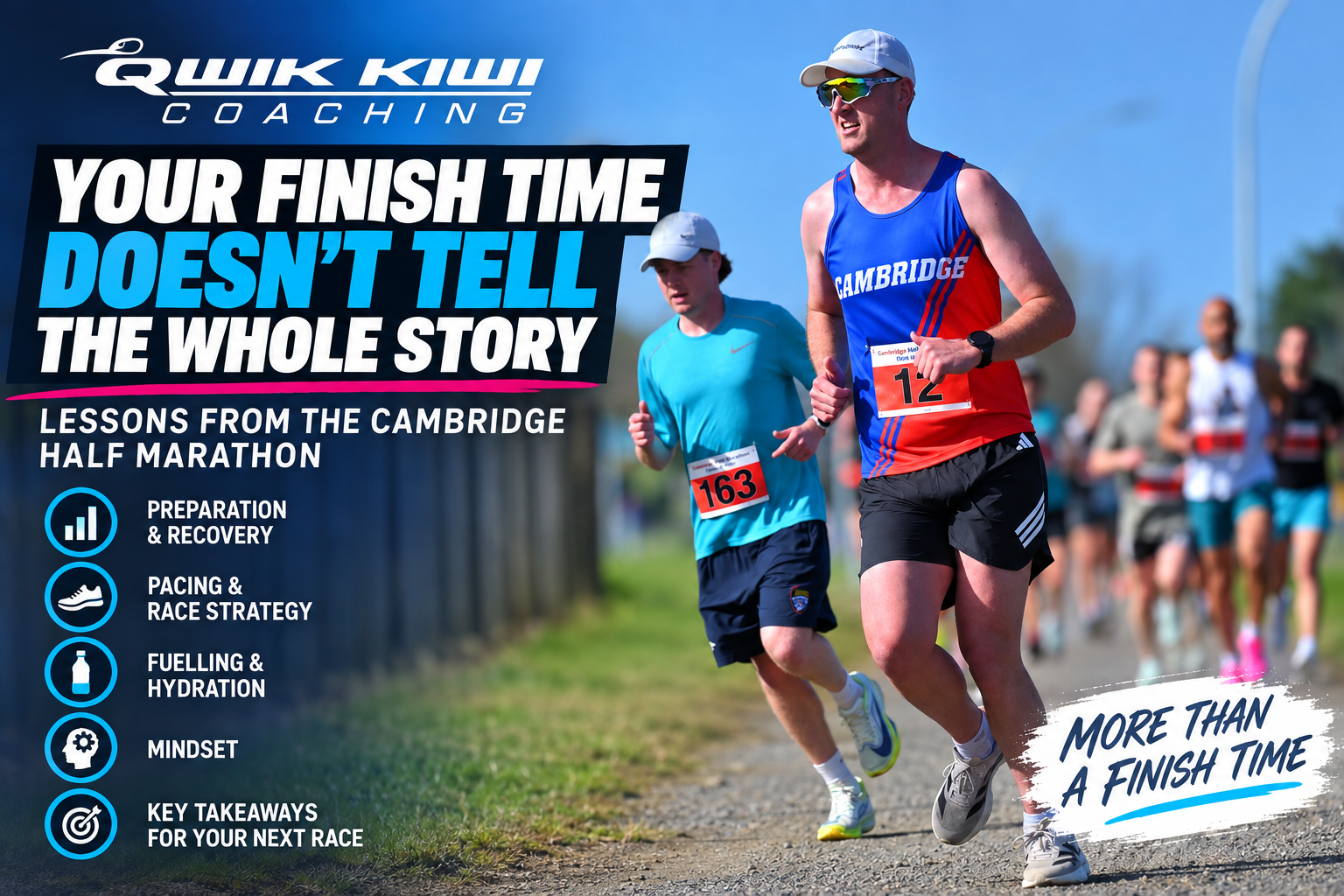
That was one of the lessons from my recent race debrief with Qwik Kiwi athlete Harrison Shaw following the Cambridge Half Marathon.
Harrison ran 1:29:45. It wasn’t quite the time we’d targeted, but he finished 24th overall, 22nd male and earned the silver medal in his age category at the Waikato Bay of Plenty Half Marathon Championships.
More importantly, when we looked beyond the finishing time, there was a lot he had done well.
Judge the Race You Actually Ran
One of the easiest mistakes after a race is comparing your finishing time against the performance you imagined under ideal conditions.
But you didn’t race in imaginary conditions.
You raced on a particular course, on a particular day, in particular weather, with whatever fitness and fatigue you brought to the start line.
Harrison encountered a significant headwind during sections of the Cambridge course. Because it was a two-lap event, he had to deal with that section twice.
The course also wasn’t quite as flat as its reputation might suggest. Although there were no major climbs, the elevation continually changed, with some individual kilometres containing meaningful climbing.
None of this means you should make excuses after a race.
It means you should add context.
There is an important difference.
An excuse attempts to remove responsibility.
Context helps explain performance so you can learn from it.
Start Your Debrief With the Preparation
Before dissecting kilometre splits, look at what happened before you reached the start line.
Ask yourself:
- How did my overall training build go?
- How fresh did I feel during race week?
- How was my sleep?
- Was I adequately hydrated?
- Did I follow my normal nutrition routine?
- Was there unusual stress in the days before the event?
- Did I arrive at the start line ready to race?
In Harrison’s case, we’d deliberately prioritised recovery during the week between his 10km club championships and the half marathon.
He felt fresher than he had going into the previous race — exactly what we’d been trying to achieve.
That’s useful information.
It tells us the adjustments made after the previous race worked.
Fitness Isn’t Built in the Final Week — But Freshness Can Be
Harrison had raced a hard 10km only one week before Cambridge.
There was very little useful fitness we could add between those two races.
There was, however, plenty of fatigue we could add if we weren’t careful.
So the emphasis became freshening him up.
That’s an important lesson when you’ve got an important race approaching:
You don’t need to prove your fitness during race week.
The hard work has already been done.
Your job is to arrive at the start line capable of expressing that fitness.
In Harrison’s case, that strategy worked. Despite the demanding conditions, he bounced back from the previous week’s difficult 10km and ran under 90 minutes for the half marathon.
A Pacing Plan Gives You Structure
Before Cambridge, Harrison and I had discussed dividing his half marathon into roughly three 7km sections.
The intention was approximately:
First 7km: controlled.
Middle 7km: gradually increase the pace.
Final 7km: race.
The actual target paces were specific to Harrison and his fitness, so they’re less important than the underlying principle.
A half marathon doesn’t need to feel like a race from the opening kilometre.
Starting conservatively gives you time to settle into the event, assess how you’re feeling and preserve your ability to increase the effort later.
Harrison’s opening kilometre was a little faster than planned — something that’s very common when adrenaline is high — but he then settled into a consistent rhythm close to the intended pace. Through the middle section he continued to track reasonably closely to the plan.
That’s good execution.
Pace Isn’t Always the Same as Effort
This becomes especially important when conditions deteriorate.
Suppose your target is 4:30min/km.
On a flat road with little wind, that might represent exactly the effort you planned.
Run 4:30min/km uphill into a strong headwind and you’re doing something very different physiologically.
Yet your watch simply displays:
4:30/km.
This is why athletes need to understand the difference between pace and effort.
Harrison noticed the headwind gradually draining his energy. It was particularly noticeable towards the end of the middle section and again later in the race.
Blindly forcing the planned pace regardless of conditions could have turned a difficult section into a complete blow-up.
Sometimes intelligent racing means allowing the pace to change while keeping the effort appropriate.
Don’t Let Your Watch Race the Course for You
A GPS watch is incredibly useful.
But it doesn’t know there’s a headwind.
It doesn’t understand the camber of the road.
It doesn’t know you’ve just climbed for several hundred metres.
It doesn’t understand the accumulated fatigue in your legs.
And it certainly doesn’t know how you’re feeling.
Use your watch as information rather than an instruction.
If you’re running into a headwind, up a hill or through another difficult section, ask:
“Is maintaining this pace worth the physiological cost?”
Sometimes the answer will be yes.
Sometimes backing off by a few seconds per kilometre will leave you in a much stronger position later.
Good pacing isn’t necessarily about producing identical splits.
It’s about distributing your available energy intelligently across the entire race.
Practise Your Fuelling Until Race Day Feels Familiar
One area Harrison executed particularly well was his nutrition.
His plan was to take a gel roughly every 30 minutes and drink some water afterwards.
Importantly, this wasn’t something we’d invented for race day.
It was what he’d been practising during his long runs.
During Cambridge, the aid-station locations happened to align well with that routine, allowing him to follow almost exactly what he’d rehearsed in training.
That’s exactly what you want.
Race day isn’t the ideal time to discover whether your stomach tolerates a particular gel or whether you can comfortably consume carbohydrate while running hard.
Practise it.
Your long runs aren’t only developing endurance.
They’re also opportunities to rehearse race-day behaviour.
Your Mindset Needs a Plan Too
We spend plenty of time developing pacing and nutrition strategies.
But what will you do when the race becomes uncomfortable?
Harrison used a remarkably simple cue:
“Lift.”
That word meant something to him.
He didn’t need a complicated motivational speech. When he noticed himself beginning to struggle, “lift” reminded him what he needed to do.
This is something any athlete can develop.
Your cue might be:
Relax.
Tall.
Strong.
Smooth.
Drive.
The particular word doesn’t matter nearly as much as the meaning you’ve attached to it.
Choose something short enough that you can remember it when you’re tired.
Reframe What Is Happening
Harrison also did something useful when negative thoughts started appearing.
Rather than interpreting the difficulty as evidence that he wasn’t capable of running well, he reminded himself that the wind was making the race harder.
That’s a subtle but important distinction.
Instead of:
“I’m falling apart.”
The interpretation becomes:
“This section is difficult because I’m running into a headwind.”
The discomfort hasn’t disappeared.
But you’ve given it an explanation that doesn’t immediately undermine your confidence.
Harrison also used competitors ahead of him as short-term targets, focusing on gradually catching the next runner rather than becoming overwhelmed by everything remaining in the race.
When a race becomes difficult, shrink the problem.
Get to the next corner.
Catch the next runner.
Reach the next kilometre marker.
Take your next gel.
Then reassess.
Adapt the Plan Before the Wheels Fall Off
Harrison couldn’t maintain the intended progression all the way through the final 7km.
But there’s an important difference between slowing slightly and completely detonating.
As fatigue and conditions accumulated, he allowed his pace to slip rather than forcing an unsustainable effort.
The wheels didn’t fall off.
He kept racing.
That’s often the difference between losing a small amount of time and losing several minutes.
A race plan should guide your decisions — not prevent you from making them.
If conditions change, your strategy may need to change with them.
In fact, one of Harrison’s main lessons afterwards was thinking more deliberately about how his race plan should adapt when weather conditions aren’t ideal.
That’s something every athlete can consider before their next race.
Don’t only create Plan A.
Ask yourself:
What will I do if it’s hot?
What changes if there’s a strong headwind?
What if it’s raining?
What if I reach halfway and feel considerably better — or worse — than expected?
You’re not predicting every possible scenario.
You’re preparing yourself to make sensible decisions.
Don’t Underestimate the Ability to Bounce Back
Perhaps one of the most important things Harrison identified in the debrief had nothing to do with his finishing time.
When I asked what he’d learned about himself as an athlete, he highlighted his ability to bounce back after the difficult 10km the previous weekend.
That’s valuable.
A disappointing performance can easily follow you into the next race.
You start questioning your fitness.
You lose confidence.
You start changing things that don’t necessarily need changing.
Instead, we reviewed the 10km, identified what had happened, adjusted his training and moved forward.
Seven days later, Harrison produced a much stronger performance.
That doesn’t mean you should forget disappointing races.
It means you should learn from them without carrying them around with you.
So, Was It a Good Race?
After every race, the clock gives you one answer.
Your debrief should give you several more.
Ask:
Did I prepare well?
Did I execute my pacing strategy appropriately?
Did I adapt when circumstances changed?
Did my nutrition and hydration work?
How did I respond mentally when things became difficult?
Did I keep racing when my original target became harder to achieve?
What should I repeat next time?
What should I change?
Harrison didn’t get the finishing time we’d originally targeted at Cambridge.
But he raced intelligently.
He handled difficult conditions.
His fuelling worked.
His pacing was considerably better.
He responded well mentally.
He bounced back from a tough race only seven days earlier.
And he came away with a silver medal from the Waikato Bay of Plenty Half Marathon Championships.
I’d call that plenty of useful evidence that the process is moving in the right direction.
Your Finish Time Is a Result. Your Race Is a Story.
Don’t ignore the clock.
But don’t allow one number to tell you everything about your performance either.
Look at the preparation.
Look at the conditions.
Look at your pacing.
Look at your fuelling.
Look at your decisions.
Look at what happened when things became difficult.
Then identify what you’ll carry forward into the next training block.
Because the purpose of a race debrief isn’t to decide whether you should feel good or bad about what happened.
It’s to make you a better athlete for what comes next.
Want to Get More From Your Training and Racing?
If you’re putting in the training but aren’t sure whether you’re getting the best from it — or you’d like someone to help you make sense of your training data, race performances, pacing and preparation — let’s have a conversation.
I offer a free 40-minute coaching consultation where we can discuss your goals, your current training, what’s working and where there may be opportunities to improve.
There’s no obligation to sign up for coaching afterwards. It’s simply an opportunity to talk about your training and see whether working together would be a good fit.
Book your free 40-minute coaching consultation with Coach Ray:
Train smart. Race smarter.
Coach Ray Boardman
Qwik Kiwi Coaching