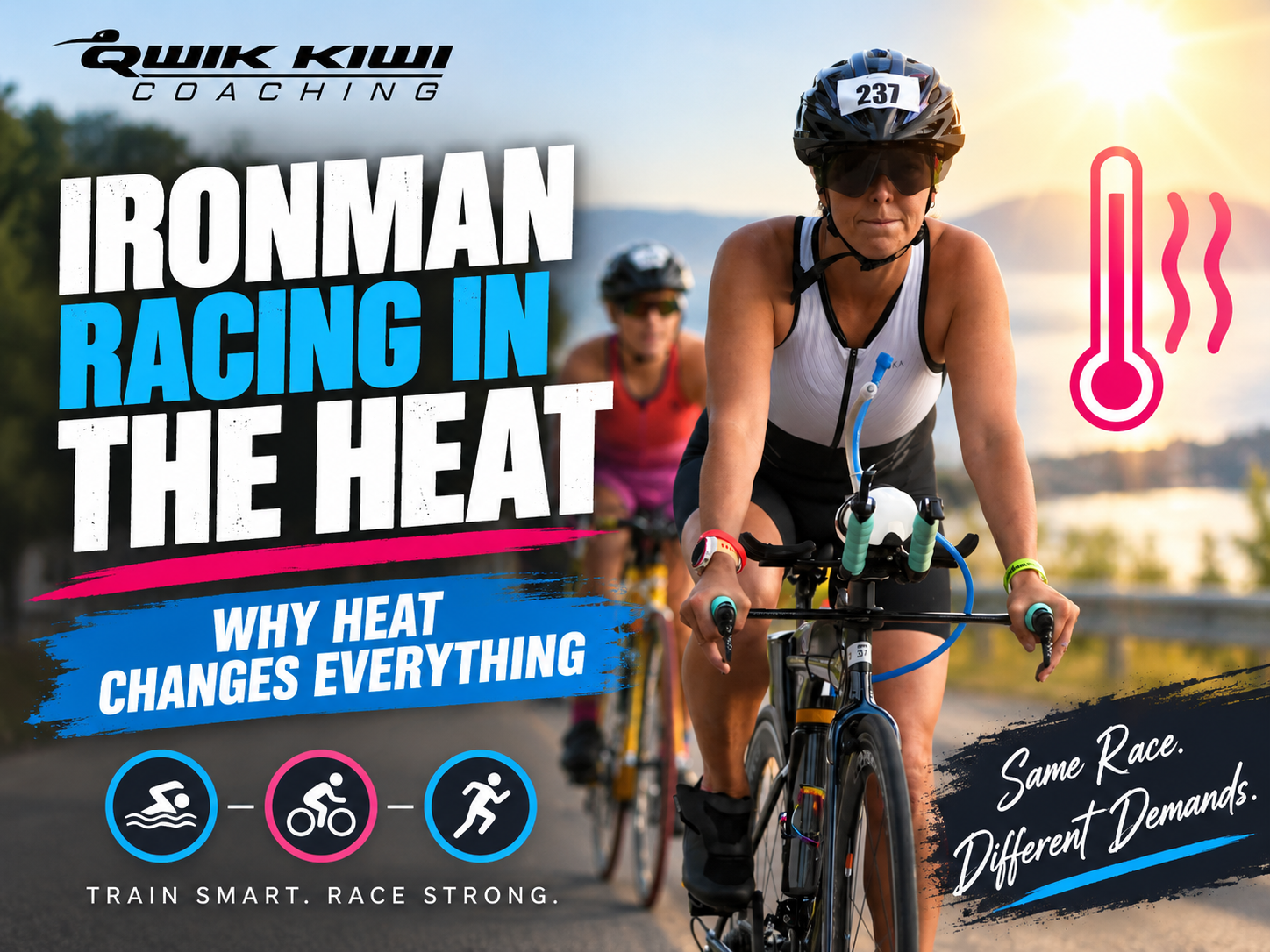
You can arrive at an Ironman with excellent fitness, a carefully rehearsed pacing strategy and a nutrition plan you’ve practised for months.
Then race day is hotter than expected.
Suddenly, the effort that normally feels comfortable doesn’t feel comfortable. Your heart rate climbs. You’re sweating more. Your thirst increases. Your nutrition becomes harder to manage. The pace or power you expected to hold starts becoming increasingly expensive.
That doesn’t necessarily mean your fitness has disappeared.
Heat changes the demands of the race.
And one of the biggest mistakes you can make is pretending it doesn’t.
Your Normal Numbers May Not Be Your Race-Day Numbers
Most athletes go into an Ironman with some idea of the power they want to ride and the pace they hope to run.
Those targets are useful—but they’re not promises.
Environmental conditions matter.
IRONMAN’s own guidance encourages athletes to know the expected weather and recognise when indicators such as heart rate or muscular strain suggest that their planned pace needs adjusting. (Ironman)
If you normally ride at a particular power or run at a particular pace, trying to force those same numbers in significantly hotter conditions can dramatically change the physiological cost.
That is where good race execution becomes important.
Your goal isn’t to prove that you can hold the numbers you wrote down before the race.
Your goal is to get to the finish line as quickly as your preparation and the conditions allow.
Heat Makes Pacing Even More Important
An Ironman already rewards patience.
A hot Ironman rewards it even more.
The early kilometres of the bike can feel deceptively manageable. You’re fresh, motivated and surrounded by other athletes. It’s easy to convince yourself that everything is going perfectly.
But heat stress accumulates.
That slightly excessive effort early in the bike can become much more significant several hours later.
The same principle applies when you reach the marathon.
Your planned running pace may have been completely realistic under the conditions you trained in. If race day is substantially hotter, blindly chasing that pace can turn the opening kilometres into an expensive mistake.
Adjusting your pace isn’t giving up on your race plan. It is adapting your race plan.
Hydration Needs Can Change
Hotter conditions usually mean more sweating, which makes your hydration strategy increasingly important.
That doesn’t mean simply drinking as much as possible.
Your hydration plan needs to account for your individual needs, the conditions and what you have practised in training. The Australian Institute of Sport specifically includes hydration, heat acclimation and cooling strategies among the key considerations when preparing athletes for thermally challenging environments. (Australian Sports Commission)
IRONMAN also advises athletes to understand what hydration and nutrition will be available on their particular course. Current IRONMAN guidance notes that hydration requirements may need to change when conditions are hotter than expected. (Ironman)
This is another reason your race nutrition and hydration strategy should be practised rather than invented on race morning.
Don’t Forget About Your Fuelling
Heat doesn’t suddenly make carbohydrates unnecessary.
You still need to fuel the work you’re asking your body to perform.
But hotter conditions can make the practical execution of your nutrition plan more challenging. That is why your fuelling and hydration strategies need to work together without becoming the same thing.
For example, if hotter conditions mean you need more fluid, you don’t necessarily want every additional mouthful of fluid to automatically increase your carbohydrate intake beyond what you’ve practised.
IRONMAN’s current on-course hydration guidance specifically discusses the potential benefit of being able to adjust fuelling and hydration independently when conditions change. (Ironman)
This is where all those long training sessions matter.
You’re not just developing fitness. You’re learning how your body responds to drinking, eating and exercising for hours at a time.
Prepare for Heat Before Race Day
If there’s a realistic chance your Ironman will be hot, preparation shouldn’t begin when you read the weather forecast three days before the race.
Heat acclimation or acclimatisation can form part of preparation for competing in hot environments. The AIS identifies both active approaches, such as exercising in hot conditions, and passive approaches such as post-training heat exposure as strategies that may be used when preparing athletes for heat. (Australian Sports Commission)
The appropriate approach depends on the athlete, their training programme, their health and the conditions they’re preparing for.
But the broader principle is straightforward:
Prepare for the conditions you may actually race in.
That can also mean testing clothing, hydration, nutrition and cooling strategies during training rather than discovering on race day that your plan doesn’t work when the temperature rises.
Use Cooling Opportunities Wisely
Cooling strategies can also play a role in managing thermal strain.
Depending on what is available at your event, that might include cold fluids, ice or water at aid stations, as well as sensible choices before the race. The AIS includes cooling alongside acclimation and hydration in its resources for athletes preparing for hot conditions. (Australian Sports Commission)
But once again, don’t turn race day into an experiment.
Know what will be available. Decide beforehand how you might use it. Practise relevant strategies where practical.
The hotter the day becomes, the more valuable good decision-making can be.
Race the Conditions You Have
One of the hardest things about a hot Ironman is letting go of the race you imagined.
You might have trained for a particular bike split.
You might have a marathon pace written on your race plan.
You might have a finishing time you’ve thought about for months.
But you don’t get to choose race-day conditions.
You only get to choose how you respond to them.
If the day is hotter than expected, your power, pace, hydration and cooling strategy may all need to change.
Trying to force your original plan regardless of conditions doesn’t make you tougher.
Smart Ironman racing means responding to the race that is actually happening.
Respect the heat early, and you give yourself a much better opportunity to keep racing later.
Because in an Ironman, heat changes everything.
Ready to Build Your Best Ironman Yet?
Whether you’re training for your first Ironman, chasing a personal best, or simply trying to avoid the common mistakes that derail so many race days, having the right plan can make all the difference.
If you’d like to discuss your training, race goals, nutrition, pacing, or race-day strategy, I’d love to help.
Book a free, no-obligation 40-minute coaching consultation and let’s chat about how we can get you to the start line feeling confident and prepared.
👉 Book your free 40-minute coaching consultation
Train smart. Race strong.