You’ve trained for months.
You’ve practised your swim pacing, spent hours building strength and endurance on the bike, and completed countless kilometres preparing your legs for the half marathon.
Then you arrive at your Ironman 70.3, walk through the expo and somebody hands you a sample of a new energy gel.
It tastes good.
The packaging promises plenty of carbohydrate.
So you decide to put a couple in your race bag.
Don’t.
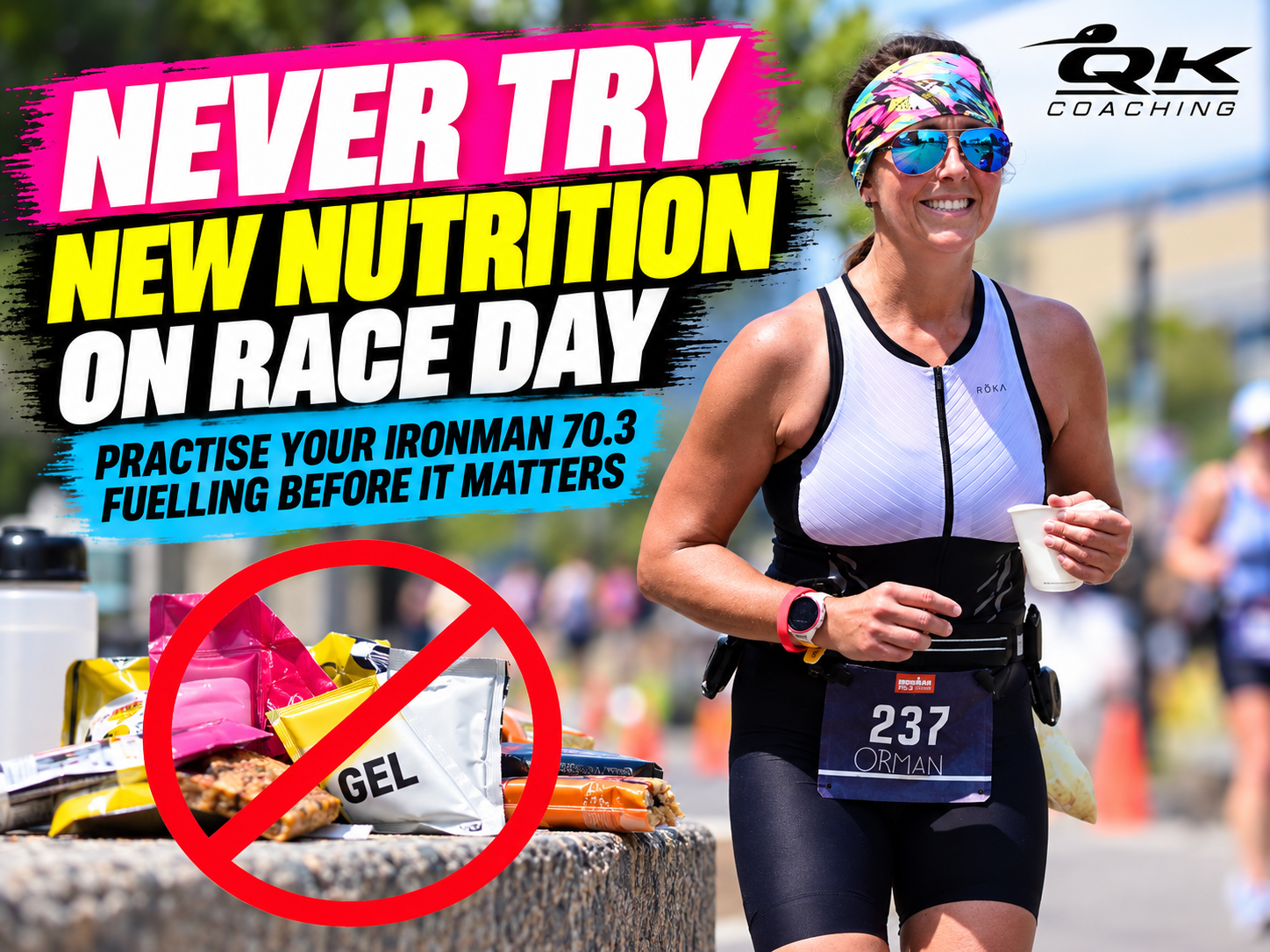
Race day is not the time to discover whether a new gel, sports drink, energy bar or other nutrition product agrees with your stomach.
One of the simplest rules you can follow for Ironman 70.3 nutrition is:
Nothing new on race day.
IRONMAN itself promotes the same principle in its race-preparation guidance: athletes should test their equipment, routines and nutrition before race day rather than introducing something unfamiliar when the result matters. (Ironman)
Your Nutrition Strategy Needs Training Too
Most athletes understand that they need to train their body for an Ironman 70.3.
But your nutrition strategy needs training as well.
An Ironman 70.3 consists of a 1.9km swim, 90km bike and 21.1km run. For most age-group athletes, that means several hours of continuous exercise.
Carbohydrate intake during prolonged endurance exercise can support performance, with recommendations for longer events commonly reaching around 60–90g of carbohydrate per hour depending on duration, intensity and individual tolerance. (OUP Academic)
But knowing how many grams of carbohydrate you intend to consume is only part of the equation.
You also need to know:
- Which products you’ll use.
- How frequently you’ll consume them.
- How much fluid you need with them.
- Whether you can comfortably digest them at race intensity.
- Whether you still enjoy the flavour after several hours.
- How you’ll carry them.
- What nutrition will be available at aid stations.
- What you’ll do if your original plan goes wrong.
Those questions should be answered during training, not halfway through your race.
A Gel Is Only Useful If You Can Tolerate It
Nutrition labels can tell you how much carbohydrate, sodium or caffeine a product contains.
They can’t tell you how your stomach will respond to it during an Ironman 70.3.
A gel that works perfectly for your training partner might leave you feeling nauseous.
A sports drink you enjoy while sitting at home might taste overwhelmingly sweet after three hours of racing.
A bar that seems easy to chew before training might become surprisingly difficult to eat while riding hard.
Even the consistency of a gel can make a difference when you’re hot, breathing heavily and several hours into an event.
That’s why your race nutrition needs to be tested in the environment where you’re actually going to use it:
while exercising.
Use Your Long Training Sessions as Nutrition Rehearsals
Your long rides and brick sessions aren’t just opportunities to build fitness.
They’re also some of your best opportunities to rehearse your Ironman 70.3 nutrition strategy.
As your race approaches, key race-specific sessions should increasingly resemble what you plan to do on race day.
Use the same gels.
Mix your drink to the same concentration.
Carry your nutrition in the same places on your bike.
Practise opening packaging while riding safely.
Eat and drink at approximately the same times you intend to during your race.
Then pay attention.
How does your stomach feel?
Do you remain comfortable when you start running?
Is your nutrition easy to access?
Are you getting tired of a particular flavour?
Are you forgetting to fuel when the riding becomes harder or more technical?
Make your mistakes in training, where they become useful information.
Don’t Let the Race Expo Change Your Plan
Race expos are full of interesting products.
That’s part of the fun.
You might find a new gel flavour, sports drink, chew, bar or supplement that you’d like to try.
Great.
Try it after the race.
Your final 24–48 hours before an Ironman 70.3 are not the time to suddenly improve a nutrition strategy you’ve spent weeks or months developing.
The same applies to your pre-race meals and breakfast.
If your normal race-morning breakfast has worked during your training rehearsals, there is little reason to replace it simply because somebody tells you about a supposedly better option at registration.
Race week should become increasingly predictable.
Your nutrition can be boring.
Boring is good.
Know What Your Race Will Provide
There is one important complication: you may intend to use nutrition supplied by the event.
That’s perfectly reasonable.
But find out what is being provided before race week.
Check the Athlete Guide and official information for your particular event rather than assuming every race will offer exactly the same products.
For example, IRONMAN’s current 2026 information identifies Maurten as its official sports nutrition partner and Precision Fuel & Hydration as its global hydration partner, while individual event pages detail exactly what is available on course. (Ironman)
Those arrangements can change, and availability can vary between events, so always check your own race information.
If you intend to rely on an on-course product, obtain some beforehand and use it during training.
The first time you drink the race’s sports drink shouldn’t be at an aid station.
Be Particularly Careful With Caffeine
Caffeine deserves additional attention.
Some gels and other sports nutrition products contain caffeine while visually looking very similar to their non-caffeinated versions.
That can make grabbing an unfamiliar product at an aid station more significant than you might realise.
If caffeine is part of your race nutrition strategy, know how much you plan to consume and where it is coming from.
For example, IRONMAN New Zealand’s current course information lists both Maurten GEL 100 and GEL 100 CAF 100, with the caffeinated version containing 100mg of caffeine per sachet. (Ironman)
That doesn’t mean you need to avoid caffeine.
It means caffeine should be part of your plan rather than an accident.
Have a Backup Plan
“Nothing new on race day” doesn’t mean race day will always go perfectly.
You could drop a bottle.
A gel could fall out of your pocket.
An aid station might not have what you expected when you arrive.
You might become tired of the flavour you’ve been consuming.
Your stomach may simply decide that your carefully rehearsed Plan A isn’t working quite as well as usual.
That’s why it can be useful to practise backup options too.
Know which on-course products you tolerate.
Know what alternatives you can comfortably use.
Understand which products contain carbohydrate, caffeine and electrolytes rather than blindly grabbing whatever is available.
The goal isn’t to create an inflexible nutrition strategy.
It’s to create a well-rehearsed strategy with well-rehearsed alternatives.
Practise Nutrition at Race Intensity
There’s another important distinction.
Eating a gel during an easy Sunday ride isn’t necessarily the same as consuming it during your Ironman 70.3.
Intensity matters.
So does heat.
And accumulated fatigue.
As you progress through your preparation, use appropriate race-specific sessions to test your nutrition under increasingly realistic conditions.
That might include consuming your planned nutrition during a long ride containing extended periods at your expected race effort, followed by a run off the bike.
You’re not trying to turn every training session into a race simulation.
You’re making sure your nutrition still works when the demands become more representative of race day.
Don’t Copy Another Athlete’s Nutrition Plan
Your training partner might swear by one particular gel.
Another athlete might prefer liquid carbohydrate.
Someone else might use a mixture of gels, chews and solid food.
That doesn’t make any of those strategies automatically right for you.
Current endurance research supports carbohydrate intake during prolonged exercise, but the appropriate amount and delivery method need to consider event duration and individual tolerance. (OUP Academic)
Develop your strategy using sound nutrition principles, then practise it on yourself.
Your race nutrition needs to work for your body, your pace, your expected race duration and your stomach.
By Race Week, Your Nutrition Should Feel Familiar
As you approach your Ironman 70.3, there should be fewer unanswered questions.
You should know what you’re having for breakfast.
You should know what goes on your bike.
You should know when you’re going to start fuelling.
You should know approximately how much carbohydrate you’re targeting.
You should know what you’re carrying onto the run.
You should know what’s available at the aid stations.
And, importantly, you should have already consumed those products during training.
Race day has enough variables without voluntarily introducing another one.
Make Your Experiments in Training
Training is where you experiment.
Training is where you discover that a particular gel doesn’t agree with you.
Training is where you realise your drink mixture is too strong.
Training is where you discover that your favourite flavour becomes unbearable after three hours.
Training is where you learn how much fluid you need with your nutrition.
Training is where you refine your plan.
Race day is where you execute it.
So when somebody offers you an exciting new nutrition product at the expo the day before your Ironman 70.3, there’s nothing wrong with taking it.
Just put it in your bag and save it for another day.
Never try new nutrition on race day.
Your stomach will probably thank you.
Want Help Planning Your Ironman 70.3?
If you’re preparing for an Ironman 70.3 and want help developing your training, pacing or race-day strategy, you can book a free, no-obligation 40-minute coaching consultation with me.
We can discuss where your training is currently at, what you’re preparing for, and practical ways to approach your race with greater confidence.
Book a free 40-minute coaching consultation with Coach Ray
Train smart. Practise your plan. Race with confidence.