There’s something satisfying about a workout where the repetitions become shorter as you progress — but don’t mistake decreasing distance for an easy finish.
This week’s Saturday Swim Session uses a descending ladder of freestyle and Pull Buoy work. Each round begins with continuous freestyle before moving into a series of 100m Pull repetitions. As the freestyle distance drops by 100m, the number of Pull repetitions drops by one.
By the time you reach the bottom of the ladder, you’ll have accumulated plenty of quality swimming while repeatedly switching between normal freestyle and Pull Buoy swimming. You’ll then finish the main work with 100m of kicking before cooling down.
Each Saturday I post a Swim Session, and most weeks I provide three options so you can choose a distance appropriate for your current training:
- Option A: 1,000–2,000m
- Option B: 2,000–3,000m
- Option C: More than 3,000m
You can also read my guide to Swim Intensity if you’re unsure how I prescribe swimming effort.
Today’s Goal
The goal of this workout is to develop freestyle endurance and consistency while repeatedly transferring your Pull Buoy work back into normal swimming.
The descending structure gives the session a natural progression. Depending on your chosen option, you’ll begin with 300m, 400m or 500m of freestyle, followed by the equivalent number of 100m Pull repetitions.
Each time through, both parts of the combination decrease.
Don’t simply count down the metres. Pay attention to how your stroke feels with the Pull Buoy and what you can carry back into your next freestyle repetition.
Why You’re Doing This Session
Pull Buoy work allows you to remove much of the contribution from your kick and concentrate more closely on your upper-body swimming.
That gives you an opportunity to focus on your catch, pull, body position and rhythm.
The useful part of this workout, however, isn’t simply accumulating Pull Buoy metres.
You continually move between Pull and normal freestyle. When the Pull Buoy comes out, try to retain the strong catch and controlled upper-body mechanics you were just practising while reintegrating your kick and maintaining your body position.
As the distances descend, you also have the opportunity to maintain — or gradually improve — the quality of your swimming rather than allowing technique to deteriorate as fatigue accumulates.
Session Inspiration
This workout comes from the Guide to Triathlon Swimming, a supplement published with Triathlon Plus, Issue 46 in October 2012.
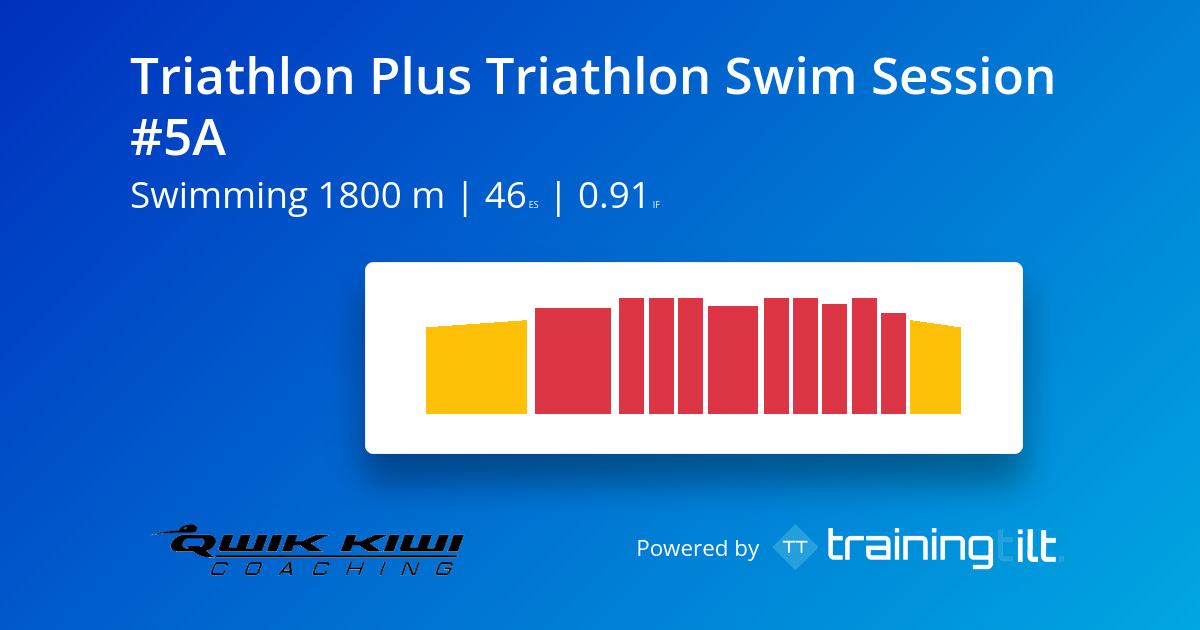
Option A is the original workout from the supplement: a 300m Warm Up followed by a descending sequence beginning with 300m freestyle and 3 × 100m Pull, then 200m freestyle and 2 × 100m Pull, before finishing with 100m freestyle, 100m Pull, 100m Kick and a 200m Cool Down.
That produces a total distance of 1,800m.
I’ve used the same concept to develop two higher-volume versions.
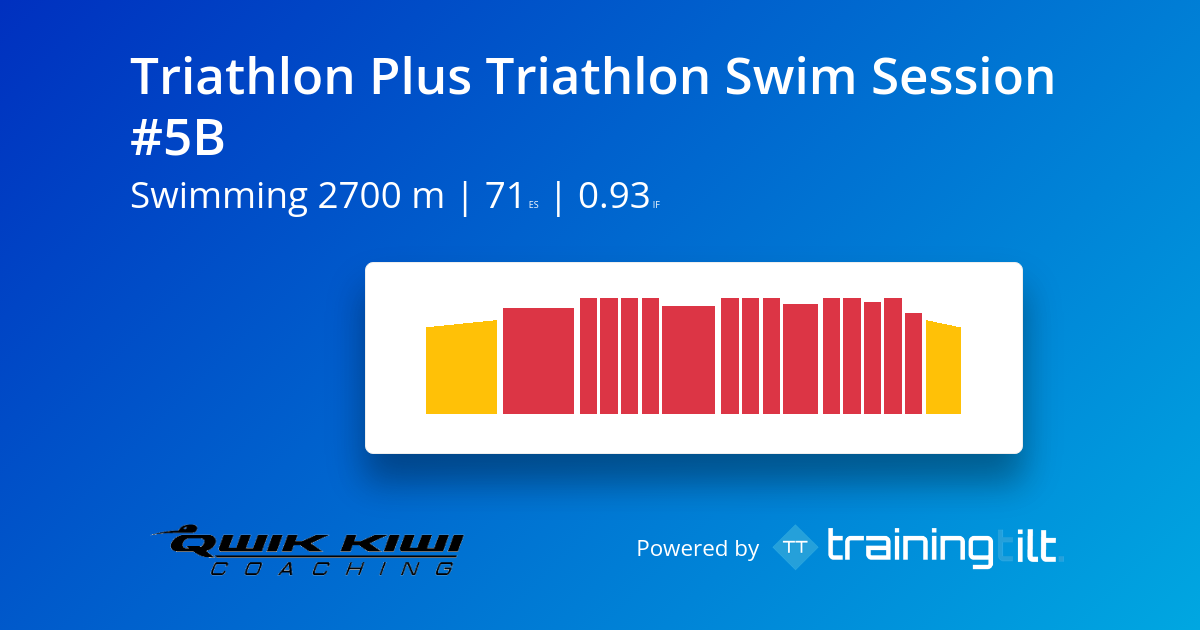
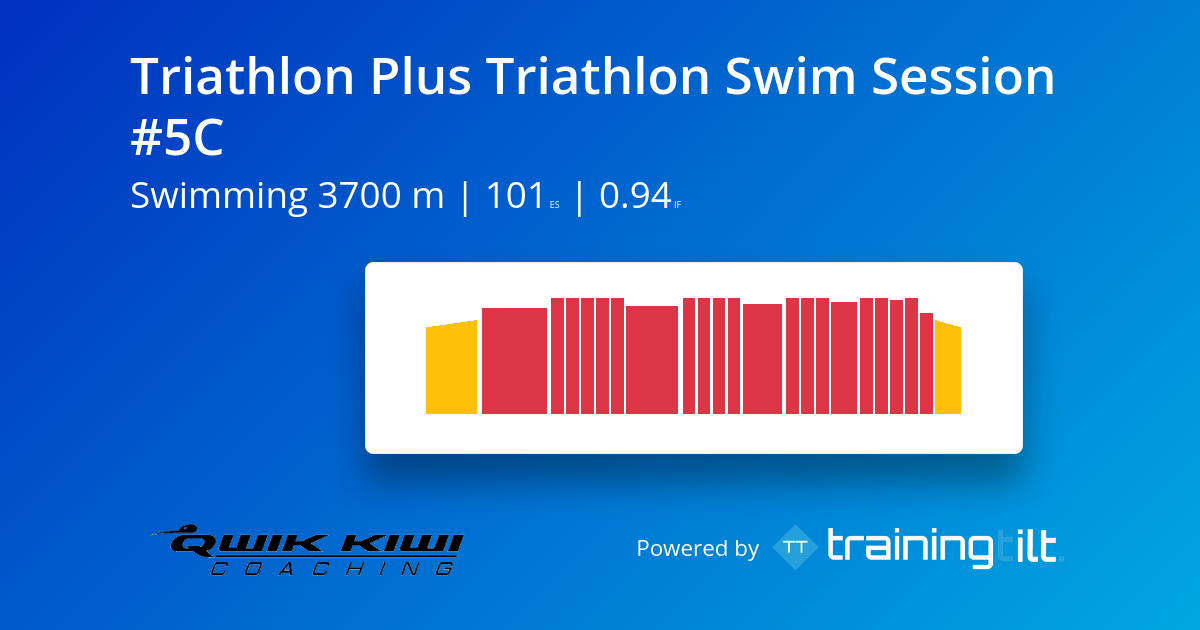
Option B begins the ladder at 400m freestyle and 4 × 100m Pull for a total of 2,700m, while Option C starts at 500m freestyle and 5 × 100m Pull for a total of 3,700m.
Today’s Workout
Option A – 1,800m
- 300m WU
- 300m, 30sec RI
- 3 × 100m Pull, 15sec RI
- 200m, 20sec RI
- 2 × 100m Pull, 15sec RI
- 100m, 15sec RI
- 100m Pull, 15sec RI
- 100m Kick
- 200m CD
Option B – 2,700m
- 400m WU
- 400m, 30sec RI
- 4 × 100m Pull, 15sec RI
- 300m, 30sec RI
- 3 × 100m Pull, 15sec RI
- 200m, 20sec RI
- 2 × 100m Pull, 15sec RI
- 100m, 15sec RI
- 100m Pull, 15sec RI
- 100m Kick
- 200m CD
Option C – 3,700m
- 400m WU
- 500m, 30sec RI
- 5 × 100m Pull, 15sec RI
- 400m, 30sec RI
- 4 × 100m Pull, 15sec RI
- 300m, 30sec RI
- 3 × 100m Pull, 15sec RI
- 200m, 20sec RI
- 2 × 100m Pull, 15sec RI
- 100m, 15sec RI
- 100m Pull, 15sec RI
- 100m Kick
- 200m CD
What You Should Focus On
The workout should feel like one connected descending ladder, rather than a collection of unrelated repetitions.
During the freestyle portions, establish a controlled rhythm and concentrate on maintaining good technique throughout the entire distance.
When you add the Pull Buoy, pay attention to what happens to your stroke. With less contribution from the legs, you can focus more closely on establishing a strong catch and effective pull.
Then notice what happens when you remove the Pull Buoy again.
Can you maintain that same connection with the water?
Can you keep your upper body working effectively while bringing your kick back into the stroke?
As the repetitions become shorter, resist the temptation to turn the session into a race. The decreasing distance should allow you to preserve the quality of your swimming as fatigue accumulates.
Common Mistakes To Avoid
Swimming the opening repetition too hard: Particularly with Option C, there’s plenty of work still to come after that first 500m.
Treating the Pull Buoy as passive swimming: The Pull repetitions aren’t simply recovery between freestyle efforts. Use them purposefully to work on your stroke.
Over-relying on the Pull Buoy for body position: Notice how your body position changes when you remove it. The aim is to transfer useful elements back into normal freestyle.
Rushing the 15-second Rest Intervals: Fifteen seconds isn’t much recovery. Use it to reset rather than becoming distracted at the wall.
Increasing speed at the expense of technique: The repetitions become shorter, but that doesn’t mean your stroke should become rushed.
Using a kickboard for the final 100m: The prescribed kick is an opportunity to work on body position as well as kicking rather than simply holding onto a board. See the video below:
Tips For Completing The Workout Successfully
Think of each freestyle-plus-Pull combination as one step down the ladder.
For Option C, for example:
500m + 5 × 100m Pull
400m + 4 × 100m Pull
300m + 3 × 100m Pull
200m + 2 × 100m Pull
100m + 1 × 100m Pull
That makes the structure easy to remember.
Try to keep your Pull 100s consistent rather than progressively slowing as fatigue builds. The short 15-second RI means sensible pacing will be important.
During the freestyle repetitions, look for something from the Pull set that you can carry across — perhaps your catch, your feel for the water or the connection through the pulling phase of your stroke.
Workout Breakdown
Warm Up
Start with:
- Option A: 300m
- Options B & C: 400m
Use mixed swimming and include a range of strokes.
The Warm Up doesn’t need to be continuous. Feel free to stop and stretch as required before beginning the main set.
Main Set – Descending Swim & Pull Ladder
Start with:
- Option A: 300m freestyle + 3 × 100m Pull
- Option B: 400m freestyle + 4 × 100m Pull
- Option C: 500m freestyle + 5 × 100m Pull
After each round, decrease the freestyle distance by 100m and reduce the Pull set by one × 100m.
Continue until you reach:
100m freestyle + 1 × 100m Pull.
Take:
- 30sec RI after the 300m, 400m and 500m freestyle repetitions
- 20sec RI after the 200m freestyle
- 15sec RI after the 100m freestyle
- 15sec RI after every 100m Pull repetition
The swimming portions of the main set are freestyle.
Kick – 100m
After completing the descending ladder, swim 100m Kick.
Avoid using a kickboard. Instead, use Kick On Front, allowing you to concentrate on your kicking while maintaining a streamlined swimming position.
Cool Down
Finish all three options with a 200m Cool Down.
Your Cool Down can include any stroke you wish. It doesn’t need to be continuous, and you can stop to rest or stretch after any length.
After Your Swim
Once you’ve finished, consider:
- Did I pace the longer freestyle repetitions appropriately?
- Were my Pull 100s consistent throughout the workout?
- What changed about my stroke when I added the Pull Buoy?
- Could I carry that feeling back into normal freestyle?
- Did my technique remain controlled as fatigue accumulated?
- Did the shorter repetitions feel stronger towards the bottom of the ladder?
- How did my body position feel during the 100m Kick without a kickboard?
The descending distances make this workout psychologically easier as you work towards the bottom of the ladder, but the real benefit comes from maintaining quality throughout the entire session.
Use the Pull Buoy to sharpen your awareness of your upper-body swimming, then see how effectively you can carry that feeling back into freestyle.
By the time you reach the final 100m, you want to be swimming with the same — or better — technical quality than you had at the top of the ladder.
Want 8 Weeks of Swim Sessions Like This?
If you enjoyed today’s workout, why stop at just one?
Download my FREE Swim Engine Builder Workout Pack and receive 24 structured swim sessions spread across three training options:
🏊 Foundation – Under 2,000m per session
🏊 Performance – 2,000–3,000m per session
🏊 Endurance – 3,000m+ per session
Whether you’re swimming for fitness, preparing for your next triathlon or simply looking for more variety in the pool, you’ll have eight weeks of purposeful workouts ready to go.
👉 Download your FREE Swim Engine Builder Workout Pack today and start building a stronger swim engine!
