You don’t need to ride harder every time you want to become a better cyclist.
Sometimes the objective is to ride better.
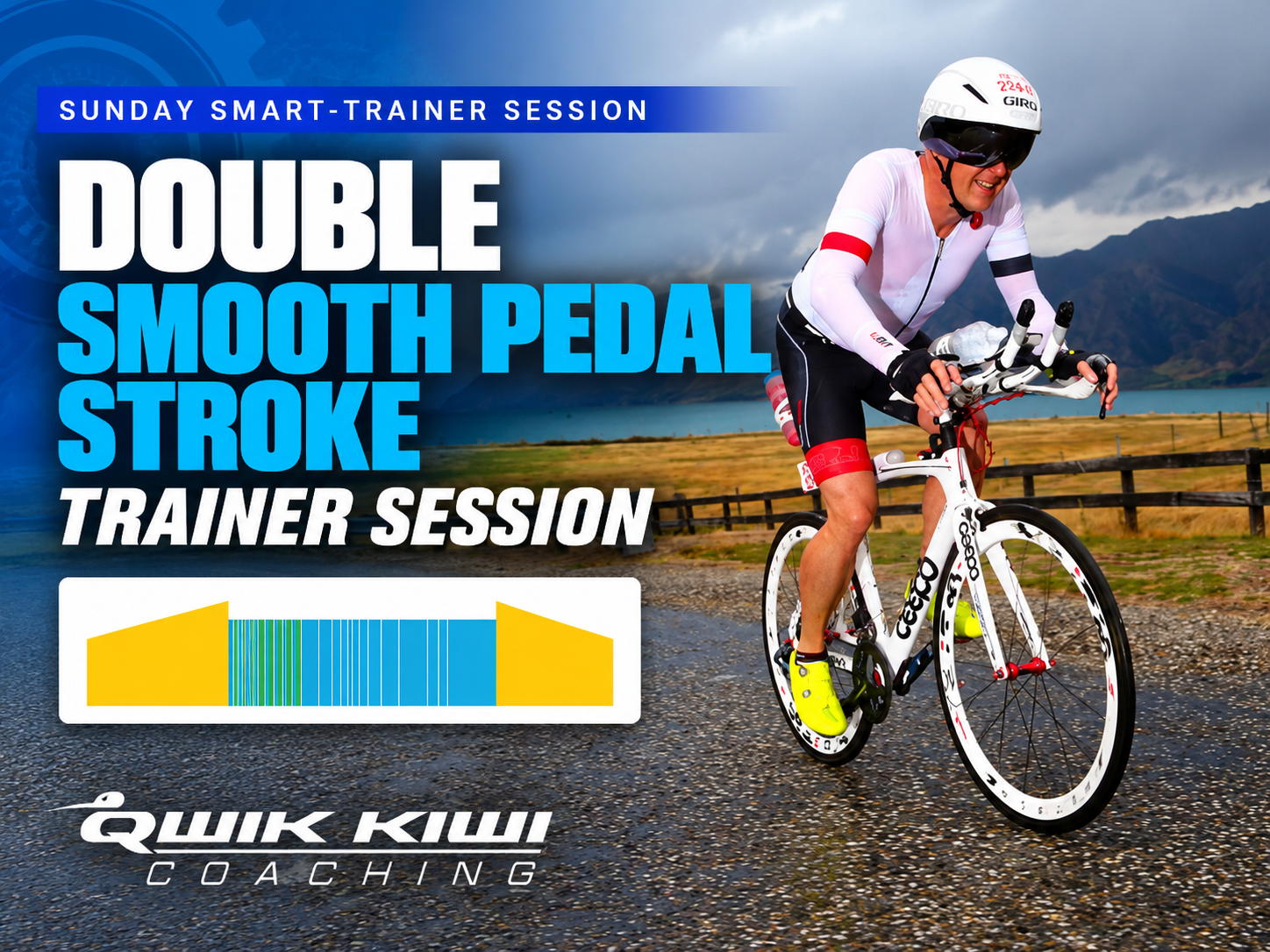
The Double Smooth Pedal Stroke Trainer Session is a 60-minute Level II workout designed to develop your pedalling technique, coordination and ability to maintain a smooth pedal stroke across a wide range of cadences.
You’ll start with single-leg drills to expose weaknesses in different parts of your pedal stroke. Then you’ll complete two cadence pyramids, progressively increasing from 90–95rpm to more than 110rpm before working your way back down again.
The important part?
The intensity stays at Level II throughout.
As your cadence increases, the objective isn’t to produce more and more power. Instead, you’re learning to pedal faster while remaining controlled, relaxed and technically efficient.
Stay easy. Pedal smoothly. Control the cadence.
Session Inspiration
The inspiration for this session came from a workout by Marilyn Chychota, a former elite cyclist and triathlete who went on to coach endurance athletes.
I originally adapted the workout into my Smooth Pedal Stroke session, which you can find here:
This Double Smooth Pedal Stroke Trainer Session builds on that concept by completing the main cadence pyramid twice.
What I like about the session is that you can create a substantial technical challenge without turning it into a high-intensity workout.
You’re staying at Level II while manipulating cadence.
That distinction is important.
Today’s Workout
Warm-Up
- 20min Level II
Start with 20 minutes of steady Level II riding.
There’s no need to rush the warm-up. Settle into a comfortable rhythm and concentrate on relaxed, smooth pedalling.
Use this time to prepare your legs for the technique work that follows.
Single-Leg Drills
Complete four rounds of:
- 30sec Single-Leg Drill — Left
- 30sec Both Legs
- 30sec Single-Leg Drill — Right
- 30sec Both Legs
Keep everything at Level II.
Each round lasts two minutes, giving you a total of eight minutes of single-leg drill work.
Main Set — Cadence Pyramid
Complete the following pyramid twice, remaining at Level II throughout:
- 2min at 90–95rpm
- 1:30min at 95–100rpm
- 1min at 100–105rpm
- 45sec at 105–110rpm
- 30sec at 110+rpm
- 45sec at 105–110rpm
- 1min at 100–105rpm
- 1:30min at 95–100rpm
- 2min at 90–95rpm
Each pyramid takes 11 minutes, giving you 22 minutes of cadence work.
There is no additional Rest Interval between the two pyramids. Once you’ve completed the last two minutes at 90–95rpm, begin the second pyramid.
Cool-Down
- 10min Level II
Finish with ten minutes of comfortable Level II riding.
Stretching
- 10min stretching
Total riding duration: 60 minutes
Why You’re Doing This Session
This isn’t primarily a fitness session.
It’s a cycling technique session.
The single-leg drills and cadence pyramids challenge your neuromuscular coordination in different ways.
During the single-leg work, removing one leg from the equation makes it much harder for the other leg to disguise inconsistencies in your pedal stroke.
You may notice a dead spot.
You may struggle through part of the circle.
Your pedal stroke might become jerky.
That’s useful feedback.
You’re not trying to produce enormous power with one leg. You’re using the drill to become more aware of how you’re applying force throughout the pedal stroke.
The cadence pyramids then present a different challenge.
As your cadence rises from 90–95rpm through to more than 110rpm, you’re asking your legs to move progressively faster without allowing the intensity to increase beyond Level II.
That’s the skill.
Intensity Stays Level II — Cadence Changes
This is probably the most important coaching point in the entire workout.
Don’t confuse cadence with intensity.
When the workout asks you to increase from 90rpm towards 110+rpm, it doesn’t mean you should also progressively increase your power.
You’re still riding at Level II.
As cadence increases, adjust your gearing or resistance as necessary so you can remain within the prescribed intensity.
The challenge is to maintain your Level II effort while your legs turn faster.
At 110+rpm, you might feel as though you’re working considerably harder simply because of the increased leg speed. But don’t turn that final 30 seconds into a sprint.
The objective is controlled speed, not maximal cadence.
What You Should Focus On
During the Single-Leg Drills
Concentrate on producing the smoothest pedal stroke you can.
Don’t worry if it isn’t perfectly circular.
Instead, notice where the pedal stroke becomes less smooth.
Keep your upper body relaxed and avoid rocking your hips in an attempt to force the pedal around.
When you return to both legs, try to retain the awareness you developed during the single-leg work.
During the Cadence Pyramids
As cadence increases, focus on staying relaxed.
Your shoulders shouldn’t rise.
Your hands shouldn’t tighten around the handlebars.
Your hips shouldn’t start bouncing on the saddle.
Instead, let your legs do the work.
The faster the cadence becomes, the more important control becomes.
Common Mistakes to Avoid
Increasing power as cadence increases.
The workout remains at Level II. Adjust the gearing or resistance rather than allowing each cadence step to become progressively harder.
Trying to set a cadence record.
The 110+rpm section isn’t a competition to see how quickly you can move your legs. Ride as quickly as you can while maintaining control and good technique.
Bouncing in the saddle.
If your hips begin bouncing as cadence increases, you’ve probably exceeded the cadence you can currently control. Back it off slightly and regain your technique.
Using too much resistance during the single-leg drills.
These are technique drills, not strength intervals.
Forcing the pedal stroke.
Don’t exaggerate pulling up or try to manufacture an artificial circular movement. Concentrate on smoothness and coordination.
Tensing your upper body.
High cadence should come from quicker leg movement, not whole-body movement.
Coach Ray’s Tips
1. Smooth Comes Before Fast
I’d much rather see you riding smoothly at 108rpm than bouncing around at 120rpm.
The cadence target gives you something to work towards, but technique remains important.
If control disappears, reduce the cadence slightly.
2. Listen to the Trainer
Single-leg drills can make inconsistencies in your pedal stroke surprisingly obvious.
You may hear changes in the trainer or drivetrain as you move through different parts of the pedal stroke.
Use that feedback.
A smoother pedal stroke will often sound smoother as well.
3. Relax as Cadence Increases
There’s a natural tendency to tense up when your legs start moving faster.
Think about relaxing your:
- shoulders;
- arms;
- hands; and
- upper body.
Let your legs spin underneath you.
4. Don’t Chase Power
This is a Level II session.
There will be plenty of other workouts where the objective is producing more power.
Today, concentrate on how you’re producing it.
5. Compare the Two Pyramids
The second cadence pyramid gives you an opportunity to apply what you learned during the first.
Does 105rpm feel smoother?
Can you control 110+rpm with less movement through your hips?
Can you transition between cadence ranges without changing your intensity?
Those are better measures of success than simply looking for higher power.
Who Is This Workout For?
This session can work well for cyclists and triathletes across a wide range of abilities.
It’s particularly useful for athletes who:
- struggle to pedal comfortably at higher cadences;
- tend to bounce when their cadence increases;
- naturally grind a bigger gear at a low cadence;
- want to improve their pedalling coordination;
- are developing their cycling technique; or
- want a lower-intensity session that still has a clear technical purpose.
It can also be a useful workout when you don’t need another demanding threshold or VO₂ Max session but still want your indoor ride to have structure and purpose.
Coach Ray Rode This Session
I’ve completed the Double Smooth Pedal Stroke Trainer Session myself, and this is where I’ll add the data from my ride.

For this particular workout, outright power won’t be the most interesting part of the data.
I’ll be looking particularly closely at cadence.
Ideally, the cadence trace should clearly show the two pyramids building progressively towards 110+rpm before stepping back down again.
At the same time, I’ll look at whether my power remained appropriately controlled at Level II rather than increasing alongside cadence.
Some of the things I’ll examine include:
- how accurately I hit each cadence range;
- whether power remained within Level II;
- how smoothly cadence changed between stages;
- whether the second pyramid was more controlled than the first;
- how heart rate responded despite the relatively steady intensity; and
- whether I maintained good technique at the highest cadences.
See My Complete Ride on Strava
Ride Double Smooth Pedal Stroke on Velocity
Want to concentrate on your pedalling technique and cadence without constantly watching the clock for the next change?
You can ride the complete Double Smooth Pedal Stroke Trainer Session with me as an OnDemand workout on Velocity.
I’ll coach you through the single-leg drills and both cadence pyramids, helping you stay at Level II while progressively increasing your cadence beyond 110rpm and then bringing it smoothly back down again. The goal isn’t to chase power—it’s to develop a smoother, more controlled pedal stroke across a wide range of cadences.
Not a Velocity member yet? Start with a 14-day free trial and you’ll also get access to the growing library of coach-led cycling workouts.
Stay easy. Pedal smoothly. Control the cadence.
Final Thoughts
The Double Smooth Pedal Stroke Trainer Session isn’t about seeing how much power you can produce.
It’s about developing the ability to pedal smoothly and efficiently while your cadence changes considerably underneath you.
The single-leg drills help you become more aware of your pedal stroke.
The cadence pyramids then challenge you to maintain that control as your leg speed progressively increases beyond 110rpm before coming back down again.
And you do all of it at Level II.
That makes this a very different challenge from the threshold and VO₂ Max workouts that often feature in the Sunday Smart-Trainer series.
Sometimes becoming a better cyclist isn’t about pushing harder.
Sometimes it’s about improving what happens with every revolution of the pedals.
Stay easy. Pedal smoothly. Control the cadence.
If you know another cyclist or triathlete who could benefit from improving their cadence and pedalling technique, share this session with them so they can give it a go too.