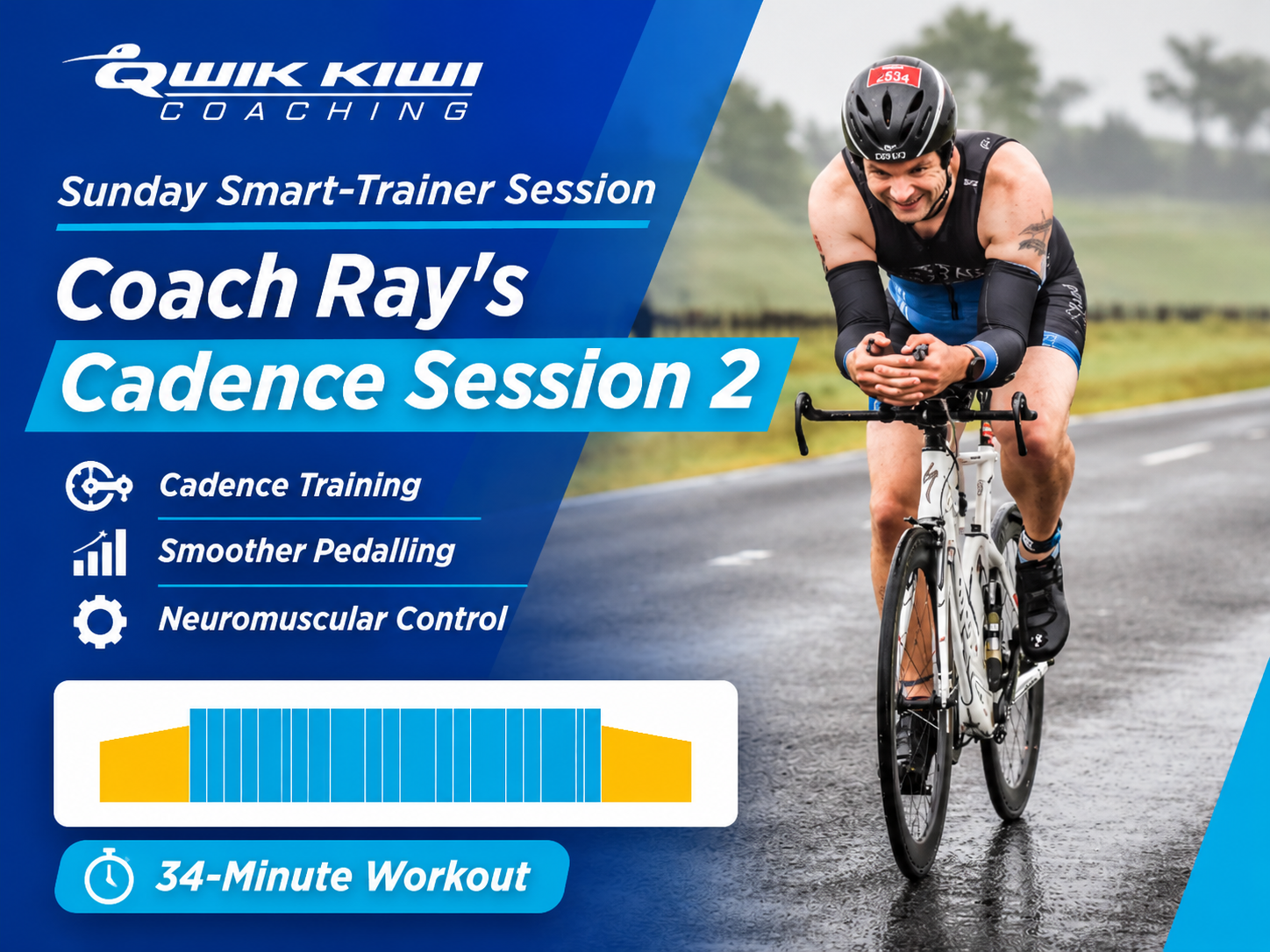
Develop smoother pedalling, improve your neuromuscular coordination and become more comfortable cycling at higher cadences with this week’s Sunday Smart-Trainer Session.
Coach Ray’s Cadence Session 2 builds on the previous session in this series by adding an additional four-minute repetition. Although the intensity remains at Level II throughout the main set, the challenge comes from progressively increasing your cadence while maintaining a consistent power output.
This is a great session for road cyclists, mountain bikers and triathletes looking to improve their cycling technique without accumulating excessive fatigue.
🎯 Today’s Goal
The primary objective of this session is to develop your ability to maintain a smooth, controlled pedal stroke across progressively higher cadences without increasing your power output.
During this workout, you will focus on:
- Improving neuromuscular coordination at higher cadences.
- Developing smoother and more controlled pedalling.
- Maintaining consistent power as your cadence increases.
- Reducing unnecessary upper-body movement.
- Building confidence and comfort when cycling at up to 110 rpm.
- Developing greater adaptability across different cycling cadences.
This isn’t about how much power you can produce. It’s about how effectively you can control your pedalling while maintaining the prescribed intensity.
🧠 Why You’re Doing This Session
Developing Neuromuscular Coordination
Cycling at higher cadences requires your nervous system to coordinate muscular contractions more rapidly. Your muscles need to contract and relax in a coordinated sequence to maintain a smooth and effective pedal stroke.
When you increase your cadence beyond your naturally preferred pedalling rhythm, maintaining this coordination becomes more challenging.
Regularly incorporating cadence drills into your training provides an opportunity to practise this skill in a controlled environment, without the additional fatigue associated with high-intensity intervals.
Understanding the Relationship Between Cadence, Torque and Power
Power production on a bicycle is determined by the relationship between torque and angular velocity (how quickly the cranks are rotating).
When cycling at a consistent power output:
- A lower cadence requires greater torque.
- A higher cadence requires less torque.
- Increasing cadence doesn’t necessarily mean increasing power.
Throughout today’s session, your cadence progressively increases from 90–95 rpm through to 105–110 rpm, but your target intensity remains at Level II.
This requires you to adjust the resistance or gearing appropriately as your cadence increases.
Learning to independently control cadence and power is a valuable skill that can be transferred to outdoor cycling.
Becoming More Adaptable as a Cyclist
There is no single optimal cadence that suits every cyclist in every situation.
Your preferred cadence may vary depending on the terrain, gradient, intensity, fatigue and the demands of your event.
Developing the ability to comfortably ride across a wider range of cadences gives you more options when responding to changing conditions, whether you’re accelerating out of a corner, transitioning over the crest of a hill or maintaining a steady effort during a triathlon.
Progressing from Cadence Session 1
Coach Ray’s Cadence Session 1 featured five four-minute repetitions, providing 20 minutes of structured cadence work.
Today’s session increases that to six repetitions, providing 24 minutes of structured cadence work.
That’s a 20% increase in the duration of the main set without increasing the prescribed intensity or maximum cadence.
This is an example of progressive overload through increasing training volume rather than intensity. You’re spending more time practising the skill and reinforcing your ability to maintain good technique.
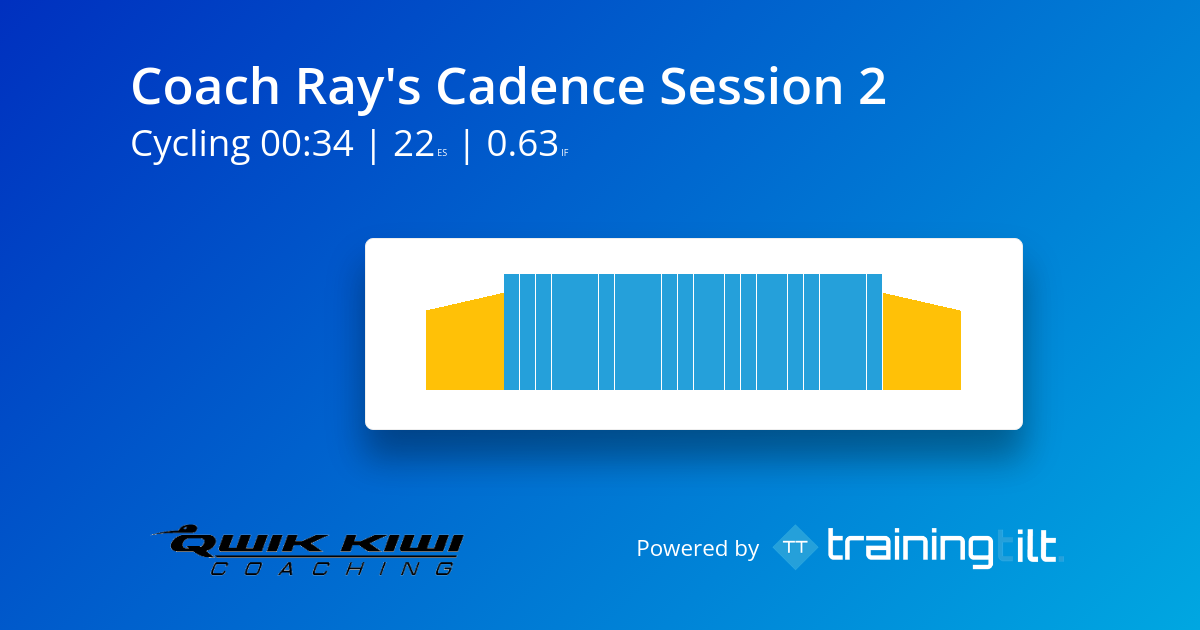
🚴 Today’s Workout – Coach Ray’s Cadence Session 2
Total Duration: 34 Minutes
Warm-Up
- 5min Level I
Main Set
Complete six repetitions of:
- 1min Level II, 90–95 rpm
- 1min Level II, 95–100 rpm
- 1min Level II, 100–105 rpm
- 1min Level II, 105–110 rpm
Cool-Down
- 5min Level I
- 10min Stretching
Workout Breakdown
| Component | Duration | Intensity |
|---|---|---|
| Warm-Up | 5min | Level I |
| Main Set | 24min | Level II |
| Cool-Down | 5min | Level I |
| Total | 34min |
There is no additional recovery between repetitions. At the conclusion of each four-minute block, reduce your cadence back to 90–95 rpm while maintaining Level II intensity and commence the next repetition.
⚠️ Common Mistakes to Avoid
1. Increasing Power as Cadence Increases
One of the most common mistakes cyclists make during cadence drills is allowing their power output to increase as they pedal faster.
The objective is to maintain Level II intensity throughout the main set. Adjust your gearing or resistance as required to accommodate the increasing cadence.
2. Bouncing on the Saddle
If you start bouncing on the saddle as your cadence increases, it’s a sign that you’re struggling to maintain smooth, controlled movement at that cadence.
Concentrate on maintaining a stable pelvis and relaxed upper body. If necessary, temporarily reduce your cadence until you regain control.
3. Gripping the Handlebars Too Tightly
Excessive tension through your hands, arms and shoulders can make it more difficult to maintain smooth pedalling.
Keep your grip relaxed, your elbows slightly bent and your shoulders free of unnecessary tension.
4. Treating the Final Minute as a Sprint
Although you’re pedalling at 105–110 rpm during the final minute of each repetition, this is not a sprint.
Maintain Level II intensity and concentrate on the quality of your movement rather than generating additional power.
5. Relying on ERG Mode
Whilst ERG mode can automatically adjust resistance to maintain a prescribed power output, I recommend completing this session without ERG mode.
By manually adjusting your gearing or resistance, you develop the ability to independently control your cadence and power output — a skill that is particularly valuable when cycling outdoors.
💡 Tips for Getting the Most from This Session
Keep your upper body relaxed. Minimise unnecessary movement through your shoulders, arms and torso as your cadence increases.
Make smooth transitions. Gradually increase your cadence at the beginning of each minute rather than suddenly accelerating.
Anticipate resistance changes. As your cadence increases, you may need to select an easier gear or reduce the resistance to maintain Level II intensity.
Maintain consistent power. Monitor your power output where available, rather than focusing exclusively on cadence.
Prioritise technique over numbers. If you’re unable to maintain good technique at 110 rpm, work towards that cadence progressively rather than forcing it.
Make your sixth repetition as good as your first. The additional repetition is an opportunity to demonstrate that you can maintain good pedalling technique throughout the entire session.
📊 Coach Ray’s Workout Data

When reviewing your own workout data, pay particular attention to how consistently you maintained your power output as your cadence increased.
Ideally, your cadence graph should demonstrate six progressive four-minute blocks, whilst your power graph remains relatively consistent throughout the main set.
Your heart rate may increase slightly during the higher-cadence efforts, even if your power output remains consistent. This can reflect the additional physiological demands associated with faster pedalling.
🚴 Ride Coach Ray’s Cadence Session 2 on Velocity
Ready to put your pedalling technique to the test?
Join me on Velocity and complete Coach Ray’s Cadence Session 2 as an interactive, coach-led indoor cycling workout. With real-time power and cadence targets, you can focus on developing smoother pedalling, improving your neuromuscular coordination and maintaining consistent power as your cadence increases.
🎁 Not a Velocity Member Yet? Try It FREE for 14 Days!
Experience everything Velocity has to offer with a FREE 14-day full membership, including:
- Live coach-led cycling sessions every Tuesday and Thursday at 6:00am New Zealand time.
- Replay classes every weekday at 7:00pm New Zealand time.
- An extensive library of on-demand cycling workouts.
- Structured endurance, tempo, threshold, VO₂ max and cycling technique sessions.
- Real-time feedback on your power and cadence.
- Post-workout compliance ratings to assess how accurately you achieved your targets.
Whether you’re a road cyclist, mountain biker or triathlete, Velocity takes the guesswork out of your indoor cycling training.
Start your free membership today and discover how structured, coach-led indoor cycling can help you become a better cyclist.
🏁 Final Thoughts
Not every cycling workout needs to leave you exhausted to be beneficial.
Developing your cycling technique, improving your neuromuscular coordination and becoming more comfortable across a wider range of cadences are all valuable components of a well-rounded cycling training programme.
Coach Ray’s Cadence Session 2 builds on the previous workout by increasing the duration of the main set while maintaining the same intensity and cadence targets.
The challenge is simple: can you maintain consistent power and smooth, controlled pedalling throughout all six repetitions?
Remember, the objective isn’t simply to pedal faster — it’s to pedal faster without unnecessarily increasing your workload or compromising your technique.
Happy training!
Coach Ray
Director & Head Coach
Qwik Kiwi Coaching