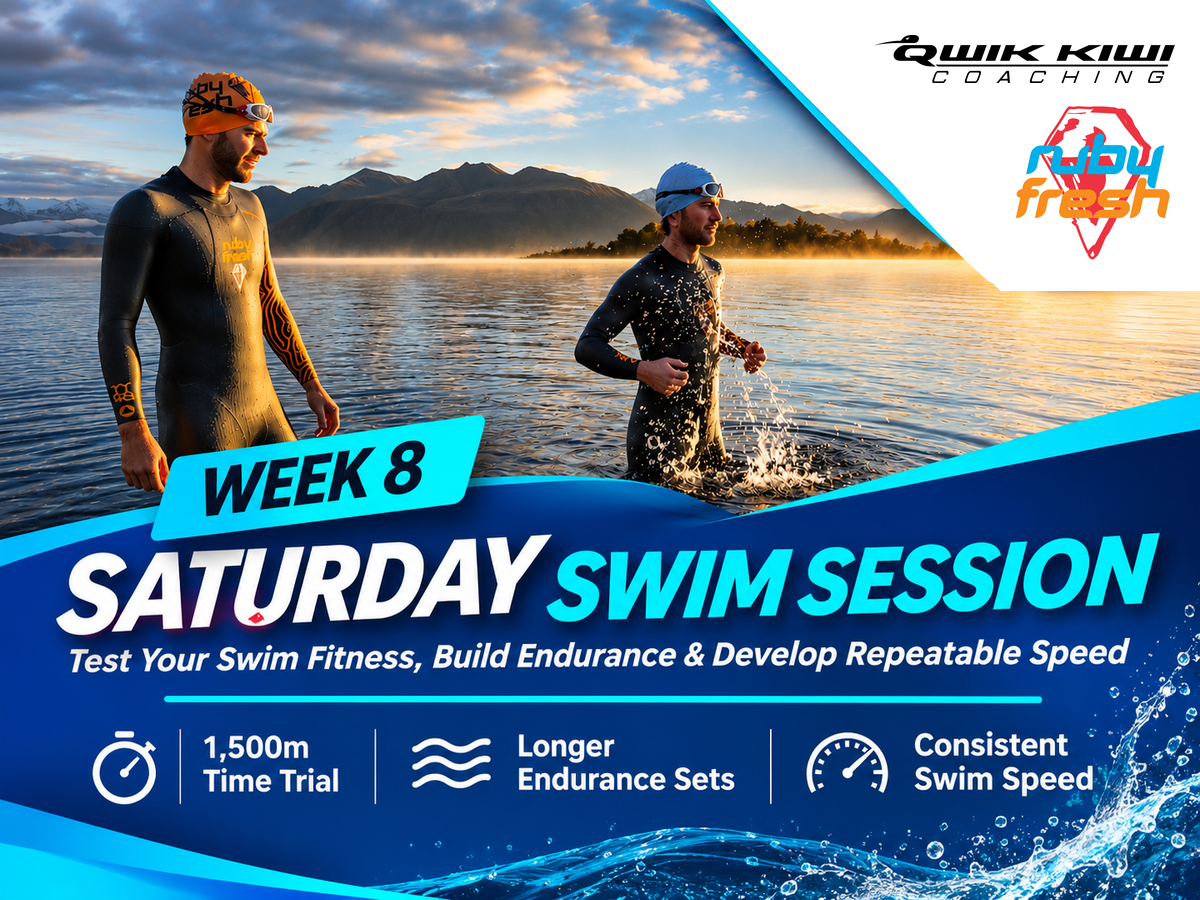
Are you becoming a faster, stronger and more efficient swimmer? How do you know whether the training you’ve been doing is delivering results?
This week’s Saturday Swim Session provides an opportunity to measure your progress with a 1,500m time trial before completing two complementary workouts designed to develop sustained swimming endurance, consistent pacing and repeatable speed.
If you’ve been following this series from Week 1, this will be your third opportunity to complete the 1,500m time trial, providing another valuable benchmark to assess your swimming development.
These sessions are particularly beneficial for triathletes preparing for Olympic-distance, Ironman 70.3, T100 and longer-distance triathlons.
Today’s Goal
The objectives of this week’s three swimming sessions are to:
- Assess your current swimming fitness with a 1,500m time trial.
- Compare your performance with your previous time trials.
- Develop sustained swimming endurance through longer 800m repetitions.
- Improve your ability to maintain consistent swimming pace across repeated 200m efforts.
- Develop repeatable swimming speed while maintaining good freestyle technique.
- Reinforce efficient body position, rotation and stroke mechanics through swimming drills.
Across the three sessions, you’ll complete 7,700m of purposeful swimming.
Why You’re Doing These Sessions
Effective triathlon swim training requires more than simply accumulating distance in the pool. Each session should have a specific purpose that contributes to your overall development as a swimmer.
This week’s sessions combine three important components of swimming performance.
Measuring Your Swimming Progress
Regular time trials provide an objective measure of your swimming fitness.
By repeating the same 1,500m time trial that you completed in Weeks 1 and 5, you can assess whether your swimming speed and endurance have improved.
However, your finishing time isn’t the only measure of progress. You may also notice improvements in your pacing, stroke efficiency, confidence and ability to maintain your technique towards the end of the time trial.
Developing Sustained Swimming Endurance
Longer repetitions, such as the 800m efforts in Session 18, develop your ability to sustain an effective swimming pace over extended periods.
Unlike shorter intervals, these repetitions provide fewer opportunities to stop, recover and reset your technique. You’ll need to concentrate on maintaining an efficient stroke as fatigue gradually develops.
This is particularly relevant for triathletes who need to complete a continuous swim before transitioning onto the bike.
Developing Repeatable Swimming Speed
The 200m and 50m repetitions in Session 19 challenge your ability to produce consistent performances with relatively short recovery periods.
Rather than swimming one exceptionally fast repetition, the objective is to maintain your performance throughout each set.
Developing this ability will help you become a more consistent swimmer who can maintain good technique and effective propulsion even when fatigued.
Today’s Workouts
Qwik Kiwi Performance Swim Session 01 — 1,500m Time Trial
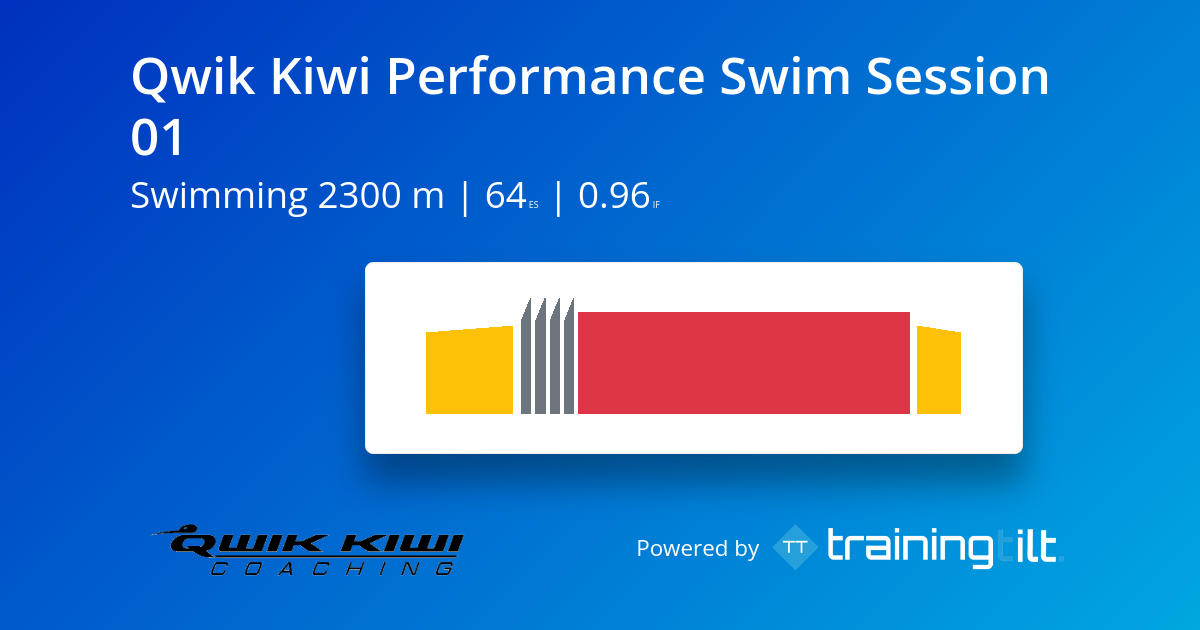
- 400m WU
- 4 × 50m Pick Up, 15sec RI
- 1,500m Time Trial
- 200m CD
How to Complete This Session
400m Warm Up
Start with relaxed, comfortable swimming and gradually build into your normal swimming rhythm.
The purpose of the warm-up is to prepare your muscles and cardiovascular system for the time trial without creating unnecessary fatigue.
You can include different strokes, short pauses or some gentle stretching as required. Concentrate on establishing an effective catch, relaxed breathing and good body position.
4 × 50m Pick Up, 15sec RI
During each 50m repetition, progressively increase your swimming speed.
Start at a comfortable pace before gradually increasing your effort throughout the repetition, finishing at a fast but controlled pace.
Think of these repetitions as progressively pressing down on the accelerator rather than suddenly flooring it.
Avoid sprinting from the wall. Instead, gradually increase your stroke rate and the force you apply through the water while maintaining good technique.
Take 15 seconds of recovery between repetitions.
These pick-ups prepare your body for the increased intensity of the time trial without unnecessarily fatiguing you beforehand.
1,500m Time Trial
Swim 1,500m as fast as possible, aiming to achieve the fastest overall time you can sustain across the entire distance.
One of the most common mistakes during a swimming time trial is starting too quickly.
Break the time trial into three mental sections:
- First 500m: Establish a strong but controlled pace. Resist the temptation to swim too aggressively during the opening lengths.
- Middle 500m: Maintain your rhythm, concentrate on your technique and work to sustain your pace as fatigue develops.
- Final 500m: Gradually increase your effort where possible, committing to a strong finish and using whatever energy you have remaining.
If possible, record your intermediate split times every 100m or 500m. These will provide valuable information about your pacing strategy and help identify opportunities for improvement.
Make sure you record your total time immediately after finishing.
200m Cool Down
Finish with relaxed swimming, allowing your breathing and heart rate to gradually return towards normal.
Focus on releasing tension through your shoulders and maintaining a smooth, comfortable freestyle stroke.
Coach Ray’s Tip: Compare Your Time Trials
If you’ve completed the previous time trials in Weeks 1 and 5, compare your results.
Consider the following questions:
- Has your overall 1,500m time improved?
- Has your average pace per 100m improved?
- Were your split times more consistent?
- Did you maintain better technique towards the end?
- Did you finish strongly, or did your pace deteriorate?
- Were the testing conditions comparable?
For the most meaningful comparison, try to complete your time trials in the same pool, using the same equipment and following the same warm-up routine.
Remember that fatigue from recent training, sleep, nutrition and other factors can influence your performance on any given day.
Don’t be discouraged if every time trial doesn’t produce a personal best. Look at the overall trend in your performance.
Qwik Kiwi Performance Swim Session 18 — Sustained Swimming Endurance
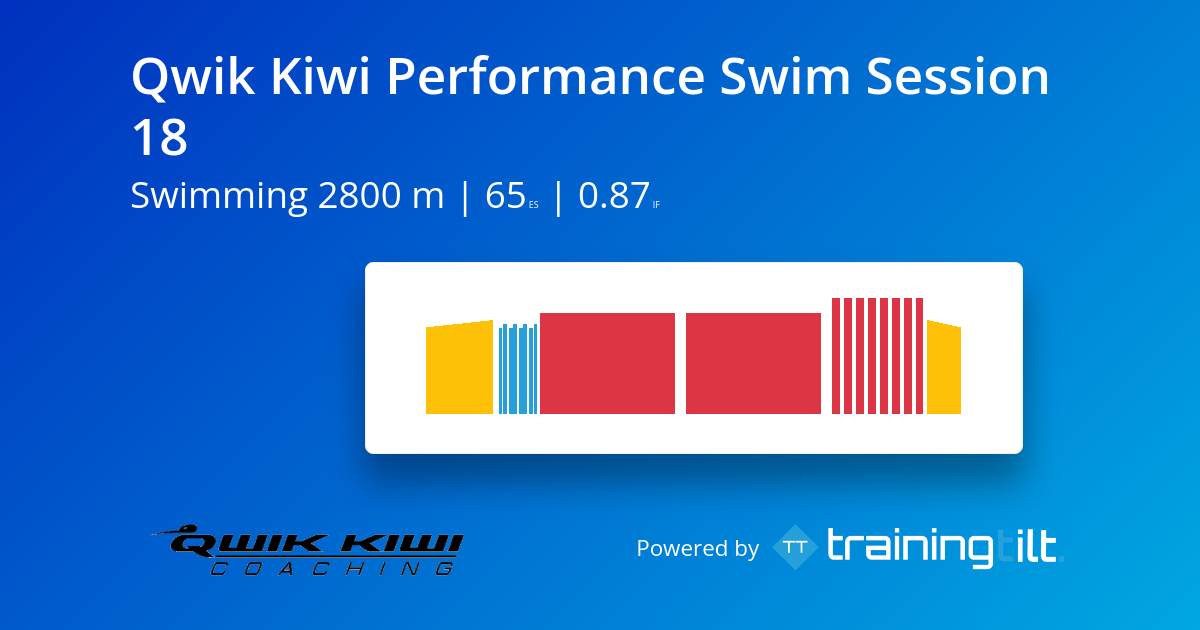
- 400m Warm Up
- 4 × 50m Drill/Swim
- 2 × 800m, 60sec RI
- 8 × 50m Swim, 20sec RI
- 200m Cool Down
How to Complete This Session
400m Warm Up
Begin with comfortable swimming, gradually establishing your rhythm and preparing yourself for the longer repetitions ahead.
Concentrate on relaxed breathing, good body position and an effective catch.
4 × 50m Drill/Swim
Complete the first 25m of each repetition using the prescribed drill, followed by 25m of normal freestyle swimming.
During the freestyle portion, concentrate on incorporating the technical elements reinforced by the drill.
Complete the following four drills:
1. Kick on Side — Left
Kick with your left arm extended in front of you, your right arm resting alongside your body and your body rotated onto your left side.
Maintain a long, streamlined body position and a relaxed, continuous flutter kick.
During the subsequent 25m of freestyle, concentrate on maintaining good alignment and rotating naturally through your stroke.
2. Kick on Side — Right
Repeat the previous drill on the opposite side, with your right arm extended and your left arm resting alongside your body.
Avoid excessive movement through your head and shoulders.
During the freestyle portion, concentrate on developing balanced rotation on both sides of your body.
3. 6/1/6 Drill
Start in the side-kicking position with one arm extended in front of you and the other resting alongside your body.
Complete six kicks before taking one freestyle stroke to rotate onto your opposite side.
Complete another six kicks before repeating the movement.
During the freestyle portion, concentrate on coordinating your body rotation with your arm movements.
4. 6/3/6 Drill
Start in the same side-kicking position and complete six kicks before taking three controlled freestyle strokes, finishing on the opposite side.
Complete another six kicks before repeating the sequence.
This drill helps develop coordinated rotation and provides a natural progression towards normal freestyle swimming.
During the freestyle portion, concentrate on maintaining smooth, connected movements through your hips, shoulders and arms.
You can use fins during the drills if they help you maintain good body position and concentrate on the technical elements.
2 × 800m, 60sec RI
These longer repetitions form the main endurance component of this session.
Swim each 800m at a strong, sustainable pace that allows you to maintain consistent swimming speed and good technique throughout both repetitions.
Avoid treating the first 800m as a time trial.
Instead, establish a pace that you can reproduce during the second repetition.
Mentally divide each 800m into four sections of 200m:
- First 200m: Establish your rhythm and settle into your target pace.
- Second 200m: Maintain an effective catch and relaxed breathing.
- Third 200m: Concentrate on maintaining your technique as fatigue develops.
- Final 200m: Sustain your pace and finish strongly without unnecessarily sprinting.
Take 60 seconds of recovery between the two repetitions.
Use this recovery to regulate your breathing, check your time and prepare mentally for the second effort.
Ideally, your second 800m should be completed in a similar time to your first.
8 × 50m Swim, 20sec RI
Following the longer endurance repetitions, these shorter efforts provide an opportunity to increase your swimming speed.
Swim these repetitions as fast as possible while maintaining good technique and consistent pace, with your last repetition as fast as your first.
Take 20 seconds of recovery between repetitions.
You’ll already have accumulated some fatigue from the 800m efforts, so maintaining an effective catch and good body position becomes particularly important.
Avoid simply increasing your stroke rate without maintaining effective propulsion.
200m Cool Down
Finish with relaxed, comfortable swimming.
Allow your breathing to settle and concentrate on maintaining a smooth, efficient stroke.
Coach Ray’s Tip: Don’t Let Your Mind Wander
During longer swimming repetitions, it’s easy to lose concentration and allow your technique to deteriorate.
Give yourself a specific technical focus for each 200m section of the 800m repetitions.
For example:
- Maintain a long, streamlined body position.
- Establish an effective catch.
- Rotate smoothly through your hips and shoulders.
- Maintain a relaxed recovery and consistent stroke rhythm.
Giving yourself something specific to concentrate on helps maintain engagement throughout the longer efforts.
Qwik Kiwi Performance Swim Session 19 — Consistent 200m Intervals & Repeatable Speed
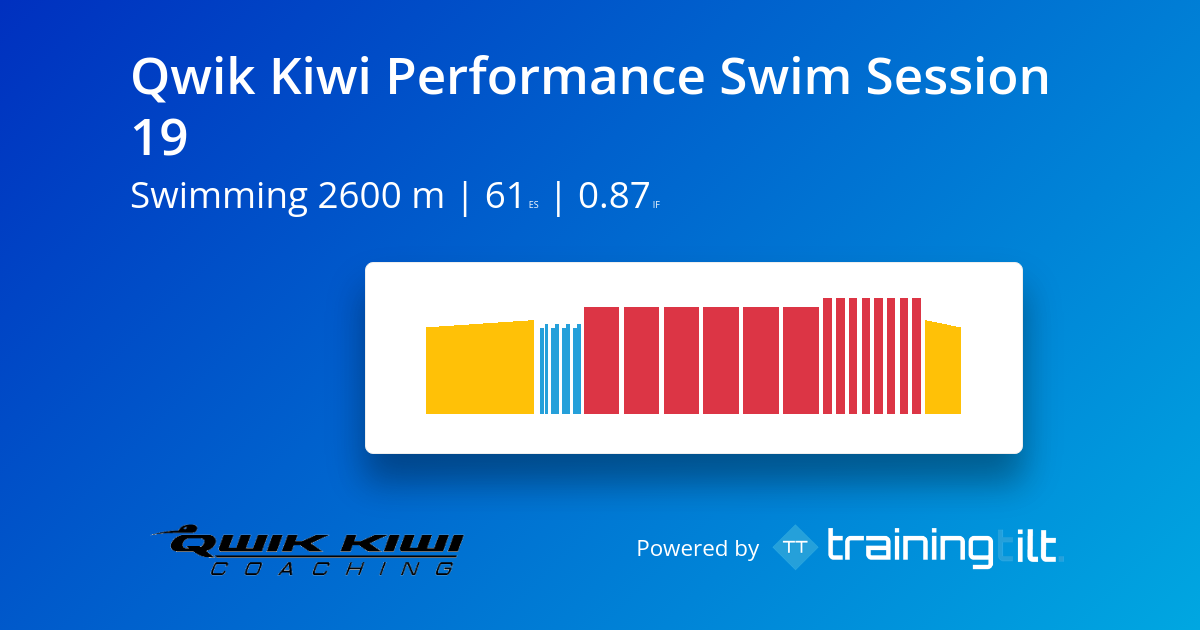
- 600m Warm Up
- 4 × 50m Drill/Swim
- 6 × 200m, 20sec RI
- 8 × 50m Swim, 20sec RI
- 200m Cool Down
How to Complete This Session
600m Warm Up
Start with relaxed swimming and gradually increase your effort as you progress through the warm-up.
Use the additional warm-up distance to establish good swimming rhythm and prepare yourself for the main interval set.
You can incorporate different strokes, short pauses or gentle stretching as required.
4 × 50m Drill/Swim
As with Session 18, complete 25m of the prescribed drill followed by 25m of normal freestyle swimming.
Use the following four-drill sequence:
- Kick on Side — Left
- Kick on Side — Right
- 6/1/6 Drill
- 6/3/6 Drill
Follow the drill instructions provided in Session 18, concentrating on transferring the technical elements of each drill into your normal freestyle swimming.
The objective isn’t simply to complete the drills. It’s to improve the quality of your freestyle swimming afterwards.
6 × 200m, 20sec RI
Swim each 200m repetition at a strong, controlled pace that you can maintain throughout all six repetitions.
With only 20 seconds of recovery, starting too aggressively will make it difficult to maintain your swimming speed towards the end of the set.
Use the first repetition to establish a challenging but sustainable pace.
During the middle repetitions, concentrate on maintaining consistent split times and an effective freestyle stroke.
As you approach the final two repetitions, resist the temptation to shorten your stroke or allow your body position to deteriorate.
Your objective is to complete all six repetitions at a similar pace, with the final repetition ideally as fast as the first.
Record your times for each 200m effort. This will help you assess your pacing and provide a useful reference for future swimming sessions.
8 × 50m Swim, 20sec RI
Finish the main set with eight fast 50m repetitions.
Swim these repetitions as fast as possible while maintaining good technique and consistent pace, with your last repetition as fast as your first.
Take 20 seconds of recovery between repetitions.
The objective is to develop repeatable speed rather than producing one exceptionally fast effort followed by progressively slower repetitions.
Concentrate on applying force effectively through the water, maintaining good body position and sustaining an appropriate stroke rate.
200m Cool Down
Finish with easy swimming, gradually reducing your effort and allowing your body to recover.
Coach Ray’s Tip: Consistency Beats One Fast Repetition
Imagine two swimmers completing the six 200m repetitions.
Swimmer A completes their repetitions in 3:20, 3:25, 3:30, 3:35, 3:40 and 3:45.
Swimmer B completes all six repetitions in 3:30.
Despite Swimmer A producing the fastest individual repetition, Swimmer B completes the entire set 15 seconds faster and demonstrates much better pacing discipline.
Aim to swim like Swimmer B.
These times are illustrative rather than prescribed targets. Your appropriate pace will depend on your current swimming fitness.
Common Mistakes to Avoid
1. Starting Your Time Trial Too Fast
Adrenaline and enthusiasm can make the opening lengths feel deceptively easy.
Starting too aggressively can result in significant fatigue later in the time trial, costing you more time than you gained during the opening stages.
Establish a controlled pace before gradually increasing your effort.
2. Turning Every Longer Repetition Into a Time Trial
The 800m repetitions in Session 18 are designed to develop sustained swimming endurance.
Swimming the first repetition as fast as possible may compromise your ability to complete the second repetition effectively and reduce the quality of the subsequent 50m efforts.
Train with the intended purpose of the session in mind.
3. Completing Drills Without Applying Them to Your Freestyle
Swimming drills are only useful if they contribute to improvements in your normal swimming stroke.
During the 25m freestyle portion of each repetition, deliberately incorporate the technical element reinforced by the drill.
4. Swimming Your First 50m Repetition Too Fast
The objective of the shorter repetitions is repeatable speed.
If your times progressively deteriorate, you’ve probably started too aggressively or selected an unsustainable pace.
Aim for your last repetition to be as fast as your first.
5. Ignoring Your Split Times
Your finishing time provides useful information, but your intermediate split times tell you how you achieved that result.
Recording your times during the 1,500m time trial, 800m repetitions and 200m intervals will help you identify pacing improvements and opportunities for further development.
6. Allowing Your Technique to Deteriorate Under Fatigue
As fatigue develops, swimmers often lift their heads, shorten their strokes, drop their elbows or lose effective body rotation.
Recognise these changes and deliberately refocus on your technique rather than simply trying harder.
Tips for Success
Give yourself adequate recovery between sessions. Where possible, spread these three workouts throughout the week rather than completing them on consecutive days.
Complete your time trial when relatively fresh. Avoid scheduling it immediately after a particularly demanding training session.
Use consistent testing conditions. Complete your time trials in the same pool and under similar conditions wherever possible.
Use the pace clock. Monitor your repetition times and recovery periods to develop better pacing awareness.
Prioritise technique throughout every session. Swimming faster should not come at the expense of an effective stroke.
Record your results. Your training diary provides valuable information about your development and helps you recognise improvements over time.
How These Three Sessions Complement Each Other
Although each session has a different primary objective, they work together to develop the qualities required for successful triathlon swimming.
| Session | Primary Focus | Secondary Benefit |
|---|---|---|
| Session 01 | Swimming fitness assessment | Pacing awareness |
| Session 18 | Sustained swimming endurance | Speed under fatigue |
| Session 19 | Consistent interval performance | Repeatable swimming speed |
The time trial establishes a benchmark for your current swimming performance.
The longer 800m repetitions develop your ability to sustain an effective swimming pace, while the 200m intervals provide opportunities to practise maintaining a strong pace with limited recovery.
Both Sessions 18 and 19 finish with shorter, faster repetitions, challenging your ability to increase your swimming speed after accumulating fatigue.
Together, these three workouts provide a balanced week of swimming development.
Track Your Swimming Progress
If you’ve been following this series from the beginning, you now have three opportunities to compare your 1,500m time trial performance.
Use the following table to record your results.
| Time Trial | Total Time | Average Pace per 100m |
|---|---|---|
| Week 1 | ||
| Week 5 | ||
| Week 8 |
To calculate your average pace per 100m, divide your total 1,500m time by 15.
For example, if you complete your 1,500m time trial in 30 minutes, your average swimming pace is 2:00 per 100m.
If you subsequently improve your time to 29 minutes, your average pace improves to 1:56 per 100m.
An improvement of just four seconds per 100m equates to a full minute over 1,500m.
Small improvements in swimming efficiency and pace can make a significant difference over the course of a triathlon swim.
Who Are These Sessions Suitable For?
These sessions are particularly suitable for:
- Triathletes preparing for Olympic-distance triathlons.
- Ironman 70.3 and T100 athletes developing swimming endurance.
- Ironman athletes looking to improve sustained swimming performance.
- Recreational swimmers wanting more structure and purpose in their training.
- Athletes looking to assess their swimming progress.
- Open-water swimmers developing consistent pacing and repeatable speed.
If you’re relatively new to swimming, you may need to reduce the number or length of the repetitions to suit your current ability.
The important thing is to retain the purpose of each workout while selecting a training volume appropriate for your fitness and experience.
Take Your Swimming to the Next Level With a Structured Training Plan
Individual swimming sessions can help improve your fitness, but following a structured training programme allows you to build on those improvements progressively.
My 16-Week Triathlon Swim Performance Plan provides three structured swimming sessions each week, designed to develop your swimming technique, endurance, strength and speed over a complete training programme.
It’s particularly suitable for triathletes preparing for Olympic-distance, Ironman 70.3 and T100 events who want to improve their swimming performance without having to work out what to do every time they visit the pool.
Each session has a specific purpose and builds on the training you’ve completed previously, helping you develop the fitness and confidence required for race day.
Want Personalised Guidance With Your Triathlon Training?
Are you putting plenty of effort into your swimming but not seeing the improvements you’re looking for?
Perhaps you’re unsure how to structure your swimming alongside your cycling and running, or you’re preparing for an upcoming triathlon and want to make the most of your available training time.
Book a FREE 40-minute coaching consultation with me. We’ll discuss your current training, your goals and how a more structured approach could help you become a stronger, faster and more confident triathlete.
Train smarter, swim stronger and make every metre count.
Coach Ray
Qwik Kiwi Coaching