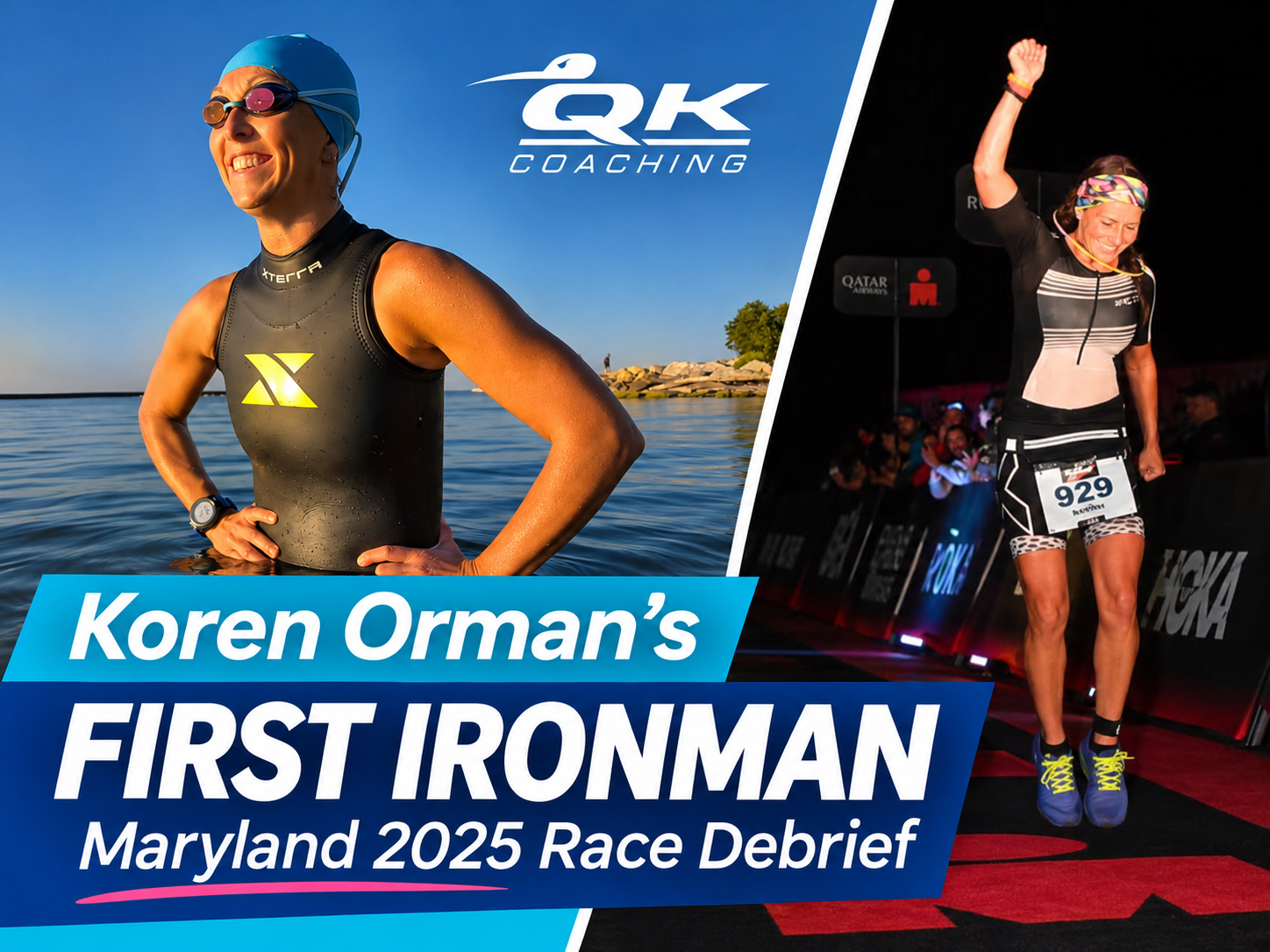
How consistent training, smart pacing and mental resilience helped Qwik Kiwi Coaching athlete Koren Orman conquer her first full-distance Ironman.
There are few moments in endurance sport quite like crossing the finish line of your first Ironman.
Months of early mornings, long training sessions, challenging workouts and personal sacrifices all come together in a matter of seconds.
For Qwik Kiwi Coaching athlete Koren Orman, crossing the finish line at Ironman Maryland 2025 was a moment of pure excitement, pride and emotion.
And it was a moment she wasn’t going to forget.
Speaking during our post-race debrief, Koren was still buzzing from the experience.
“I’m still really proud of myself. I can’t believe that I did this big thing.”
Watching from New Zealand, I had followed Koren’s progress through the Ironman tracker as she worked her way around the course. Her performance was a wonderful example of what can happen when an athlete combines consistent preparation with disciplined race execution.
But her journey wasn’t without challenges.
From swimming amongst jellyfish to battling strong headwinds on the bike and managing stomach problems during the marathon, Koren faced plenty of situations that could have disrupted her race.
Instead, she kept moving forward.
Here is how her first Ironman unfolded, and what other aspiring Ironman athletes can learn from her experience.
Building Towards Ironman: Consistency Was the Key
When I asked Koren what had worked particularly well during her Ironman preparation, her answer was immediate.
Consistency.
Throughout her training programme, Koren worked hard to complete the sessions prescribed for her.
Like most recreational athletes preparing for a major endurance event, there were times when the training load and the approaching race felt overwhelming.
But she kept showing up.
“Staying on track and doing as much as you possibly can to do all of the workouts, because it gets you to the finish line.”
This is something I regularly emphasise to the athletes I coach.
Consistency is one of the most important ingredients in successful endurance training.
You don’t need every training session to be perfect.
You don’t need to smash every interval workout or set personal bests every weekend.
What matters is accumulating appropriate training, week after week, while allowing your body to adapt.
For Koren, that consistent approach developed the physical endurance and confidence she needed to tackle her first full-distance Ironman.
Could She Have Done Anything Differently?
Looking back, Koren felt she might have benefited from spending a little more time on the bike, particularly towards the end of her preparation.
She explained that the swim and run had initially made her more nervous, so she had naturally placed considerable attention on those disciplines.
However, she also acknowledged that she had completed her prescribed training consistently.
And that is an important distinction.
There is always something an athlete could have done differently, but that doesn’t mean their preparation was inadequate.
The objective isn’t to arrive at the start line having completed the greatest possible amount of training.
It is to arrive sufficiently prepared, healthy, confident and ready to perform.
Koren achieved exactly that.
Race Week: Preparing the Body and Managing the Nerves
As race day approached, Koren paid particular attention to her nutrition and hydration.
Having experienced a nutritional setback during training a couple of weeks earlier, she wanted to minimise the possibility of encountering similar problems during the event.
By Wednesday of race week, she was carefully monitoring her fluid intake and planning her meals.
Rather than leaving everything until the last minute, she made deliberate decisions about what she would eat and drink.
That preparation helped give her confidence heading into race day.
The Night Before an Ironman
One aspect of race preparation that didn’t go quite as smoothly was sleep.
Koren described lying awake in her hotel room, noticing seemingly every noise around her.
At one point, she thought it must be time to get up, only to discover that race morning was still some time away.
Fortunately, she had slept well the previous night.
This is something we had discussed before the race.
Poor sleep immediately before a major event is extremely common.
When you’re preparing for something as significant as your first Ironman, it is natural to feel nervous and excited.
You have invested months in preparation, and suddenly the opportunity to put that work into practice is almost here.
One restless night doesn’t automatically undo all that training.
Getting adequate sleep throughout race week, rather than placing all the emphasis on the final night, is a sensible approach.
The Swim: Jellyfish, Nerves and a Brilliant Start
Of the three disciplines, the swim was the one Koren had been most nervous about.
Despite knowing she was physically capable of completing the distance, she still felt apprehensive about what awaited her in the water.
Her strategy was straightforward.
Start conservatively, maintain long, controlled strokes and avoid becoming excessively breathless.
“I learned that if I get out of breath, then I’m working too much and I’m working too fast.”
Rather than becoming caught up in the excitement of the start, Koren focused on swimming at an effort she could sustain.
It worked beautifully.
When she emerged from the water and discovered her swim time, she was delighted.
And when I woke up in New Zealand and checked the tracker, I was equally impressed.
It was a fantastic start to her first Ironman.
An Unexpected Challenge: Swimming With Jellyfish
There was, however, one aspect of the Maryland swim that Koren hadn’t previously experienced.
Jellyfish.
Coming from a background of swimming in freshwater, she wasn’t accustomed to sharing the water with creatures that could sting her.
Fortunately, she had completed a practice swim the day before the race.
That gave her an opportunity to experience the conditions and process what it felt like to encounter jellyfish.
During that practice swim, another swimmer offered some advice.
“Just pretend it’s seaweed.”
It might sound simple, but that mental reframing helped Koren deal with the unfamiliar sensation.
She knew what to expect when race morning arrived.
We had also watched course-preview information from Steve Moody, which had highlighted the possibility of encountering jellyfish.
That advance warning proved valuable.
Coach Ray’s Takeaway: Familiarity Reduces Anxiety
One of the best ways to manage race-day nerves is to remove as many unknowns as possible.
If an official practice swim is available, it can be worth taking advantage of it.
You can familiarise yourself with the water, practise sighting, assess the conditions and become more comfortable with the environment.
For Koren, that preparation helped turn an unfamiliar challenge into something she knew she could manage.
The Bike: 112 Miles and a Battle With the Wind
After her successful swim, Koren moved onto the 112-mile (180km) bike leg.
Her objective was to maintain a controlled effort rather than becoming overly enthusiastic early in the ride.
She understood that riding too hard could have serious consequences later in the day, particularly with a marathon still to come.
For much of the bike leg, she managed her effort well.
But the Maryland conditions presented a significant challenge.
When the Headwind Arrived
Koren described two particularly demanding sections where riders were exposed to strong oncoming winds.
The second encounter came late in the ride, when she was already approaching the final stages of the 112-mile course.
By approximately mile 102, she was ready to get off the bike.
“You have to dig down deep to try to finish that up.”
This was probably the toughest part of her entire race.
After hours in the saddle, the combination of fatigue, headwinds and the knowledge that she still had a marathon ahead of her made those final miles particularly challenging.
But Koren didn’t allow that difficult period to determine the outcome of her race.
Instead, she concentrated on getting to the next point along the course.
And then the next.
Eventually, she reached transition.
Coach Ray’s Takeaway: Ride for the Marathon
One of the biggest mistakes athletes can make during a full-distance Ironman is riding too aggressively.
The bike leg is long enough to punish poor pacing decisions, and the consequences often become apparent during the marathon.
Koren understood the importance of maintaining a sustainable effort.
Although the wind affected her bike time, she resisted the temptation to force the pace simply to recover lost minutes.
That discipline would prove particularly valuable when she began running.
The Marathon: Her Strongest Discipline
Despite having already completed a 3.8km swim and 180km bike ride, Koren identified the marathon as the part of the event where she felt strongest.
That is a wonderful reflection of both her preparation and her race-day pacing.
Her plan was to keep her running effort controlled, predominantly around Level II, rather than pushing too hard early.
She had practised this approach during her long runs in training.
By the time she arrived at the marathon, she understood what the appropriate effort should feel like.
And she stuck to it.
From my perspective, watching the Ironman tracker in New Zealand, her consistency was particularly impressive.
Her predicted finish time remained relatively stable as she progressed around the run course.
She wasn’t producing dramatic surges followed by significant slowdowns.
She was simply ticking off the distance.
However, the marathon wasn’t completely trouble-free.
When the Stomach Problems Started
At approximately mile eight of the marathon, Koren began experiencing gastrointestinal discomfort.
This was frustrating because she had practised her nutrition strategy throughout training and hadn’t deliberately changed anything on race day.
She wondered whether the saltwater swim might have contributed, although the actual cause remained uncertain.
Rather than panicking, she adjusted her approach.
She reduced some of her nutritional intake temporarily while continuing to pay attention to hydration.
She tried eating a banana, but that didn’t provide much relief.
Eventually, she tried a fizzy soft drink at an aid station.
For Koren, that appeared to help settle her stomach.
By approximately mile 16, she was feeling considerably better.
“Once it calmed down, I was like, ‘All right, we got this.'”
With her stomach settling, her confidence returned.
She could concentrate on completing the remaining miles.
Coach Ray’s Takeaway: Have a Plan, but Be Prepared to Adapt
Practising your nutrition strategy during training is essential for long-distance triathlon.
However, even a well-rehearsed strategy cannot guarantee that everything will go perfectly on race day.
Environmental conditions, intensity, hydration, food choices and the cumulative stress of racing can all influence gastrointestinal comfort.
The important lesson from Koren’s experience is that she recognised a developing problem and responded rather than ignoring it.
She adjusted what she was consuming, monitored how she felt and continued when she was comfortable doing so.
Of course, significant or worsening symptoms require a different response, and athletes should seek medical assistance when appropriate.
But in Koren’s situation, the discomfort gradually settled and she was able to finish strongly.
The Mental Strategy That Kept Koren Moving Forward
One of the most valuable parts of our post-race conversation was hearing how Koren managed the psychological demands of her first Ironman.
She didn’t spend the entire day thinking about how far she still had to travel.
Instead, she broke the race into smaller, manageable sections.
During the swim, she focused on reaching the next buoy.
On the bike, she celebrated each ten-mile marker.
During the marathon, she concentrated on reaching the next mile.
And she often acknowledged those milestones out loud.
“No, we made it this far!”
Even when other competitors reminded her that there was still a long way to go, Koren preferred to focus on what she had already achieved.
This is an excellent strategy for managing long endurance events.
Celebrate the Small Victories
Completing an Ironman can feel overwhelming if you continually think about the entire distance.
But reaching the next buoy?
That’s manageable.
Riding another ten miles?
You can focus on that.
Running to the next mile marker?
That’s another achievable objective.
Each small milestone becomes evidence that you’re making progress.
Koren used these small victories to maintain a positive mindset throughout the day.
Dealing With Negative Thoughts
Even with her positive approach, Koren experienced moments when negative thoughts appeared.
The headwinds late in the bike leg were particularly challenging.
At one point, she considered what would happen if she stopped.
But instead of making a decision about the entire race, she gave herself a smaller objective.
Just keep riding to the next point.
Then reassess.
By the time she reached that next point, she was ready to continue.
She used a similar strategy when her stomach became uncomfortable during the marathon.
Rather than immediately allowing the problem to overwhelm her, she focused on what she could control.
She adjusted her intake, monitored her symptoms and kept moving forward.
We had discussed the psychological peaks and troughs of Ironman racing before the event.
Even well-prepared athletes experience difficult periods.
The key is recognising that a low point doesn’t necessarily mean the rest of the race will unfold in the same way.
For Koren, those difficult moments passed.
And each time, she emerged with renewed confidence.
Hydration: One of Koren’s Biggest Priorities
When I asked Koren what had gone particularly well overall, she highlighted hydration.
She had been deliberate about her fluid intake during race week and continued paying attention to it throughout the event.
Her husband, Sean, had also been reminding her of its importance.
During the bike leg, Koren was conscious that she was sweating even when the sun wasn’t particularly intense.
She understood that maintaining appropriate hydration was an important part of sustaining her performance.
Her race nutrition also included gels, carbohydrate-containing drinks and foods such as fig bars.
Although she encountered stomach discomfort during the marathon, she felt that her overall fuelling and hydration preparation had served her well.
For other athletes, the lesson isn’t simply to drink as much as possible.
It is to develop and practise an individualised hydration and fuelling strategy that reflects your needs, expected conditions and race intensity.
Both inadequate and excessive fluid intake can create problems during endurance events.
Koren’s confidence came from having prepared her strategy rather than leaving those decisions to chance.
The Final Miles: Realising the Finish Line Was Close
As Koren progressed around the three-loop marathon course, she saw Sean supporting her.
During one encounter, he asked how much longer she thought she had remaining.
Her response was enthusiastic.
“Probably only about an hour and a half. We’ll be good!”
For an athlete who had already spent so many hours racing, the prospect of having only another hour and a half to go was exciting.
She wasn’t simply surviving the final discipline.
She was enjoying the knowledge that she was getting closer to achieving something extraordinary.
Despite the earlier stomach problems, she still felt strong.
And she knew the finish line was getting closer.
The Finish Line: “Koren, You Are an Ironman!”
Before race day, Koren and I had discussed the importance of enjoying the finish chute.
I encouraged her not to rush those final moments.
After months of preparation and a full day of racing, that finish chute is an opportunity to absorb what you have accomplished.
During our post-race debrief, we watched the footage of Koren crossing the finish line.
As the announcer called her name and declared her an Ironman, her reaction was completely spontaneous.
The excitement and emotion were wonderful to see.
There was no rehearsed celebration.
Just the pure joy of someone realising that she had achieved a major personal goal.
As her coach, those moments are incredibly rewarding.
You can explain to an athlete beforehand how special their first Ironman finish will be.
But I don’t think you can fully appreciate that experience until you’ve actually crossed the line yourself.
For Koren, the moment was everything she had worked towards.
And it showed.
What Koren Learned From Her First Ironman
Towards the end of our debrief, I asked Koren what she had learned about herself during the preparation and the race.
Her answer captured the entire experience.
“You can do hard things if you’re consistent and if you try and you have faith in yourself.”
She went on to explain that achieving a major goal requires showing up, including on the days when you don’t particularly feel like training.
That was perhaps the most important lesson of her Ironman journey.
Not a particular swim technique.
Not a special cycling workout.
Not a secret nutrition strategy.
But the understanding that consistent effort, combined with confidence and perseverance, can help you achieve something that once seemed incredibly daunting.
Five Lessons Aspiring Ironman Athletes Can Learn From Koren
Koren’s experience provides some valuable lessons for anyone preparing for their first full-distance Ironman.
1. Consistency beats occasional brilliance.
Regular, appropriate training develops the endurance and resilience required for long-distance racing. One exceptional workout cannot replace months of consistent preparation.
2. Start conservatively and respect your pacing plan.
Koren controlled her effort during the swim, bike and marathon. That helped her maintain a remarkably consistent performance throughout the day.
3. Practise your nutrition, but remain adaptable.
A well-rehearsed fuelling strategy provides a strong foundation, but unexpected issues can still arise. Recognising problems early and responding appropriately is an important race-day skill.
4. Break the race into manageable sections.
Rather than becoming overwhelmed by the total distance, Koren concentrated on reaching the next buoy, mile marker or milestone. Those small victories helped maintain her confidence.
5. Enjoy the achievement.
The finish line isn’t simply the end of the race. It represents the months of preparation, commitment and personal growth that made the achievement possible.
Take the time to enjoy it.
Coach Ray’s Final Thoughts: A Brilliant First Ironman
Koren’s performance at Ironman Maryland 2025 was something special.
Not simply because she completed her first full-distance Ironman, but because of how she approached the entire journey.
She trained consistently.
She prepared carefully.
She respected her pacing strategy.
She managed unexpected challenges.
And when things became difficult, she found ways to keep moving forward.
Watching her progress on the tracker from New Zealand was exciting enough.
Seeing her cross the finish line, and witnessing the emotion that followed, was even better.
It was also wonderful to see the support from the wider Qwik Kiwi Coaching community, with fellow athletes following her progress and cheering her towards the finish.
Koren, congratulations on becoming an Ironman.
You earned that finish line through months of dedication and hard work.
And you should be incredibly proud of what you’ve achieved.
Ready to Start Your Own Ironman Journey? 🏊♀️🚴♂️🏃♀️
Koren’s journey to becoming an Ironman shows what is possible with consistent training, smart preparation and the right support.
Whether you’re dreaming of completing your first triathlon, stepping up to a 70.3 or preparing for your first full-distance Ironman, you don’t have to figure everything out on your own.
Book a FREE 40-minute coaching consultation with Coach Ray.
We’ll discuss your goals, current fitness, training experience and the challenges you face. Together, we’ll explore how a personalised training approach can help you prepare with confidence and work towards your own unforgettable finish-line moment.
👉 Book Your FREE 40-Minute Coaching Consultation
Your Ironman journey starts with a single step. Let’s make sure it’s in the right direction.