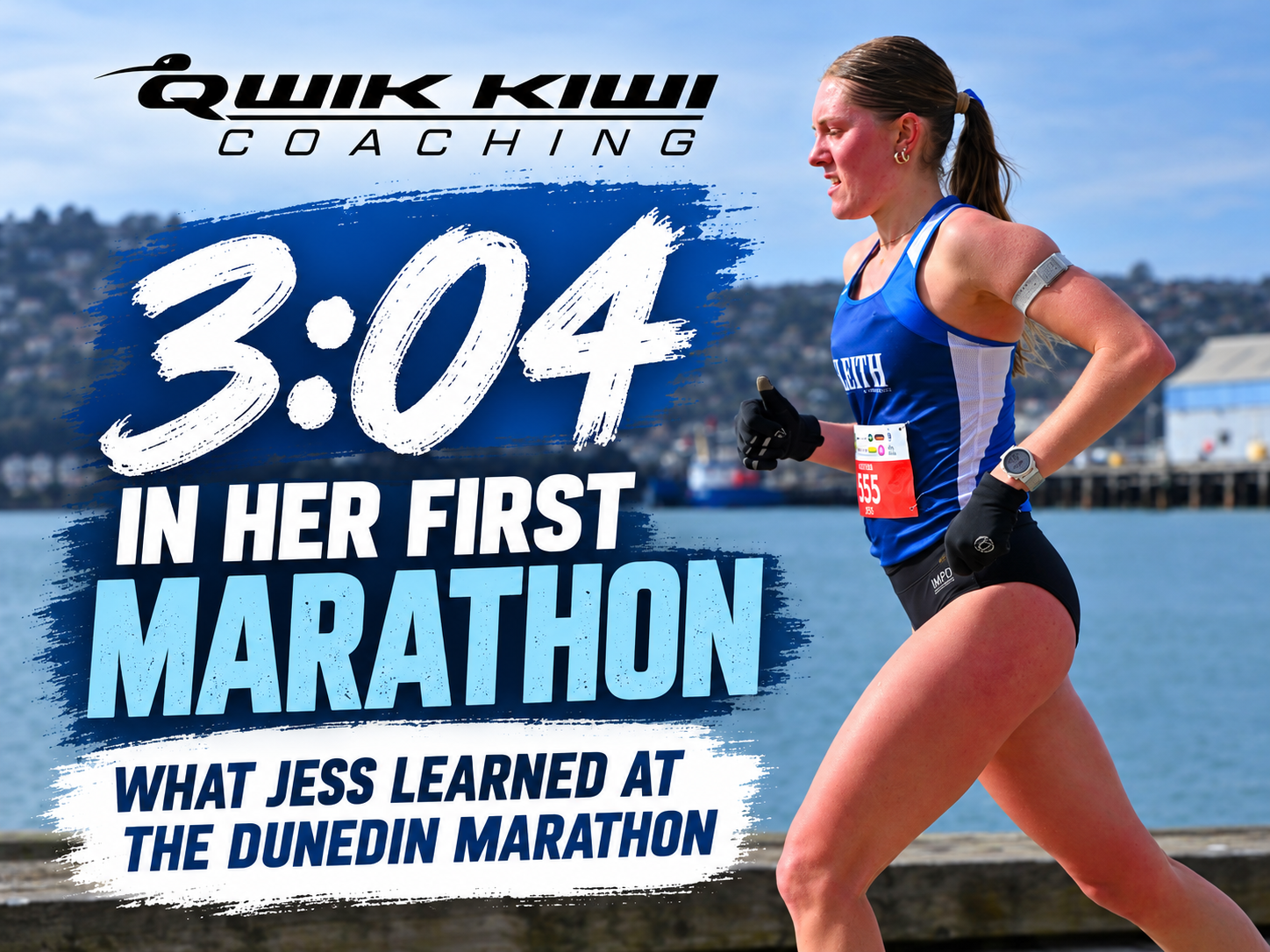
Running your first marathon is a significant achievement.
Running 3:04, finishing fourth woman and doing it without specifically preparing to race a marathon makes it considerably more interesting.
That was the experience of Qwik Kiwi athlete Jess Bray at the Dunedin Marathon.
Jess wasn’t coming into Dunedin at the end of a traditional marathon build. There hadn’t been months of marathon-specific preparation followed by a carefully planned taper. In fact, she had completed some testing in the week leading into the event.
Why?
Because the marathon wasn’t her primary goal.
Jess is preparing for the World Long Course Triathlon Championships, and the Dunedin Marathon was an opportunity to experience 42.2km for the first time while getting a substantial endurance stimulus along the way.
The result was an impressive performance — but arguably the most valuable part of the day was everything Jess learned about racing, fuelling and herself.
This Wasn’t A Marathon-Specific Build
If you looked only at Jess’s training in the week before Dunedin, you might wonder what her coach was thinking.
There were time trials and some reasonably intense work.
That’s hardly the textbook way to taper for your first marathon.
But context matters.
We weren’t preparing Jess to produce the fastest marathon she was capable of running. The bigger picture remained her preparation for the World Long Course Triathlon Championships.
That meant we weren’t going to compromise the broader training programme to create a full marathon taper for what was essentially a training event.
Jess went into Dunedin knowing that.
Rather than chasing a predetermined finishing time, the goal was to run conservatively, listen to her body and see what happened.
As it turned out, quite a lot happened.
Lesson One: Know The Course You’re Racing
One of Jess’s first observations in our post-race debrief was something she’d change next time.
She’d study the course more closely.
That’s particularly important at Dunedin because the wind can have a major influence on how the race unfolds.
There were sections where Jess was running into significant headwinds and other sections where the wind direction changed dramatically. Trying to maintain an exact pace under those conditions would have been a mistake.
Instead, she adapted.
When conditions were favourable, pace naturally increased. Into the headwind, pace slowed.
That’s an important lesson for any endurance athlete.
Your race plan should guide you, not trap you.
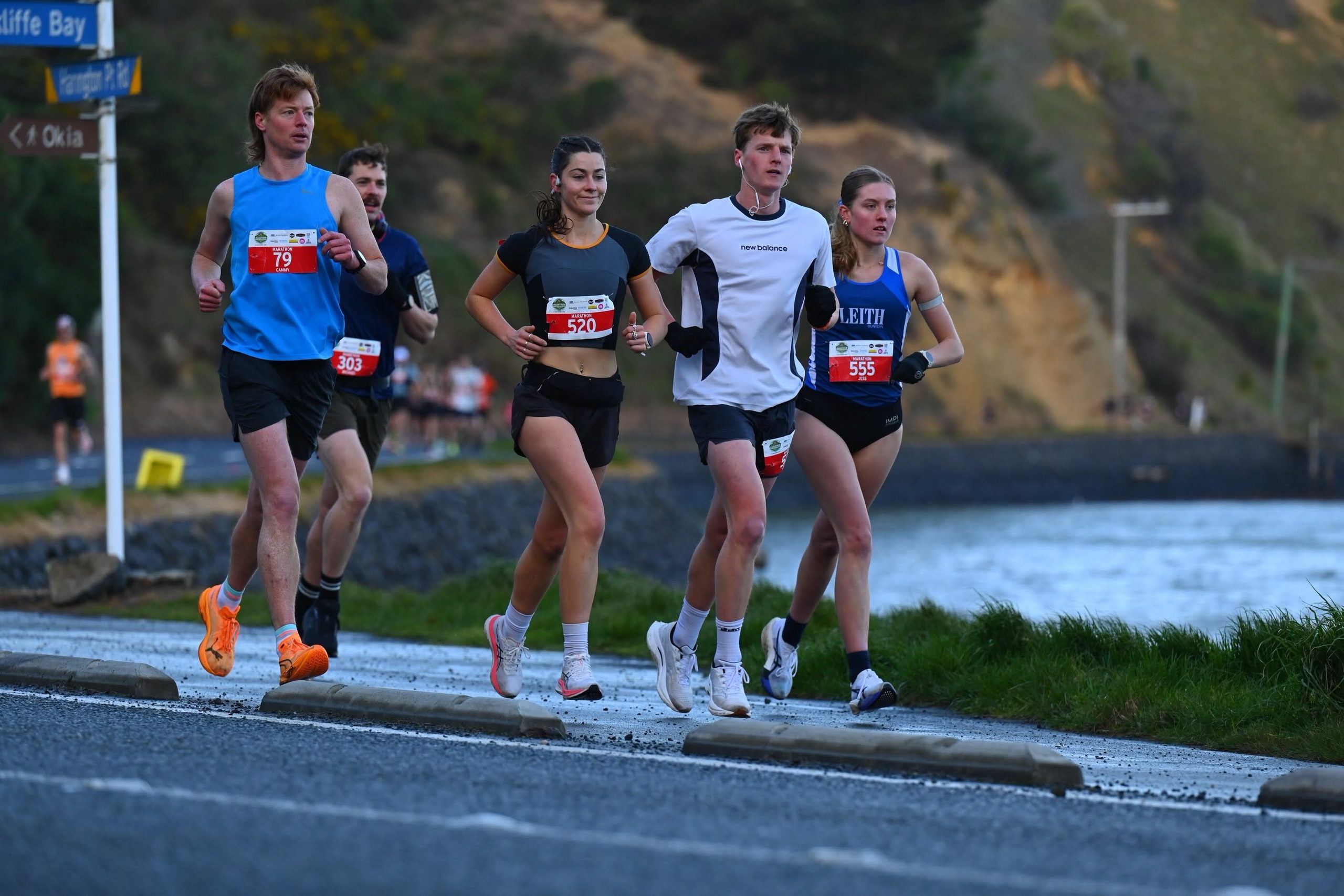
If you’re running into a strong headwind, climbing a hill or dealing with difficult conditions, blindly chasing the pace displayed on your watch can cost you dearly later.
Race the effort as well as the pace.
For a future marathon where Jess was genuinely chasing a goal time, we’d analyse the course beforehand and identify where she could afford to push and where conserving energy would be the smarter choice.
Lesson Two: Fuelling Starts Before The Gun Goes
Jess experimented with a more deliberate carbohydrate-loading strategy before Dunedin.
Although she’d always increased her carbohydrate intake before important events, this time she paid much closer attention to how much carbohydrate she was actually consuming.
Her verdict?
She felt it helped.
She also made hydration a priority during the days leading into the race, carrying a bottle with her during normal daily activities so she could keep drinking regularly.
Then came race morning.
And the first curveball.
The marathon start was delayed by approximately 40 minutes.
Worse still, it was cold enough that Jess found herself shivering while waiting for the race to finally begin.
You can plan a race in extraordinary detail, but you can’t control everything.
What you can control is your response.
Jess put warmer clothing back on and dealt with the delay rather than allowing it to derail her race before it had even started.
For an athlete faced with a similar delay, I’d also consider restarting part of the warm-up closer to the revised start time — some gentle jogging and movement to get the blood flowing and body temperature back up.
Lesson Three: Make Your Race-Day Nutrition Easy To Execute
Jess came up with a simple solution to one of the practical problems of marathon fuelling.
How do you carry enough gels and fluid for more than three hours of running?
Dunedin allowed athletes to have their own bottles available at aid stations, so Jess used that opportunity.
She placed bottles at the aid stations with a gel attached to each bottle. As she came through, she could grab her bottle, drink comfortably, take the gel and continue running.
That was particularly useful because Jess struggles to drink effectively from cups while running.
She also carried several spare gels.
Those became increasingly useful later in the race when she began taking carbohydrate slightly earlier as fatigue accumulated.
By the end, Jess estimated she’d consumed around nine gels during the marathon, plus another before the start.
Most importantly, her stomach handled it.
That’s valuable information for future endurance events.
The lesson isn’t that every marathon runner should consume exactly what Jess consumed. Fuelling requirements and gastrointestinal tolerance are individual.
The lesson is to develop a strategy that you have practised and can actually execute while racing.
Jess also floated the possibility of using carbohydrate in some of her bottles next time. That’s something we’d test carefully in training first. Combining carbohydrate drinks with gels can significantly increase the concentration of carbohydrate hitting the gut.
More isn’t automatically better.
Practise your race nutrition in training and find the combination that works for you.
The Toughest Part Came Earlier Than Expected
Ask most marathon runners where the race gets difficult and they’ll probably point towards the final 10km.
Jess certainly experienced the accumulating muscular fatigue late in the race.
But interestingly, the moment she identified as perhaps the toughest came at around 16km.
She was running largely by herself and battling the wind. There were runners ahead, but despite trying to close the gap she couldn’t seem to reach them.
Mentally, it was becoming difficult.
Then another runner came past.
Jess made a decision.
Rather than letting him disappear up the road, she went with him.
That changed her race.
Together they caught the runners ahead and formed a small group. For approximately the next 15km, Jess was able to work with other athletes rather than fighting the conditions alone.
At one point the group needed somebody to take the lead.
Jess went to the front.
She even led them up one of the course’s longer hills and found herself feeling remarkably strong.
That’s racing.
Sometimes the smartest tactical decision isn’t found on your watch or in your pre-race pacing spreadsheet.
It’s recognising an opportunity when it appears.
Don’t Underestimate The Value Of Running With Others
Running behind another athlete wasn’t simply about getting some protection from the wind.
It gave Jess something to focus on.
Feet.
Instead of constantly thinking about pace, distance, discomfort or how far remained, she could concentrate on staying with the runner ahead.
That reduced the mental load of the race.
Eventually the group broke apart and, with around 5km remaining, Jess was largely left to finish the job herself.
By then things were hurting.
But 5km is psychologically very different from contemplating another 42.2km.
She knew she could run 5km.
So that became the task.
Not finishing a marathon.
Just getting through the next few kilometres.
The Final 10km: Where The Marathon Really Begins
There’s an old marathon saying that the race doesn’t really begin until 20 miles — approximately 32km.
Everything before that is simply getting yourself into position.
Jess discovered why.
Her legs had gradually become heavier from around halfway. Muscles down the sides of her legs became increasingly tight, and the final kilometres turned into a grind.
But there was an important distinction.
Jess didn’t describe hitting the classic marathon “wall”.
There wasn’t a sudden catastrophic collapse in energy accompanied by the realisation that she’d badly overcooked the opening kilometres.
Instead, fatigue progressively accumulated.
And she kept running.
That’s a very different scenario.
She had respected the distance early enough that when the marathon became difficult, she still had the capacity to continue.
The final kilometres became less about physiology and increasingly about mindset.
“I Am Stronger Than This”
This was perhaps the most important part of Jess’s race.
Negative thoughts did appear.
At 16km, when she was battling the wind alone, she wanted to back off.
Later there was pain, fatigue and the repeated temptation to focus on how difficult everything felt.
Jess deliberately replaced those thoughts.
Rather than:
This hurts.
This is hard.
I want to stop.
Her focus became:
Stay on these feet.
A few more kilometres.
I can do this.
And eventually:
There’s only 5km to go. I know I can run 5km.
That ability wasn’t magically created on race morning.
Jess trains alone for much of the time, often without music. She has spent countless training sessions learning how to manage her own thoughts when things become uncomfortable.
Mental resilience is trainable.
You develop it by repeatedly putting yourself in appropriate challenging situations and discovering that you can continue.
Running Her Own Race Paid Off
Perhaps one of the most impressive decisions Jess made happened very early.
She saw some of the leading women ahead of her.
She could have gone with them.
She didn’t.
This wasn’t the race we’d come to Dunedin to race aggressively, and Jess understood that chasing athletes around her could completely change the cost of the day.
So she let them go.
She ran her race.
What Jess didn’t know was what was happening further up the road.
I was watching the timing updates from home. Late in the marathon it became apparent that the women ahead were slowing and Jess was closing.
Fast.
Suddenly fourth place wasn’t simply fourth place.
The podium was getting closer.
Jess had no idea.
She couldn’t see the women ahead and nobody was giving her time gaps.
She simply continued running her own race.
She ultimately finished fourth woman in 3:04.
For a first marathon that wasn’t the primary target of her training programme, that’s a pretty impressive debut.
More importantly, she was finishing strongly relative to some of the athletes ahead.
It raises an interesting question:
What could Jess eventually run if we actually trained her specifically for a marathon?
That’s a question for another time.
What The Training Data Told Us
After the race we looked at Jess’s TrainingPeaks data.
Her Intensity Factor was 0.88, putting the performance right towards the upper end of what she could sustain aerobically across an event of this duration.
Her Normalised Graded Pace was approximately 4:21 min/km.
A substantial proportion of the marathon was completed around Level III, with time extending towards Level IV as well.
Considering the wind, the duration and the fact this wasn’t a marathon-specific training block, the data reinforced what we’d already seen from the result.
Jess had produced a very strong endurance performance.
But data only tells part of the story.
What interested me even more was what Jess said when I asked what she’d learned about herself.
From Being Afraid To Fail To Being Excited To Try
Jess reflected on how much her mindset has changed.
Earlier in her athletic development, she’d often go into races without genuine belief in what she could achieve.
Even at the beginning of her current training block, there was some fear around failing.
That’s changing.
Jess described how she now approaches difficult challenges with excitement rather than fear.
She wants to discover what she can do.
And if something doesn’t work?
There will still be something to learn.
That change is significant.
Physical fitness matters enormously, of course. But eventually every endurance athlete reaches a point where the body is uncomfortable and the mind begins negotiating.
Maybe slow down.
Maybe today isn’t the day.
Maybe you’ve done enough.
The athlete who has practised responding to those thoughts has another tool available.
Dunedin gave Jess an opportunity to use it for more than three hours.
You Don’t Necessarily Need To Run Every Day To Become A Strong Runner
Another interesting part of Jess’s development is that she isn’t training like a conventional marathon runner.
She’s a multisport athlete.
Jess mentioned during our conversation that she might run only three times in a week while some runners she knows are running considerably more frequently.
Her aerobic fitness is also being developed through swimming and cycling.
That doesn’t mean three runs per week is automatically the best way to train for a marathon. If we were specifically preparing Jess to race 42.2km, her programme would look different and would contain greater running specificity.
But her performance is a useful reminder that endurance fitness isn’t created through one discipline alone.
Swimming, cycling and running all contribute to Jess’s aerobic development while giving us different ways to apply training stress.
The programme needs to reflect the athlete and their goals — not simply copy what everybody else is doing.
What Would We Change Next Time?
If Jess eventually decides she wants to see what she can really do over the marathon distance, there are plenty of opportunities.
We’d build the training specifically around the demands of 42.2km.
We’d study the course and conditions more closely.
We’d refine the race-day fuelling strategy.
We’d continue developing the muscular durability required to maintain form deep into the marathon.
And we’d taper specifically for the race rather than completing fitness testing during race week!
But there’s no urgency.
Jess has other goals.
The marathon has simply revealed another pathway that could be explored in the future.
A 3:04 Starting Point
The most exciting thing about Jess’s Dunedin Marathon isn’t necessarily the 3:04.
It’s what the performance represents.
She went into an unfamiliar distance without putting pressure on herself to chase a particular finishing time.
She adapted to strong winds.
She dealt with a 40-minute delayed start.
She executed a fuelling strategy that allowed her to keep taking carbohydrate late in the race.
She resisted the temptation to chase the leading women early.
She recognised when working with another runner could change her race.
She managed the increasing discomfort of the final kilometres.
And when the marathon became a mental battle, she kept finding reasons to continue.
Fourth woman.
3:04:20
First marathon.
And plenty still to learn.
That’s a pretty good place to start.
Want To Find Out What You’re Capable Of?
Good endurance training isn’t about copying somebody else’s weekly mileage or following a generic programme and hoping for the best.
It’s about understanding your goals, your current fitness, your strengths, your weaknesses and the training load you can realistically absorb — then building the programme around you.
If you’re preparing for a running, cycling or triathlon goal and want help putting those pieces together, Qwik Kiwi Coaching can help.
Book a free 40-minute coaching consultation with Coach Ray and let’s talk about where you are now, where you want to go, and what it will take to get there.