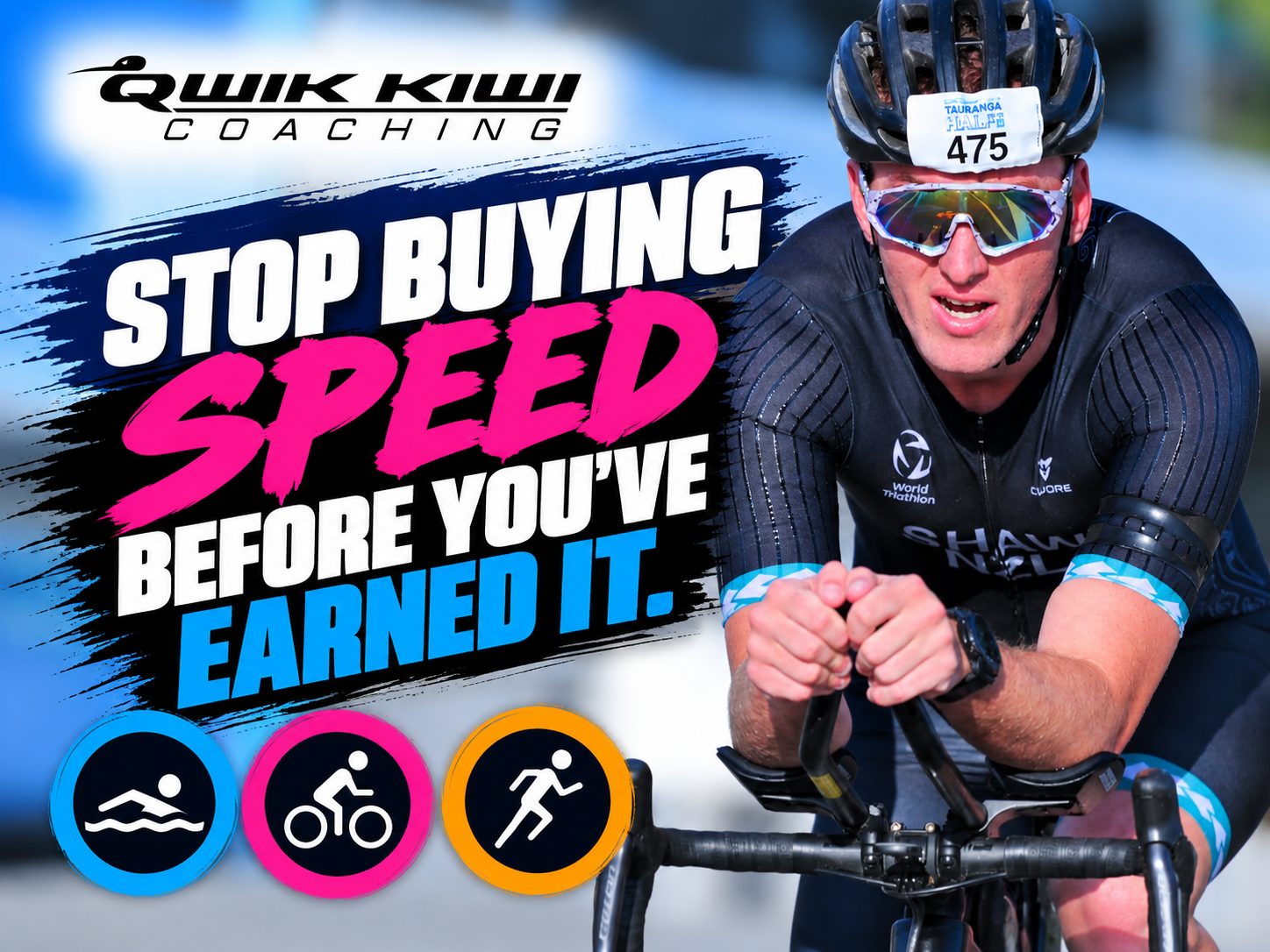
Triathlon can be an expensive sport.
Walk through a transition area and you’ll see carbon wheels, aero helmets, electronic shifting, deep-section rims, disc wheels, power meters, superbikes and enough aerodynamic accessories to make almost any triathlete wonder whether their own bike is holding them back.
And yes, good equipment can make you faster.
Aerodynamics matter. Tyres matter. Wheels matter. Clothing matters. Your bike matters.
But before you spend thousands of dollars trying to make your bike faster, there’s a more important question:
Are you getting everything you can from the athlete riding it?
Because equipment can enhance speed.
It can’t replace the work required to develop it.
The Fastest Upgrade Might Not Be Something You Buy
It’s easy to look at someone riding a faster bike split and focus on what they’re riding.
You notice the bike.
The wheels.
The helmet.
What you don’t immediately see are the months and years of training that allow them to produce the power, maintain their position, handle the bike confidently, pace intelligently and still run strongly afterwards.
That’s the less glamorous side of speed.
And for many age-group triathletes, that’s where the biggest opportunities still exist.
Before asking:
“What should I upgrade next?”
I’d rather you ask:
“What am I currently doing that is costing me speed?”
The answer might save you a considerable amount of money.
Build the Engine First
If you want to ride faster, one of the most reliable ways to do it is to become a better cyclist.
That means developing the physical qualities required for your event.
Your aerobic endurance.
Your threshold.
Your muscular endurance.
Your ability to produce appropriate power repeatedly.
Your cadence.
Your ability to maintain race-specific intensity without falling apart later in the ride.
And, because you’re a triathlete rather than a time trial cyclist, your ability to do all of that while preserving enough energy to run afterwards.
There’s nothing wrong with buying equipment while you’re developing those qualities.
But don’t mistake purchasing performance for developing performance.
A faster bike won’t complete your training for you.
Earn Your Aerodynamic Position
Aerodynamics are extremely important in triathlon.
But one of the biggest aerodynamic components on your bike isn’t the frame.
It’s you.
Your position can make a substantial difference to how efficiently you move through the air. A good triathlon fit needs to balance comfort, power and aerodynamics rather than simply trying to make you look as low and aggressive as possible. TrainingPeaks
And this is where athletes sometimes get things backwards.
They buy the aerodynamic bike.
Then the deep wheels.
Then the aero helmet.
But they can’t comfortably stay in their aero position.
Twenty minutes into the ride they’re sitting up.
Then they’re back down.
Then their neck hurts.
Then they’re sitting up again.
You’ve bought an aerodynamic machine, but you’re spending large chunks of the race presenting your torso to the wind.
Before chasing increasingly expensive marginal gains, develop a position that you can actually use.
Get an appropriate bike fit.
Then train in that position.
Holding an aero position comfortably and confidently is itself a skill that needs practice. TrainingPeaks
Can You Produce Power While Aero?
There’s another important part of this.
It’s no good finding an extremely aerodynamic position if you can’t pedal effectively in it.
Nor is it useful if the position is so uncomfortable that you’re constantly moving around.
Your race position needs to allow you to produce the power you need while remaining sustainable for the duration of your event. That’s why comfort and power should be established alongside aerodynamics rather than sacrificed in pursuit of the smallest possible frontal area. TrainingPeaks
For a triathlete, there’s one more test:
What happens when you get off the bike?
The objective isn’t simply to produce the fastest possible bike split.
It’s to produce the best overall triathlon.
An aerodynamic change that saves energy at a given speed can potentially leave more available for the run—but an unsustainable position that excessively fatigues muscles needed for running may negate that advantage. TrainingPeaks
That’s why your position needs to be tested in training, not merely admired in the bike shop.
Learn to Ride the Bike You Already Own
You can buy a very fast bicycle and still ride it slowly.
Or badly.
Bike handling is one of the most overlooked opportunities for improvement among triathletes.
Can you corner confidently?
Can you descend?
Do you brake before the corner rather than all the way through it?
Can you choose the right gear before a climb?
Can you hold a predictable line?
Can you drink without weaving across the road?
Can you safely look behind you?
Can you remain relaxed when it’s windy?
Can you stay aero when conditions allow?
None of those skills arrive in a cardboard box with your new wheels.
They come from riding your bike.
And they matter. Strong fitness doesn’t automatically translate into a strong race result if your bike skills prevent you from using that fitness effectively. TrainingPeaks
Stop Giving Away Speed in the Corners
Here’s a scenario I’ve seen many times.
Athlete A has the more expensive bike.
Athlete B is the better bike rider.
They approach a corner.
Athlete A sits up early, brakes excessively, hesitates through the turn and then has to accelerate hard back to race speed.
Athlete B approaches under control, selects a sensible line, brakes appropriately, moves smoothly through the corner and carries more momentum out the other side.
Athlete A might have spent thousands reducing aerodynamic drag.
Athlete B has just gained time through skill.
And Athlete B didn’t need a credit card to do it.
If your race is technical, improving your handling may provide a far more useful performance gain than another piece of equipment.
Learn to Pace Before Buying More Power
Another source of “free speed” is intelligent pacing.
Plenty of triathletes are physically capable of riding quickly.
The problem is that they use that fitness badly.
They surge up hills.
Attack out of corners.
Chase other competitors.
Push too hard into headwinds.
Get excited during the first 20 minutes.
Then wonder why their legs disappear later in the race.
The bike leg is a significant part of your triathlon, but it doesn’t exist in isolation. Appropriate bike pacing is crucial because you still need to run afterwards. TrainingPeaks
You don’t necessarily need more watts.
You may need to use the watts you already have more intelligently.
That’s an upgrade worth earning.
Practise Your Fuelling
You can own an exceptionally aerodynamic bike and still have a terrible race because you didn’t eat and drink properly.
Fuelling isn’t as exciting as a new wheelset.
But your ability to maintain performance during a longer triathlon depends heavily on providing your body with what it needs.
And simply knowing your nutrition targets isn’t enough.
You need to practise them.
Can you comfortably reach your bottles while riding?
Can you drink while staying in control?
Can you access your nutrition without sitting up for extended periods?
Does your planned intake agree with your stomach at race intensity?
Where will you store everything?
Equipment optimisation can include how you carry nutrition and spares because poorly arranged storage can undermine an otherwise aerodynamic setup. TrainingPeaks
Again, the answer isn’t necessarily buying more.
Sometimes it’s simply learning to use what you already have better.
Don’t Ignore the Simple Equipment Gains
“Stop buying speed” doesn’t mean equipment is irrelevant.
Far from it.
It means there should be some logic to where you spend your money.
Before replacing an entire bike, look at the basics.
Is your current bike the correct size?
Does it fit you properly?
Is it mechanically sound?
Is your drivetrain clean and maintained?
Are your tyres appropriate?
Are they in good condition?
Are you using sensible tyre pressures?
Is your clothing comfortable and reasonably aerodynamic?
Can you carry your hydration and nutrition efficiently?
Are your gears appropriate for the courses you’re racing?
There can be meaningful gains available from optimising your existing setup before making the jump to a completely new machine. TrainingPeaks
Where I’d Invest First
If you’re wondering where your triathlon budget should go, I wouldn’t automatically start with the most impressive piece of carbon fibre.
For many developing triathletes, I’d look first at the things that help you use your existing equipment better.
A quality bike fit can be an excellent investment.
Structured training or coaching can help you develop the engine and use your available training time more effectively.
Time spent improving bike-handling skills costs very little.
Race-specific training teaches you how to apply your fitness to the course you’re actually going to race.
Good maintenance keeps the equipment you already own working properly.
Better pacing and fuelling can improve your entire race rather than only your bike split.
None of those things look particularly spectacular leaning against the transition rack.
But race results aren’t awarded for having the most impressive transition area.
When Should You Buy the Faster Equipment?
Once you’ve built those foundations, equipment becomes much more interesting.
If you’re training consistently, your position is dialled in, you can hold it comfortably, you’re handling the bike confidently, you’re pacing appropriately and your fuelling works, then marginal gains become increasingly valuable.
At that point, you’re enhancing something that already works.
And there are legitimate reasons to upgrade. Newer bikes can offer improvements in aerodynamics, fit adjustability, gearing, integrated storage and other areas. TrainingPeaks
If you’ve got the budget and you simply enjoy nice bikes, that’s also perfectly okay.
You don’t have to justify every cycling purchase with a spreadsheet showing seconds saved per dollar.
Triathlon is your hobby. You’re allowed to enjoy it.
The distinction I’d make is between:
“I want this because I like it.”
and
“I need this because my equipment is stopping me from getting faster.”
Those aren’t always the same thing.
Marginal Gains Matter—After You’ve Built the Foundation
At the pointy end of performance, tiny improvements matter.
Aero helmets.
Race suits.
Wheels.
Tyres.
Drivetrain efficiency.
Hydration placement.
Cable routing.
All those small improvements can accumulate into something worthwhile. TrainingPeaks
But they’re called marginal gains for a reason.
If there are still enormous gains available through your fitness, position, handling, pacing and fuelling, I’d address those first.
Don’t obsess over saving a handful of watts while unnecessarily wasting far more through poor execution.
Earn Your Speed
The latest equipment can absolutely make you faster.
But it works best when it’s amplifying a capable athlete.
So before your next major upgrade, ask yourself:
Can I hold my race position comfortably?
Am I producing the fitness required for my event?
Can I handle my bike confidently?
Am I pacing intelligently?
Have I practised my fuelling?
Am I actually getting everything I can from the equipment I already own?
If the answer to some of those questions is no, you’ve probably discovered your next upgrade.
And it might not cost anything.
Equipment should enhance the athlete you’ve developed—not compensate for the athlete you haven’t developed yet.
Build the engine.
Develop the skills.
Dial in your position.
Learn to pace.
Practise your fuelling.
Then, when you’ve earned those gains, let the equipment make them even better.
Don’t just buy speed. Earn it first.
Want to Get Faster Without Simply Buying More Gear?
If you’re unsure where the biggest improvements are hiding in your triathlon performance, let’s have a look at your training rather than automatically reaching for another upgrade.
I offer a free, no-obligation 40-minute coaching call where we can discuss your goals, current training and what could make the biggest difference to your next race.