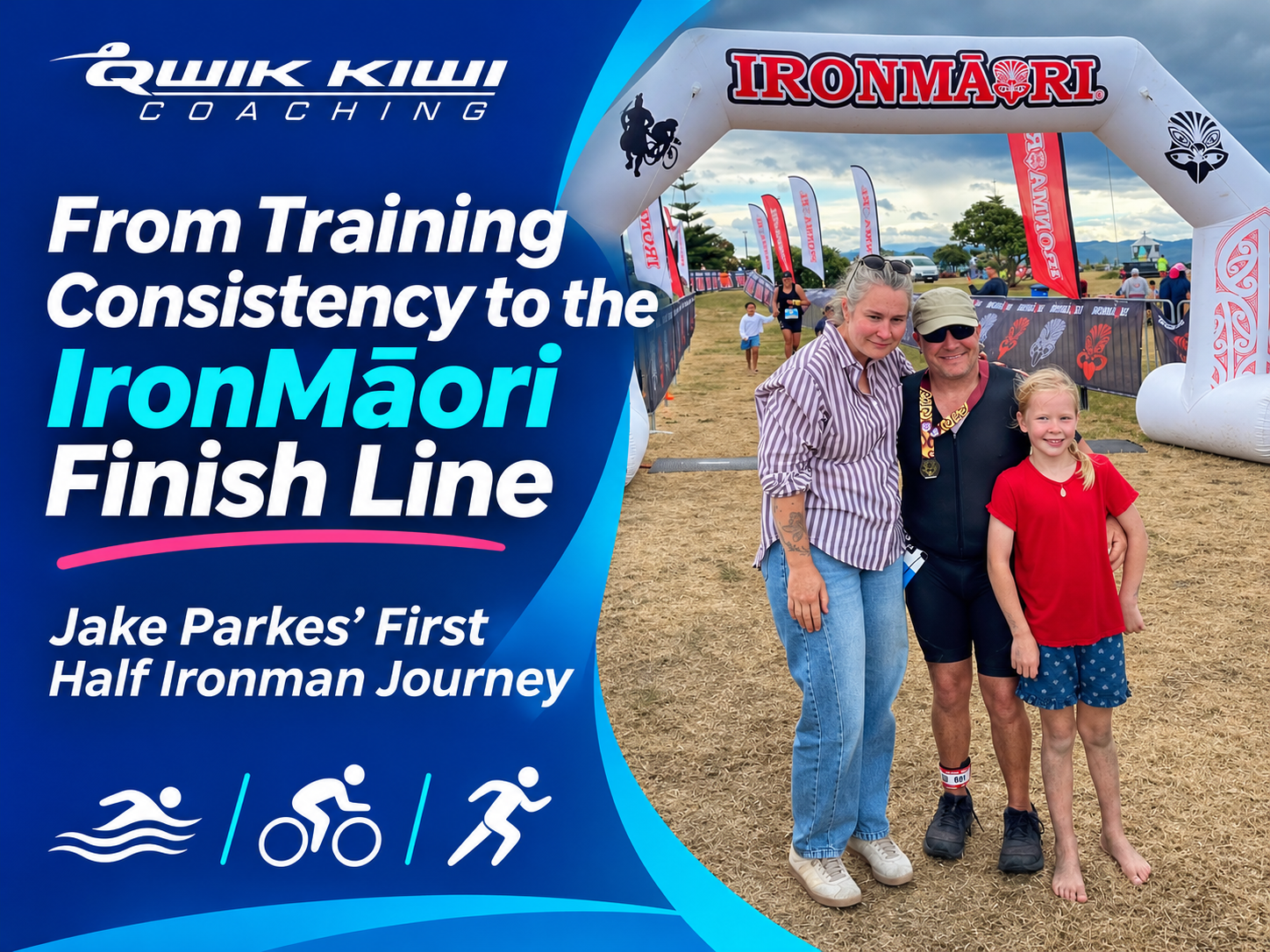
What does it take to complete your first half-Ironman-distance triathlon? For Qwik Kiwi Coaching athlete Jake Parkes, the answer was consistent training, a realistic race plan, the ability to adapt when things became difficult, and the determination to keep moving forward.
Completing a 1.9km swim, 90km cycle and 21.1km run is a significant achievement for any recreational athlete. For someone tackling the distance for the first time, there are plenty of unknowns.
Will the training be enough? How will the body respond after several hours of racing? Will the nutrition strategy work? And perhaps most importantly, what happens when things don’t go according to plan?
These were some of the questions Jake faced heading into IronMāori in Napier.
Following his successful finish, I sat down with Jake for a post-race debrief to discuss his preparation, race-day experiences, the challenges he encountered and the lessons he would take into his next event.
His experience provides some valuable insights for anyone considering their first half-Ironman-distance triathlon.
Building Confidence Through Consistent Training
One of the biggest positives Jake identified was the confidence he had developed through his preparation.
Rather than arriving at race week wondering whether he had done enough, Jake knew he had completed the training required to cover each discipline.
His swimming sessions had taken him beyond the race distance, giving him confidence that he could handle the 1.9km ocean swim, even if conditions were challenging.
Similarly, his cycling preparation meant he knew he could complete the 90km ride, while his running training had provided the endurance necessary to tackle the final half marathon.
As Jake explained:
“The training, I found, was enough to get me across the line.”
That confidence didn’t come from one particularly impressive training session. It came from repeatedly completing the workouts prescribed throughout his programme.
Training Around Work and Family Commitments
One aspect of Jake’s preparation that particularly stood out was how well the training fitted around his everyday life.
Like many recreational triathletes, Jake had to balance his training with work and family responsibilities.
He highlighted the importance of spreading the sessions appropriately throughout the week.
The structure allowed him to complete the necessary training without sacrificing the other important parts of his life.
This is something I place considerable emphasis on when coaching recreational athletes.
The best training programme isn’t necessarily the one containing the most hours. It’s the programme an athlete can consistently complete while managing their other commitments.
When I reviewed Jake’s training history following the event, the consistency was obvious. His training calendar was filled with successfully completed sessions.
That consistency was a major contributor to his IronMāori finish.
Preparing for Race Day: Nutrition, Hydration and Managing Nerves
With his physical preparation completed, Jake turned his attention to the other important elements of racing.
Nutrition and hydration were particularly significant.
Jake acknowledged that he wasn’t naturally someone who drank large quantities of water throughout the day. As race day approached, he made a conscious effort to pay more attention to his hydration.
He also spent time researching carbohydrate intake and race-day fuelling.
For a first-time athlete, this can be surprisingly confusing.
There is an enormous amount of advice available online, but not all of it is appropriate for every athlete.
Jake recognised that finding a strategy suited to his needs was important and that future events would provide opportunities to refine his approach further.
Managing the Pre-Race Nerves
Despite the magnitude of the challenge ahead, Jake generally slept well during the lead-up.
On race morning, he woke at approximately 3:00am, earlier than planned, but having already achieved around six to seven hours of sleep.
Rather than becoming overly concerned, he accepted the situation.
He completed his morning routine, ate breakfast and found himself with some additional time before leaving home.
His solution was simple: sit on the couch, relax and clear his head.
Mentally, Jake had also prepared himself for the possibility that the event might become difficult.
He knew he could complete each discipline individually.
If the cycling became particularly challenging, he planned to change his mindset from racing to simply going for a bike ride.
This was a useful strategy because it removed some of the pressure associated with maintaining a particular performance.
The objective was to keep progressing towards the finish line.
The Swim: Staying Relaxed in Unexpected Ocean Conditions
Jake’s race began with a 1.9km swim at Ahuriri.
He had expected relatively calm water, but the ocean had other ideas.
Instead of the glassy conditions he had hoped for, competitors encountered choppy, rolling water.
For an athlete completing their first event over this distance, conditions like these can quickly increase anxiety and encourage an overly aggressive start.
Jake took a different approach.
His plan was to settle into a comfortable rhythm, avoid pushing too hard and treat the swim almost as a warm-up for the remainder of the event.
He focused on enjoying the experience rather than worrying about how quickly he was covering the distance.
This was a sensible approach.
For most first-time half-Ironman athletes, the swim should be about maintaining control, swimming efficiently and exiting the water in a condition that allows them to cycle effectively.
There is little benefit in gaining a couple of minutes during the swim if the effort compromises the remaining disciplines.
Jake successfully negotiated the challenging conditions and headed into the first transition.
The Bike: A Controlled Effort Despite Torrential Rain
Of the three disciplines, Jake had been particularly nervous about the cycling.
Interestingly, when we discussed the event afterwards, he identified the bike as the easiest and most enjoyable part of his day.
His pacing strategy was based around maintaining a heart rate of approximately 144 beats per minute.
Although his heart rate varied throughout the ride, having a target gave him a reference point for managing his effort.
His nutrition included three bottles containing HydroFuel and four packets of Jet Planes, with four sweets in each packet.
He aimed to drink approximately every five minutes and consume the sweets towards the end of each hour to provide additional carbohydrate.
When the Weather Forecast Gets It Wrong
The weather introduced an unexpected challenge.
The forecast had suggested some early rain followed by improving conditions.
Instead, Jake encountered torrential rain during the cycling leg.
Rather than allowing this to become a major distraction, he accepted the conditions and continued.
His attitude was straightforward: the weather was what it was, and he needed to get on with the job.
This ability to remain composed is an important part of successful endurance racing.
We cannot control the weather, but we can control how we respond to it.
Despite the conditions and his pre-race nerves, Jake finished the cycle feeling relatively strong.
In fact, he was almost concerned that he felt too good.
Unfortunately, the next discipline would prove considerably more demanding.
The Run: Where the Real Battle Began
After successfully completing the swim and bike, Jake started the 21.1km run.
This was where the event changed.
Before the race, we had discussed a potential running pace of approximately 6:15min/km.
However, almost immediately after starting, Jake realised that maintaining this pace wasn’t going to be realistic.
Rather than stubbornly chasing the original target, he adjusted his expectations.
His energy levels began dropping quickly, and the run became a much greater challenge than he had anticipated.
Managing Fatigue and Muscular Discomfort
Approximately 40 minutes into the run, Jake began experiencing problems with both calves.
For a period, he was concerned that this might prevent him from finishing.
Fortunately, the discomfort subsided.
However, he subsequently developed significant tightness and fatigue through the upper quadriceps and hip region.
This discomfort remained with him throughout the rest of the event.
The contrast between the bike and run was substantial.
On the bike, Jake had felt strong and comfortable. On the run, his body was increasingly reminding him of the accumulated effort.
This is one of the defining challenges of half-Ironman racing.
Being able to run a half marathon when fresh is very different from running one after swimming 1.9km and cycling 90km.
The accumulated fatigue, nutritional demands and environmental conditions all influence how an athlete performs.
Adapting the Fuelling Strategy
Jake had started the run carrying five sports gels, initially planning to take one approximately every 30 minutes if required.
However, after around 20 minutes, he felt the need for additional energy and consumed his first gel.
Approximately 15 minutes later, he took another.
Over the course of the run, he consumed around four gels, along with glucose provided at the event’s aid stations.
Although he didn’t experience the immediate improvement he had hoped for, he continued making use of the nutrition available.
This highlights an important consideration for endurance athletes.
Race-day fuelling needs to be planned and practised during training, rather than relying entirely on hunger, fatigue or an expected immediate energy boost to determine when carbohydrates are consumed.
Jake’s experience provides useful information that we can use to refine his fuelling strategy for future events.
From Torrential Rain to a Hot Afternoon
The weather changed dramatically again during the run.
After the heavy rain experienced on the bike, the clouds cleared and the sun appeared.
Jake described the afternoon around Ahuriri as extremely hot.
Suddenly, he was dealing with a very different challenge.
Instead of wet cycling conditions, he now had to manage increasing heat stress while already experiencing substantial muscular fatigue.
His response was to increase his attention to hydration and use water at aid stations to help cool himself.
He drank additional water and poured water over his head.
These were practical adaptations to the conditions he encountered.
For athletes racing longer events, this is a useful reminder that the conditions at the start of a race may be very different from those experienced several hours later.
Pacing, hydration and cooling strategies all need to account for those changes.
The Mental Challenge: One Foot in Front of the Other
As the run progressed, Jake began incorporating walking breaks.
Interestingly, one of the psychological challenges he described was not wanting spectators to see him walking.
He found himself trying to manage where he took his breaks, preferring quieter sections of the course.
This is a feeling many recreational athletes will recognise.
There can be an expectation that walking during a running event somehow represents failure.
But in long-distance triathlon, strategically incorporating walking breaks can be an entirely sensible way to manage fatigue and maintain forward progress.
Jake’s internal conversation was focused on continuing towards the finish line.
He reminded himself that the longer he walked, the longer the event would take.
He encouraged himself to run whenever he could and keep progressing.
Importantly, despite the physical discomfort, Jake said he never seriously considered withdrawing.
He was tired, sore and wanted the discomfort to end, but his objective remained the same.
Get to the finish line.
The Motivation That Mattered Most
When I asked Jake what kept him motivated during the most difficult moments, his answer was his family.
Seeing them supporting him around the course made an enormous difference.
In particular, seeing his daughter gave him renewed energy and encouragement to continue.
For Jake, the event wasn’t simply about completing a particular distance or achieving a finishing time.
It was also about the commitment he had made, the training he had completed and the people who had supported him throughout the journey.
Those moments of encouragement helped him through the hardest part of his race.
And when he finally crossed the finish line, his family was there to share the achievement.
What Would Jake Change Next Time?
One of the most encouraging aspects of our post-race discussion was that Jake didn’t identify any major changes he wanted to make to his training structure.
He was satisfied with the preparation and how it fitted around his life.
Instead, he focused on the small practical details that can make race day more comfortable.
For example, he had used a soapy substance on his swimming goggles to help prevent fogging but hadn’t rinsed them thoroughly afterwards.
He also identified the importance of properly removing sand from his feet during transition to reduce the likelihood of discomfort later in the race.
These might seem like minor details, but over several hours of racing, small irritations can become significant distractions.
The experience also gave Jake an opportunity to consider further refinements to his nutrition and hydration.
This is exactly why a post-race debrief is so valuable.
Rather than simply celebrating the finish and moving on, we can identify what worked, what didn’t and where small improvements can be made.
What Did Jake Learn About Himself?
Towards the end of our conversation, I asked Jake what he had learnt about himself as an athlete.
His response focused on discovering just how far he could push himself.
He was proud of his ability to keep going when the event became uncomfortable.
When fatigue accumulated and the run became a battle, he continued putting one foot in front of the other.
That experience is something he can carry into future events.
Having successfully completed his first half-Ironman-distance triathlon, Jake now has a much better understanding of what the distance demands, both physically and mentally.
He also knows that he can work through difficult moments without abandoning his overall objective.
Coach Ray’s Takeaways: Five Lessons for First-Time Half-Ironman Athletes
Jake’s experience reinforces several important principles that apply to recreational triathletes preparing for their first 70.3-distance event.
1. Consistency Matters More Than Individual Hero Sessions
Jake’s preparation wasn’t built around occasional enormous training sessions.
It was built around regularly completing the training prescribed.
The cumulative effect of those sessions provided the endurance and confidence he needed on race day.
2. Training Must Fit Around Your Life
A programme that creates constant conflict with work and family responsibilities is unlikely to be sustainable.
Jake’s training was structured to allow him to prepare effectively while continuing to meet those commitments.
This helped him maintain his consistency.
3. Have a Race Plan, but Be Prepared to Adapt
Jake had pacing and nutrition strategies heading into the event.
However, he also recognised when circumstances required a change.
He adjusted his running expectations, responded to changing weather conditions and used the resources available to him.
Successful endurance racing requires both preparation and flexibility.
4. The Run Deserves Particular Attention
The final half marathon is often where the accumulated demands of a long-distance triathlon become most apparent.
Jake’s experience demonstrated that feeling strong after the bike doesn’t guarantee an easy run.
Appropriate bike pacing, sufficient fuelling, run-specific endurance and realistic expectations all contribute to managing this final discipline.
5. Mental Resilience Is Developed Through Experience
Jake discovered that he could continue progressing despite considerable discomfort.
His ability to remain focused on the finish line, supported by encouragement from his family, was a significant part of his success.
That confidence will be valuable in whatever endurance challenges he chooses to pursue next.
A Well-Earned IronMāori Finish
One of the most rewarding parts of coaching is seeing athletes achieve something that once seemed daunting.
Jake’s successful completion of his first half-Ironman-distance event is a fantastic example of what can be achieved through consistent preparation, sensible pacing and determination.
The event certainly wasn’t without its challenges.
He encountered rough swimming conditions, torrential rain on the bike, intense heat on the run, muscular fatigue and a difficult final half marathon.
But he adapted, persevered and finished.
When we spoke afterwards, Jake was understandably delighted with his achievement.
And from a coaching perspective, I was equally pleased.
Not simply because he crossed the finish line, but because of the consistent training and commitment that made that finish possible.
Congratulations, Jake. A thoroughly deserved achievement, and one you and your family can be extremely proud of.
Preparing for Your First Half-Ironman?
If Jake’s experience has inspired you to consider your own half-Ironman-distance triathlon, the most important step is developing a realistic training plan that suits your current fitness, experience and lifestyle.
At Qwik Kiwi Coaching, I work with beginner and recreational triathletes to help them prepare for their endurance goals through structured, progressive training.
Whether you’re preparing for your first 70.3-distance event or looking to improve on a previous performance, having the right training structure and coaching support can make a significant difference.
Visit www.CoachRay.nz to explore the training and coaching options available, or book a free 40-minute coaching consultation to discuss your goals.
Coach Ray Boardman
Qwik Kiwi Coaching