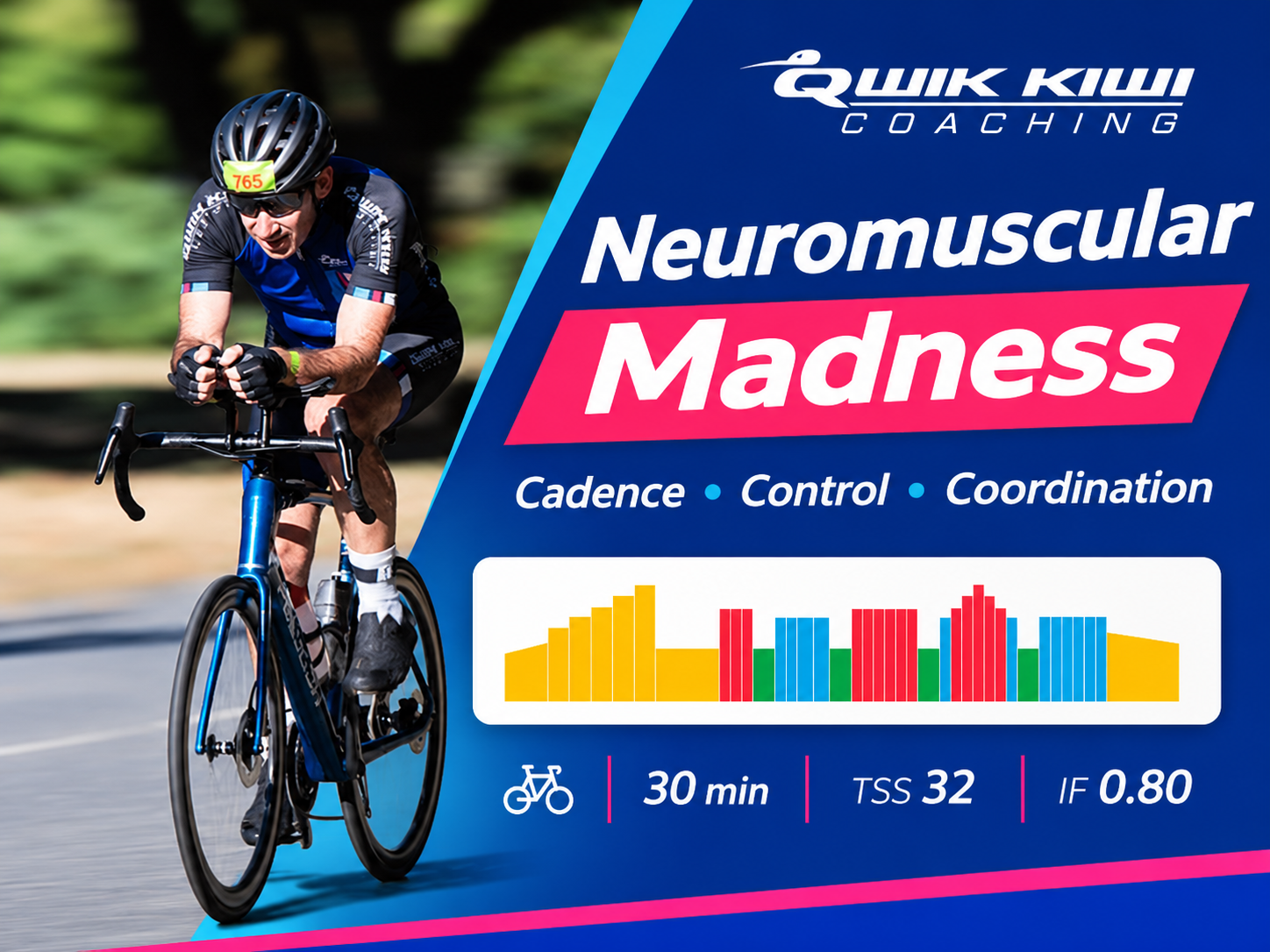
30 Minutes of Cadence Changes, Pedalling Coordination and Cycling Technique
How well can you control your pedalling when the cadence keeps changing?
Most cyclists have a preferred cadence that feels natural and comfortable. But what happens when you’re asked to pedal at 110 rpm, drop to 60 rpm, then accelerate back towards 100 rpm?
That’s the challenge in this week’s Sunday Smart-Trainer Session.
Neuromuscular Madness is a 30-minute indoor cycling workout that combines different cadences, resistance demands and intensity levels to challenge your coordination and control on the bike.
You’ll experience everything from relatively slow, resistance-heavy pedalling at 50 rpm through to fast, controlled spinning at 110 rpm.
Some efforts are completed at Level III, others at Level III+, Level IV or Level V.
The objective isn’t simply to pedal faster or push harder. It’s to develop the ability to adapt your pedalling technique while maintaining control as the demands change.
This workout is relevant to road cyclists, mountain bikers and triathletes who want to develop a broader range of pedalling skills.
🎯 Today’s Goal
The primary objective of Neuromuscular Madness is to challenge your neuromuscular coordination through frequent changes in cadence and cycling intensity.
Throughout the workout, you’ll practise:
- Maintaining smooth pedalling at different cadences.
- Adjusting gearing or resistance without losing control.
- Producing controlled force at lower cadences.
- Maintaining a relaxed upper body during faster pedalling.
- Transitioning between different cadence and intensity combinations.
The workout includes five distinct cadence-focused blocks, each presenting a different challenge.
🧠 Why Are We Doing This Session?
1. Improve Neuromuscular Coordination
Cycling isn’t simply about producing power.
Your nervous system must coordinate muscle activation throughout each pedal revolution to produce a smooth and controlled movement.
Practising different cadences gives you opportunities to refine that coordination.
At higher cadences, the challenge is to maintain a smooth pedal stroke without bouncing on the saddle or introducing unnecessary upper-body movement.
At lower cadences, the challenge shifts towards producing greater force with each pedal revolution while maintaining good technique.
2. Develop Control Across a Wider Cadence Range
Many cyclists naturally settle into a relatively narrow cadence range.
However, real-world riding doesn’t always allow you to maintain your preferred pedalling rate.
Steep climbs, changes in terrain, corners and gear selections can all require adjustments.
Neuromuscular Madness deliberately takes you outside your usual cadence range.
The aim isn’t to suggest that 50 rpm or 110 rpm is inherently better than your normal cadence.
Instead, you’re practising the ability to adapt when circumstances require it.
3. Explore the Relationship Between Cadence, Torque and Power
Power on the bike depends on both the torque applied to the pedals and how quickly the cranks rotate.
At a given power output, reducing cadence generally requires greater torque per pedal revolution.
Increasing cadence allows the same power to be produced with less torque per revolution, although it may create different muscular and physiological demands.
This workout exposes you to several combinations of cadence and intensity.
For example, riding at Level V and 60 rpm presents a very different challenge from riding at Level III and 110 rpm.
Both require concentration, but for different reasons.
4. Practise Rapid Cadence Transitions
Several sections require you to change cadence every 30 seconds.
One block alternates between 90 and 95 rpm, while another moves repeatedly between lower and higher cadences.
These changes challenge your ability to adjust your pedalling rhythm quickly without losing control.
The goal is to make each transition deliberate and smooth rather than jerky or rushed.
5. Improve Pedalling Adaptability
There isn’t one universally optimal cadence for every cyclist or every situation.
Your preferred cadence can change depending on power output, terrain, fatigue, experience and individual characteristics.
By practising a variety of cadences, you’re developing familiarity with different pedalling demands.
This can help you become more adaptable when riding conditions change.
🚴 Today’s Workout: Neuromuscular Madness
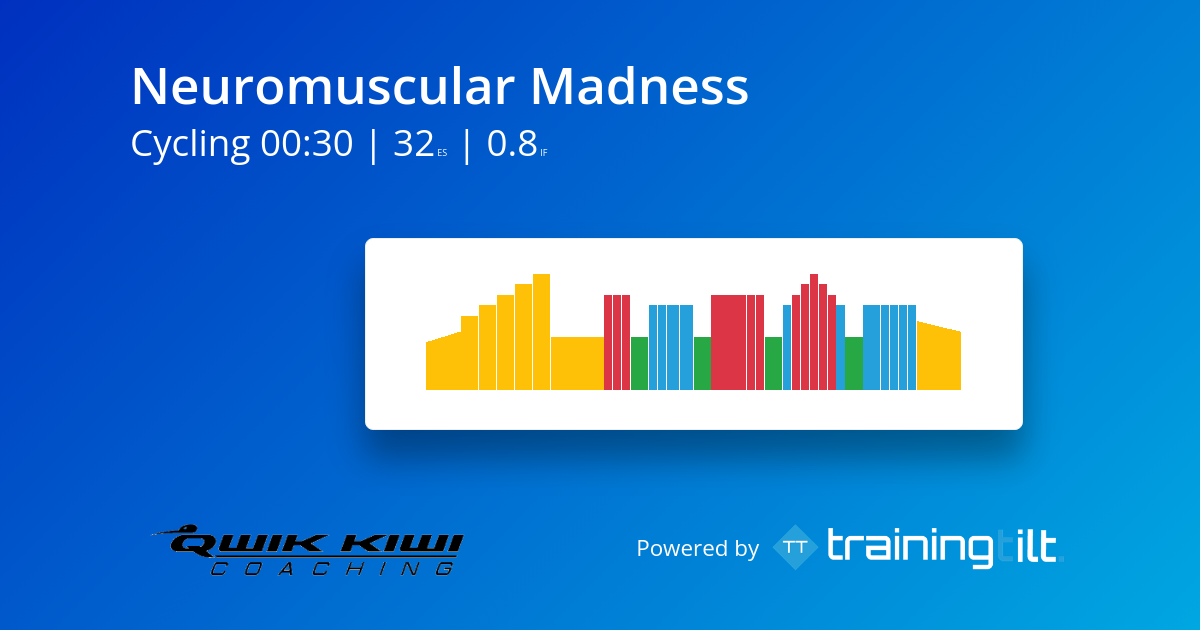
Warm-Up — 7 Minutes
- 2min Level I (50%)
- 1min Level II (70%)
- 1min Level III (80%)
- 1min Level III+ (90%)
- 1min Level IV (100%)
- 1min Level V (110%)
The warm-up progresses through several intensity levels before the cadence-specific work begins.
Follow the prescribed targets and prepare for the changes in pedalling rhythm ahead.
Recovery — 3 Minutes
- 3min Level I
Allow your breathing and legs to settle before beginning the first cadence block.
Block 1 — Progressive Cadence
1 minute 30 seconds — Level III+
- 30sec at 80 rpm
- 30sec at 90 rpm
- 30sec at 100 rpm
Maintain Level III+ intensity while progressively increasing cadence.
Adjust your gearing or resistance as necessary to keep the workload controlled.
Recovery: 1min Level I
Block 2 — Building Cadence
2 minutes 30 seconds — Level III
- 30sec at 70 rpm
- 30sec at 80 rpm
- 45sec at 90 rpm
- 45sec at 100 rpm
Begin with a relatively low cadence and gradually increase your pedalling rate.
Concentrate on smooth transitions and maintaining the prescribed Level III intensity.
Recovery: 1min Level I
Block 3 — Low-Cadence Control
3 Minutes — Level III+
- 30sec at 70 rpm
- 30sec at 90 rpm
- 30sec at 60 rpm
- 30sec at 90 rpm
- 30sec at 50 rpm
- 30sec at 90 rpm
This block alternates between progressively lower cadences and a consistent 90 rpm.
As cadence decreases, the torque required to maintain the same power increases.
Concentrate on remaining seated, keeping your upper body stable and applying force smoothly.
Avoid forcing the pedals if the resistance becomes uncomfortable or your technique deteriorates.
Recovery: 1min Level I
Block 4 — Changing Cadence and Intensity
3 Minutes 30 Seconds
- 30sec Level III at 110 rpm
- 30sec Level III+ at 100 rpm
- 30sec Level IV at 80 rpm
- 30sec Level V at 60 rpm
- 30sec Level IV at 80 rpm
- 30sec Level III+ at 100 rpm
- 30sec Level III at 110 rpm
This is arguably the most demanding coordination challenge of the session.
You’ll begin at a high cadence, progressively reduce your pedalling rate while increasing intensity, then reverse the sequence.
The central 30 seconds at Level V and 60 rpm combines high intensity with a relatively low cadence.
Maintain control throughout. Avoid excessive upper-body movement or grinding through the pedals.
Recovery: 1min Level I
Block 5 — Cadence Precision
3 Minutes — Level III
Complete three repetitions of:
- 30sec at 90 rpm
- 30sec at 95 rpm
This final block may appear straightforward compared with the previous efforts.
However, the challenge is precision.
Can you consistently distinguish between 90 and 95 rpm while maintaining the same intensity?
Concentrate on smooth, relaxed pedalling and accurate cadence control.
Cool-Down — 2 Minutes 30 Seconds
- 2:30min Level II
Settle into a comfortable rhythm and allow your breathing to recover.
Post-Workout
10 minutes stretching.
⚠️ Common Mistakes to Avoid
1. Increasing Power Every Time Cadence Increases
A higher cadence doesn’t automatically require a higher power output.
During blocks where the prescribed intensity remains constant, adjust your resistance or gearing so you can change cadence without unnecessarily increasing the workload.
2. Bouncing on the Saddle
During the 100–110 rpm sections, avoid allowing your hips to bounce.
Keep your upper body relaxed and concentrate on smooth, controlled pedal revolutions.
If you can’t maintain control at the prescribed cadence, prioritise technique over chasing the number.
3. Grinding Through the Low-Cadence Efforts
The 50–60 rpm sections can create relatively high pedal forces.
Avoid excessive rocking, pulling on the handlebars or forcing your knees through an uncomfortable movement.
These are controlled technique efforts, not maximal-strength tests.
4. Anticipating the Next Interval Too Early
Several cadence changes happen after only 30 seconds.
Stay focused on the current target rather than beginning the next change prematurely.
5. Treating Every Interval Like a Sprint
Despite its name, Neuromuscular Madness isn’t a series of maximal sprints.
Each section has a prescribed intensity and cadence.
Your job is to follow both targets as accurately as possible while maintaining good technique.
💡 Coach Ray’s Tips for Success
1. Watch both cadence and intensity.
This workout requires you to manage two variables simultaneously. Don’t focus exclusively on one while neglecting the other.
2. Stay seated throughout the cadence drills.
A stable seated position makes it easier to assess your pedalling control and coordination.
3. Relax your shoulders and upper body.
Unnecessary tension can make faster pedalling feel more difficult.
4. Prepare for the low-cadence efforts.
Select an appropriate resistance before the cadence drops significantly, rather than suddenly forcing the pedals against excessive resistance.
5. Prioritise smooth transitions.
The objective is controlled adaptation, not abrupt changes that disrupt your technique.
6. Use the recovery intervals.
The Level I recoveries are there to allow you to regain control and prepare for the next challenge.
📈 How Did Coach Ray Get On?

I’m particularly interested in how accurately I maintained the prescribed cadences (yellow line), whether my power (purple line) remained controlled during the cadence changes and how the low-cadence efforts compared with the faster pedalling sections.
📱 Follow My Session on Strava
I’ll share my Strava activity here so you can see how the workout unfolded and compare the prescribed cadence changes with my actual performance.
🎁 Take Your Cycling Training Further
🎁 Get 14 Days of FREE Velocity Membership – And Try Neuromuscular Madness!
Want to put your cadence control and pedalling coordination to the test?
Neuromuscular Madness is just one of the structured indoor cycling workouts waiting for you inside Velocity.
And if you’re new to Velocity, you can experience everything it has to offer with 14 days of FREE full membership!
Your free trial gives you access to:
- 🚴 A growing library of structured cycling workouts – From endurance and technique sessions through to tempo, threshold, VO₂ max and mixed-intensity training.
- 🎯 Purposeful training – Follow structured workouts with clearly defined intensity targets rather than simply riding without a plan.
- 👨🏫 Live coach-led sessions – Join Coach Ray every Tuesday and Thursday at 6:00am New Zealand time.
- 📺 Daily replay classes – Join the 7:00pm NZ time replay sessions.
- ⚡ Workouts for different abilities and goals – Whether you’re a road cyclist, mountain biker or triathlete, there’s plenty to challenge you.
🚀 Start Your FREE 14-Day Velocity Trial
Experience the full Velocity membership for 14 days and discover how structured indoor cycling can help you train with greater purpose.
🚴 Ready to Ride Neuromuscular Madness?
Already a Velocity member? Jump straight into this 30-minute workout and see how well you can manage the changing cadences and intensity levels.
From controlled low-cadence efforts at 50 rpm through to fast spinning at 110 rpm, this session will challenge your coordination, pedalling technique and ability to adapt.
🏁 Final Thoughts
Neuromuscular Madness is a short but varied workout that challenges your ability to control your pedalling across a wide range of cadences and intensities.
From 50 rpm through to 110 rpm, each section presents a slightly different coordination challenge.
Some efforts require greater pedal force, while others demand quick, smooth leg movements.
The objective isn’t to find one perfect cadence or produce the highest possible power.
It’s to become more comfortable, coordinated and adaptable when the demands of cycling change.
Remember: good pedalling technique isn’t simply about how quickly you turn the pedals. It’s about maintaining control, whatever cadence you’re riding.
Happy training!
Coach Ray
Director & Head Coach
Qwik Kiwi Coaching
www.CoachRay.nz